The Largest Car Forum in the Philippines
- Forums
- Discussions
- Events
- Community

Results 17,841 to 17,860 of 39250
-

 Social Dementia

- Join Date
- Sep 2003
- Posts
- 25,189
-
 nag-memeron
- Join Date
- Mar 2006
- Posts
- 19,003
September 19th, 2020 04:51 PM #17842some good news for cabin fever struck pinoys
PAL makes it to top 10 list of safest carriers | Philstar.com
at least when the green light to travel goes on, you'll know who to fly w/ in the friendly skies.
-
nag-memeron
- Join Date
- Mar 2006
- Posts
- 19,003
September 19th, 2020 05:03 PM #17843interesting results coming out of sweden
How ice cool scientist saved Sweden from coronavirus WITHOUT lockdown - and now he'''s a national hero
but comments on twitter who claim to be swedes say that this isn't true at all. they say that at present, it still isn't safe to visit the scandinavian state.
or are these commenters just declaring that to prevent outsiders (particularly brits afflicted w/ wanderlust (it's a uk based tabloid)) from setting foot into their borders and thus avoid bringing in more of the deadly virus.
-
Tsikoteer
- Join Date
- Mar 2008
- Posts
- 54,644
September 19th, 2020 07:16 PM #17844good point. Originally Posted by Flipo

hindi pa kailangan ng freezer for delivery and storage.
-
Tsikoteer
- Join Date
- Mar 2008
- Posts
- 54,644
September 19th, 2020 07:25 PM #17845post naman kayo ng pictures ng beach, hindi pictures ng madla lang. Originally Posted by Monseratto
nag-hanap tuloy ako sa yu-tube.
heh heh.
may nagpapalipad na ng guryon, sa background ng video na nakita ko.Last edited by dr. d; September 19th, 2020 at 07:29 PM.
-
Social Dementia
- Join Date
- Sep 2003
- Posts
- 25,189
-
 Darker and Bigger
- Join Date
- Oct 2002
- Posts
- 40,599
September 19th, 2020 08:49 PM #17847Ano ginagawa ng Cambodia, Laos, Vietnam and Thailand? Bakit hinde natin magaya?
Sent from my iPhone using Tapatalk
-
 Tsikot Member Rank 4
- Join Date
- Nov 2005
- Posts
- 45,927
September 19th, 2020 09:38 PM #17848dunno about Thailand did but i know Vietnam used quarantine centers very early in the pandemic and they have very thorough contact tracing
that's 2 things we did not do
sa atin naalala ko in March/April puro mass testing ang dinedemand ng mga tao so nag focus ang gobyerno sa testing
pero pag nag positive pauuwiin lang ung tao
so what's the use in testing if you don't isolate?
kaya eto tayo ngayon
-
Tsikot Member Rank 4
- Join Date
- Nov 2005
- Posts
- 45,927
September 19th, 2020 09:41 PM #17849tapos ang contact tracing natin 1 layer lang (if there's even contact tracing at all)
Sa Korea matindi... 3, 4 or 5 layers ang tine-trace nila
-
Social Dementia
- Join Date
- Sep 2003
- Posts
- 25,189
September 19th, 2020 10:00 PM #17850Quarantine problema ng PH... Sa Cebu was a big example gano bulok ang quarantine ng local government. Home Quarantine was a big no no. Pero sa squatter area pina pa Home Quarantine. Already repeatedly mentioned in this thread yung may sakit nakakalabas at kipag inuman. Tapos buong pamilya na infect dahil siksikan sa bahay.
-
Verified Tsikot Member
- Join Date
- Mar 2010
- Posts
- 2,275
September 19th, 2020 11:24 PM #17851Will we be wearing masks forever? Here'''s what experts think Originally Posted by Flipo
Sent from my ASUS_Z017DA using Tsikot Forums mobile app
-
 Moderator
- Join Date
- Nov 2010
- Posts
- 25,276
September 20th, 2020 09:28 AM #17852Grabe active cases natin, hindi man lang bumababa Originally Posted by Monseratto
Sent from my SM-N960F/DS using TapatalkFasten your seatbelt! Or else... Driven To Thrill!
-
Verified Tsikot Member
- Join Date
- Mar 2010
- Posts
- 2,275
September 20th, 2020 09:49 AM #17853https://www.washingtonpost.com/world...rom%20%251%24s
Sent from my ASUS_Z017DA using Tsikot Forums mobile app
-
Tsikoteer
- Join Date
- Mar 2008
- Posts
- 54,644
September 20th, 2020 10:03 AM #17854"... bending long-standing rules..." Originally Posted by Flipo
i wonder, what its long-term effects will be...
-
 Night stalker
- Join Date
- Jul 2009
- Posts
- 10,310
September 20th, 2020 11:20 AM #17855Bakit hindi nabanggit sa clinical trials ang Pinas? Hindi ba tayo sumali sa trials ng Russia or China? Originally Posted by Flipo
Sent from my Mi 9T Pro using Tapatalk
-
Tsikot Member Rank 4
- Join Date
- Nov 2005
- Posts
- 45,927
-
 CBD Lounger
- Join Date
- Jul 2004
- Posts
- 8,599
September 20th, 2020 11:28 AM #17857Sa China vaccine trials, yung mga ganun tinatago, inaaresto o nililibing Originally Posted by uls


-
Tsikot Member Rank 4
- Join Date
- Nov 2005
- Posts
- 45,927
September 20th, 2020 11:28 AM #17858di pa yata nag umpisa Originally Posted by BratPAQ
puro press release palang
-
Tsikot Member Rank 4
- Join Date
- Nov 2005
- Posts
- 45,927
-
Social Dementia
- Join Date
- Sep 2003
- Posts
- 25,189
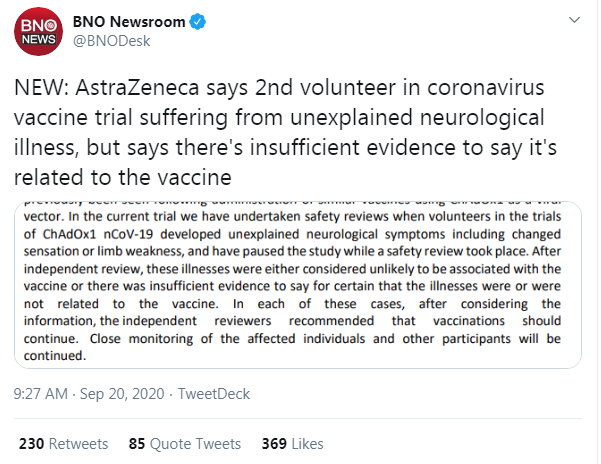
September 20th, 2020 12:14 PM #17860Second case of Transverse myelitis... One more and bye bye vaccine.
AstraZeneca, Under Fire for Vaccine Safety, Releases Trial Blueprints - The New York Times
The company has released few details about the two cases of serious illness in its trial. The first participant received one dose of the vaccine before developing inflammation of the spinal cord, known as transverse myelitis, according to a participant information sheet for AstraZeneca’s vaccine from July. The condition can cause weakness in the arms and legs, paralysis, pain and bowel and bladder problems.
The case prompted a pause in AstraZeneca’s vaccine trials to allow for a safety review by independent experts. A company spokeswoman told the Times last week that the volunteer was later determined to have a previously undiagnosed case of multiple sclerosis, unrelated to the vaccine, and that the trial resumed shortly thereafter.
The company said it had not confirmed a diagnosis in the second case, a participant who got sick after the second dose of the vaccine. A person familiar with the situation who spoke with The Times on the condition of anonymity said the participant’s illness had been pinpointed as transverse myelitis. The trial was paused again on Sept. 6 after she fell ill.
The condition is rare, but serious, and experts said that finding even one case among thousands of trial participants could be a red flag. Multiple confirmed cases, they said, could be enough to halt AstraZeneca’s vaccine bid entirely.
“If there are two cases, then this starts to look like a dangerous pattern,” said Mark Slifka, a vaccine expert at Oregon Health and Science University. “If a third case of neurological disease pops up in the vaccine group, then this vaccine may be done.”
A participant information sheet dated Sept. 11 on AstraZeneca’s trial in Britain lumped the two volunteers’ cases together, stating the illnesses were “unlikely to be associated with the vaccine or there was insufficient evidence to say for certain that the illnesses were or were not related to the vaccine,” based on safety reviews. The next day, AstraZeneca announced that it had resumed the trial in Britain.
But the F.D.A. has so far not allowed the company to start up again in the United States.
A spokesman for the F.D.A. declined to comment. The National Institutes of Health said in a statement that it “remains to be seen” whether the onset of illness in trial participants was coincidental or tied to the vaccine, adding that “pausing to allow for further evaluation is consistent with standard practice.”Last edited by Monseratto; September 20th, 2020 at 12:19 PM.



 Reply With Quote
 Originally Posted by Flipo