
It's when the infected coughs or sneezes or breathes heavily and we are in an enclosed space. When I accept packages it's just left sa gate but some kailangan iabot but I didn't know that just their breathe is infectious. Now I am worried if I caught it na tuloy. Though lahat naman ng delivery may mask. If that is the case then kahit sa garage namin hindi na ko makakalabasOriginally Posted by dr. d


OMG nahihirapan tuloy ako huminga ngayon

The Largest Car Forum in the Philippines
- Forums
- Discussions
- Events
- Community
Results 17,381 to 17,400 of 39250
-

 High & Dry

- Join Date
- Jul 2007
- Posts
- 57,779
September 5th, 2020 09:08 PM #17381
-
 Darker and Bigger
- Join Date
- Oct 2002
- Posts
- 40,599
September 5th, 2020 09:23 PM #17382Kuya si a jerk, probably the sibling na nag age out at hinde nakasama. The one relative left na pinapadalhan dito ng allowance. Originally Posted by dr. d
If meron pinabili relatives abroad. hinde ko sinisingil, considered as gift.
Sent from my iPhone using Tapatalk
-
 Tsikoteer
- Join Date
- Oct 2012
- Posts
- 27,624
-
Tsikoteer
- Join Date
- Mar 2008
- Posts
- 54,644
September 5th, 2020 11:55 PM #17384it is so difficult sometimes, to decipher an australian's accent... Originally Posted by StockEngine
truly,
they are murderers of the queen's english.
heh heh.
-
 Tsikot Member Rank 8
- Join Date
- Oct 2002
- Posts
- 21,433
September 6th, 2020 12:33 AM #17385Nothing to worry if naka mask mga deliveries. Sila dapat matakot sayo since hindi ka naka-mask. Originally Posted by _Cathy_
Di ba we are always reminded that wearing of masks is to save others, not yourself.Signature
-
Tsikoteer
- Join Date
- Oct 2012
- Posts
- 27,624
September 6th, 2020 12:39 AM #17386I think it is the ***iest female accent. Im already wondereing if the singlish of one relative is changed to oz-singlish Originally Posted by dr. d
-
Tsikoteer
- Join Date
- Oct 2012
- Posts
- 27,624
-
 Night stalker
- Join Date
- Jul 2009
- Posts
- 10,310
September 6th, 2020 02:50 AM #17388Pero I doubt kung laging naka face mask mga delivery guys. Baka nagsusuot lang sila pag haharap na sa yo. Meanwhile they may be coughing with no mask while arranging their items to deliver. That's why I shower the item 1st with alcohol. Originally Posted by boybi
Sent from my Mi 9T Pro using Tapatalk
-
Tsikoteer
- Join Date
- Oct 2012
- Posts
- 27,624
September 6th, 2020 03:22 AM #17389it doesn't matter if they wear a mask or not, you wear a mask, you disinfect the package. Originally Posted by BratPAQ
-
 Social Dementia
- Join Date
- Sep 2003
- Posts
- 25,189
September 6th, 2020 10:50 AM #17390Another brother of Cebu Governor Garcia dies
Garcia's death was confirmed in a Facebook post by his brother, Winston Garcia. "To lose one brother is painful enough, but to lose another brother in the same week, my heart just can not take any further. The true fighter that he was, my brother, Marlon has been fighting for his life for the last few weeks," Winston said.
"This morning, he joins my brother, Nelson, and my mother in heaven," he added.
The post did not mention Garcia's cause of death.
This comes after the Cebu governor confirmed in a speech on August 2 that Marlon had tested positive for COVID-19.
-
Social Dementia
- Join Date
- Sep 2003
- Posts
- 25,189
September 6th, 2020 10:54 AM #17391Low vitamin D levels may be linked to a higher chance of dying from the coronavirus — here's how to avoid a deficiency | Business Insider
An Italian study of 42 patients published Sunday in the Journal of Endocrinological Investigation found that after 10 days of hospitalization, 50% of patients with severe vitamin D deficiencies died, compared with just 5% of patients who did not have severe deficiencies.
Similarly, July research from the Philippines, which hasn't yet been peer-reviewed, found a significant correlation between how high a COVID-19 patient's vitamin D levels were and how likely they were to have a mild case of the illness. And a May preprint study — also still awaiting peer review — showed that people in countries with high rates of mortality from COVID-19 had lower vitamin D levels overall, compared with people in countries that weren't as hard-hit.
Vitamin D strengthens parts of the immune system that fight viruses, like white blood cells, and can also help quell cytokine storms. That's when the immune system overreacts, flooding the bloodstream with messenger proteins that lead the body to attack its own cells rather than just the virus. Many patients with severe COVID-19 cases experience cytokine storms, which can destroy lung tissue and cause fatal pneumonia.
In June, three health organizations in the UK published reports detailing what we know (and still don't) about the role vitamin D might play in coronavirus cases. They advised people to ensure they're getting adequate amounts of vitamin D through supplements and sun exposure, though they concluded more research was needed.
For people with lighter skin who have regular access to the outdoors, going on a 15-minute walk outside between 11 a.m. and 3 p.m., when sunlight is especially rich in UVB rays, can stimulate the skin to synthesize enough vitamin D3, the active form of vitamin D. The needed length of that walk can double on a cloudy day, when UVB rays are reduced by 50% according to the National Institutes of Health.
Those concerned about not getting enough vitamin D can also take supplements or eat foods rich in vitamin D, like milk, eggs, and fatty fish. Orange juice and breakfast cereals are often fortified with a synthetic version.
Vitamin D supplements can also help people at risk of deficiencies. But don't take more than one or two a day — and if you think you're probably getting enough vitamin D, don't take supplements at all. Too much vitamin D can cause diarrhea, hair loss, and kidney issues.
-
Tsikoteer
- Join Date
- Mar 2008
- Posts
- 54,644
September 6th, 2020 11:11 AM #17392but have we thought it thru? Originally Posted by boybi
when the covid-infected individual coughs or sneezes,
does the mask they are wearing remain always in place and catch all the aerosol?
and how many times have we seen folks wearing the mask in-correctly?
wear mask, folks.
especially around total strangers.Last edited by dr. d; September 6th, 2020 at 11:15 AM.
-
Darker and Bigger
- Join Date
- Oct 2002
- Posts
- 40,599
September 6th, 2020 11:20 AM #17393Walang effect yun tuob? [emoji848] Originally Posted by Monseratto
Sent from my iPhone using Tapatalk
-
Social Dementia
- Join Date
- Sep 2003
- Posts
- 25,189
September 6th, 2020 11:42 AM #17394COVID-19 Is Transmitted Through Aerosols. We Need to Adapt | Time
We should continue doing what has already been recommended: wash hands, keep six feet apart, and so on. But that is not enough. A new, consistent and logical set of recommendations must emerge to reduce aerosol transmission. I propose the following: Avoid Crowding, Indoors, low Ventilation, Close proximity, long Duration, Unmasked, Talking/singing/Yelling (“A CIViC DUTY”). These are the important factors in mathematical models of aerosol transmission, and can also be simply understood as factors that impact how much “smoke” we would inhale.
Second, masks are essential, even when we are able to maintain social distance. We should also pay attention to fitting masks snugly, as they are not just a parapet against ballistic droplets, but also a means to prevent “smoke” from leaking in through gaps. We should not remove masks to talk, nor allow someone who is not wearing a mask to talk to us, because we exhale aerosols 10 times as much when talking compared to breathing. Everyone should be careful to not stand behind someone with a poorly fitting mask, as the curvature of an ill-fitting mask can cause aerosols to travel behind the person wearing it.
It is important to think about ventilation and air cleaning. We take operable windows and HVAC systems for granted, rarely paying attention to how they work. Times are different now, and we need to learn how to best use these systems to decrease risk. We need to increase the amount of indoor air that is replaced by outdoor air, by opening windows or adjusting mechanical systems. We need better filters installed in many ventilation systems that recirculate some of the air. These interventions can get costly, so it is very important to think carefully and prioritize objectively—we can, for example, use affordable CO2 measurements to identify the most dangerous, underventilated frequently occupied public spaces, and prioritize them.
Portable HEPA air cleaners work well to remove virus-laden aerosols, but unfortunately they are costly. Makeshift fan-filter cleaners can be made for less than $50, have been shown to work in multiple tests including peer-reviewed papers, and have been used for years in China to reduce the impact of pollution in homes. They can be noisy and are not a long-term solution, but they may help us get through the next few months. Germicidal UV systems can help in some situations, but only if ventilation and filtering cannot do the job. We should also remember that air cleaning is not a silver bullet: if we simulate the Skagit choir outbreak with an added large amount of air cleaning, the infection rate only drops by half. Spending as much time as possible outdoors, wearing masks, and reducing density will remain critical no matter how well we ventilate and clean the air.
-
 Tsikot Member Rank 4
- Join Date
- Nov 2005
- Posts
- 45,927
September 6th, 2020 12:13 PM #17395what's new about finding coronavirus in wastewater? Originally Posted by StockEngine
ACE2 receptors are present throughout our body including the colon
kung saan meron ACE2 receptor the virus will attach
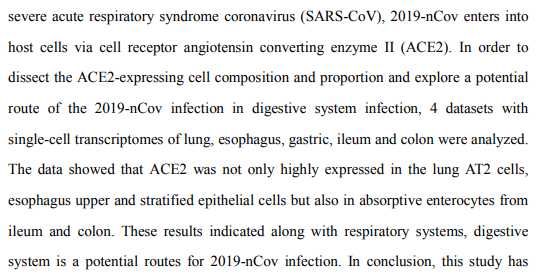
the virus is found in stool
google it
-
Tsikoteer
- Join Date
- Mar 2008
- Posts
- 54,644
September 6th, 2020 12:17 PM #17396the potential implication is, Originally Posted by uls
whereas before, it was thought that covid was passed on via ubo, hatching, hininga, as well as hawaQ,
not, it would appear, baka puede ring fecal route.
-
Tsikot Member Rank 4
- Join Date
- Nov 2005
- Posts
- 45,927
September 6th, 2020 12:22 PM #17397 Originally Posted by dr. d
point ko Doc that isn't new news
the screenshot i posted above is from January
ito March
Does Coronavirus Spread by Fecal Transmission? - MedicineNet Health News

-
Tsikoteer
- Join Date
- Mar 2008
- Posts
- 54,644
September 6th, 2020 12:25 PM #17398no, it's not. Originally Posted by uls
i also read it, months ago.
but our loyal readers may not be as... historical, as you or me.Last edited by dr. d; September 6th, 2020 at 12:55 PM.
-
Tsikot Member Rank 4
- Join Date
- Nov 2005
- Posts
- 45,927
September 6th, 2020 12:26 PM #17399during sars1 may transmission in a building in HK
ung piping ng toilet runs from top to bottom of building so meron may virus sa higher floor
ung pag flush ng toilet generates aerosols nag leak sa pipe sa lower floors
nagka virus mga sa lower floor
-
scientists knew that so they looked for sarscov2 in stool infected people and they found virus
-
Tsikot Member Rank 4
- Join Date
- Nov 2005
- Posts
- 45,927
September 6th, 2020 12:32 PM #17400i never saw a post in this thread about avoiding shared toilets (public toilet, office restrooms etc)
puro disinfecting packages mga nababasa ko
pag may virus ang unang gumamit ng toilet at nag flush siya without putting down the lid, ung aerosols generated will float in the air
tapos meron sumunod na gumamit ng toilet...
i guess people didn't think about that
now that's one more thing to worry about hehe
 Originally Posted by dr. d

 Reply With Quote
