
HOW MUCH does Rebuilding an Engine Cost? How much does HHO cost?Originally Posted by dvldoc

How long to rebuild an engine or do an engine swap? How long to install an ordinary hho kit?
Here's an emission test - ACTUAL FOOTAGE! NOT a REBUILT ENGINE - kasi, hindi po kami ganun ka rich tulad niyo. (WELL, NOT YET) Walang ginagalaw sa loob ng makina. Non intrusive! At para sa mga takot mapasukan ng tubig ang makina sa piston, wala pong tubig na pumasok sa makina... no water injection of sort... On that light, come to think of it... The Ethanol blend of fuel that goes into your engine will become water in the tank if not used for some weeks... so who doesnt have water in your car?... Anyway, this is uncut video, actual footage, and yes - you may trace the plate number.
By the way, Hindi namin binaba ang idling ng kotse - just to prove that by flicking a switch can have some effect. I dont even clean the engine room at all!. I am one of those who think that a clean car is a sign of a sick mind... (sometimes I also have a sick mind) :-D
Of course, hindi pa rin ground shaking kasi, hindi pa rin totally zero... I still would like to see a car in tested in an uncut video actual footage showing how they read the emissions... like no more adjustment on idling or tweaking on the spot.
[ame="http://www.youtube.com/watch?v=fVSfxV3rMFA"]YouTube - Hydrogen Enhanced Daihatsu Charade Emission Tested Footage 1 of 2[/ame]

The Largest Car Forum in the Philippines
- Forums
- Discussions
- Events
- Community
Results 241 to 260 of 429
-

 enthusiast

- Join Date
- Mar 2007
- Posts
- 855
September 26th, 2009 03:52 PM #241
-
enthusiast
- Join Date
- Mar 2007
- Posts
- 855
September 26th, 2009 04:05 PM #242I see you have great gains above 3,000 rpm Originally Posted by dvldoc
Reality check, how often does one put 3,000 rpm in Manila Traffic?
The gains provided by a low grade HHO kit is at the lower power range like from 1,000 to 3,000 rpm.
In what you have presented, there was no significant gains in power achieved by H2O/Alchohol injection below the 3K band.
If you want to go racing, of course - everyone can benefit from water or alchohol injection... most Mini owner use this. In the 70's Turboed drag cars also use this. But that is not really an additional fuel at all. It is simply a way to reduce temp to increase BTU volume.
Anyway, I am not going into that - thats you're territory. :-)
-
 ElgrandClubph FB
- Join Date
- Dec 2007
- Posts
- 1,961
September 26th, 2009 04:41 PM #243Really what exactly are you looking at? When you make these comments it just make you seem less creditable even with the facts right in your face, Nobody has address any other points put before them. You also actually need to know how it works don't you think? If it's set to come on at 2500rpm then that's were you will see power increase, you knew that already though right??In what you have presented, there was no significant gains in power achieved by H2O/Alchohol injection below the 3K band.
Hmm no real gains below 3k LOL. The starex made 51lbs of tq more and 12.6hp at 1500rpms, No gains there lol. You do no how to read a dyno chart right?
It's the activation point were the system comes on were the power appears, How about this 1997 Mazda MPV, no real gains here below 3000K either right?
The starex made 51lbs of tq more and 12.6hp at 1500rpms, No gains there
1500rpm 13.3 hp and 47lbs of Torque, no power gained there right. even on strait water it crushes any power that a HHO kit could even think about making.
2000rpms 31hp and 81lbs of Tq so you were saying what again?? Should I put up the Hilux D4D making 60ft of TQ more and 25hp more at 2000rpms?
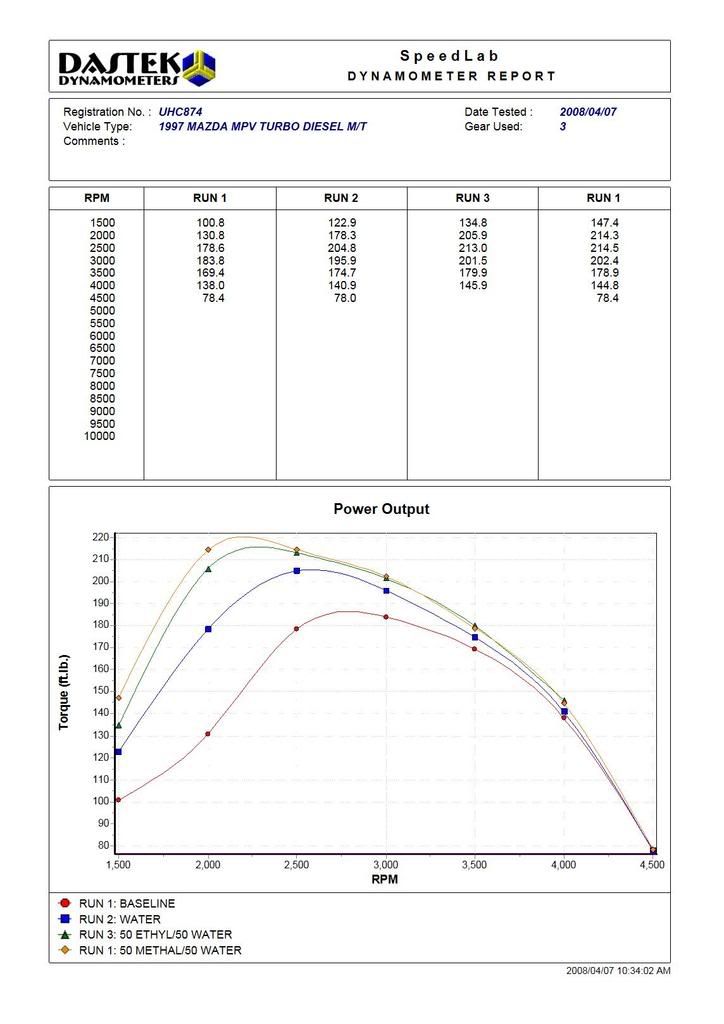
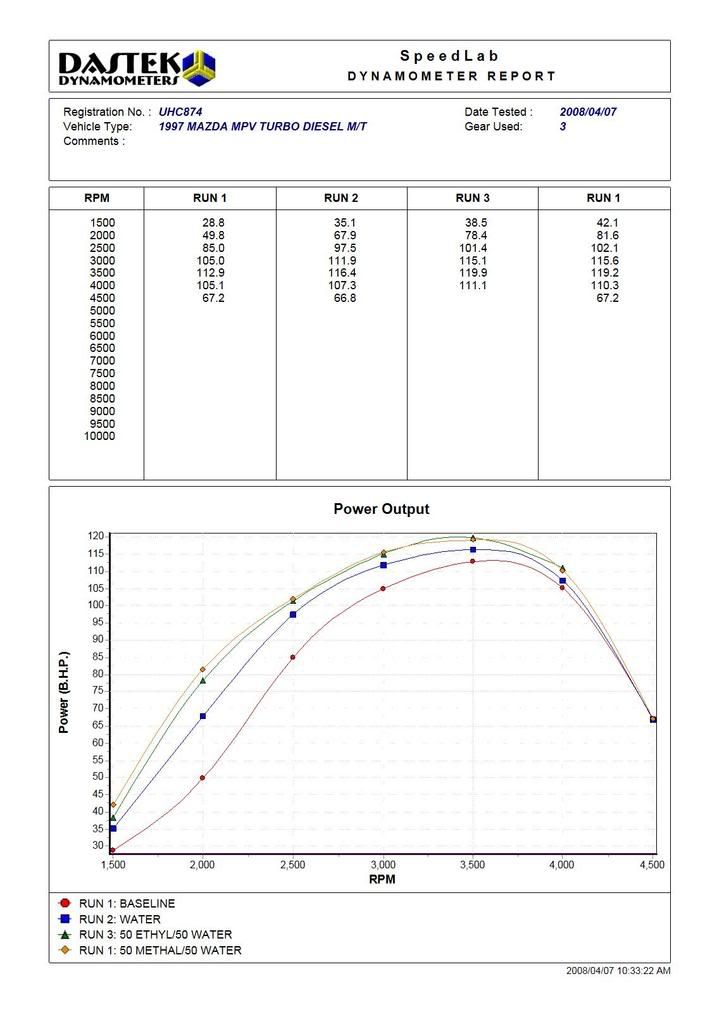
How about almost doubling the HP of a vehicle with a bit of tuning and water injection? Why does this guy only get about 15% better fuel economy and not 40% or 100mpg when we almost doubled the power and efficiency of the engine?

About the best your going to squeeze out of just about any vehicle is about 20% better fuel economy with add on products like this. Even then you will normally get around 10% to 15% better.
Are any of you ever going to answer about the amount of hydrogen these bubbles make vs the amount of air the vehicle consumes at a given rpm?? It's been ask 5 times. When you you guys provide some real proof besides youtube videos?
I even gave you a emission test that shows the HHO results that are being claimed are not even impressive. What no comment on that?
Your still using the Youtube vids the results in that video are 250ppm . CO 0.11% still way over the FX which by the way the engine was redone 14 months prior to the test so what is your point with the emission results that are considerbally higher than a vehicle without the system. How does that prove it is more effiecient???? Does HHO defy common scence as well as science? How is posting a test with HC emissions and CO emission much higher prove it works? You don't even have a before and after to go on.
The FX is just a standard engine with nothing added and it smokes phimagi's results. and the ones on your youtube video. Explanation? And this test is years old.
Other readers feel free to go look at your own last testing and compare them to what the HHO crowd has presented to you and see if they are significantly lower.Last edited by dvldoc; September 26th, 2009 at 04:55 PM.
-
Verified Tsikot Member
- Join Date
- Sep 2009
- Posts
- 52
September 26th, 2009 05:28 PM #244Hi! Regarding electrolysis by using methanol, this HHO project is not yet in the stage of the commercial evaluation. I am aware of other modes of reforming, the production of H2 using hydrocarbon sources. Looking at the positive side of the deliberation, also rest assured that they will be considered. If done at this stage, it might turn out like counting the "chicks before the eggs hatch, when this HHO project is not yet concluded. Anyway, the following will be addressed in the later part, if ever:
1. Is the application of electrolysis using methanol (hydrocarbon base) with relatively complicated cell construction, production of CO2, membrane replacement, circulting pump, etc. serve the purpose of the project?
2. Is the quantity of HHO production, say in the magnitude of 1/4 - 3 lpm or a bit more warrants the use of electrolysis using methanol vs regular electrolysis using other electrolytes readily available at home or the grocery store?
3. Is this HHO project an issue on how much HHO and/or H2 can be produced? Is HHO the same as H2? They say HHO is more powerful than H2, the latter when ignited with O2.
4. Is the difference in amperage as required by the two processes significant in process selection for relatively low production of HHO, considering the issue on "for prctical purposes"?
Anyway, the project results, data collected, initial evaluation will be subjected to "value engineering" before professionals, users would be, and unrelated professions. All queries will be asked and answered, including seemingly stupid questions (don't take these latter questions for granted for I experienced that some of them solved major operational problems many engineers failed to recognized).
This post is conditioned only if the undertaking works to satisfactory level. If ever it does, the improvemnts will only come later. Hence, this post appears hypothetical, and may just deserve a hypothetical answers.
-
Verified Tsikot Member
- Join Date
- Sep 2009
- Posts
- 52
September 26th, 2009 06:29 PM #245This is to clarify the pervious posting of emission test results of my 2002 Exalta, 1.6 li, a/t, efi as showm below for ref. here:
1) 2002 Exalta w/ HHO system; CO, 0.0X % by vol.
2) 2002 Exalta w/o HHO system: CO, 0.00X % by vol - this was done after only hours of disabling the HHO system ( in effect as it was parked overnight after test). The technicians told me to come back after days, not hours to give time for ECU to adjust, and until the former smoke stain in my exhaust pipe returns.
3.) 2002 Honda CRV (std OEM): CO, 0.X % by vol. (earlier post was a 2000 CRV but actaully a 2002, I recall, incidentally done simultaneouly).
For other values of the tests like HC and CO, please refer to previous post. I did not make any technical evaluation on anything, just posted the results as obtained, no ifs and buts, in all honesty. I just said, I consumed more gasoline this time w/o HHO system. It just surprised everybody in the test center on the results in item (2) w/o the HHO sytem, because even a new Exalta will not give CO at 0.00X %, they say.
Final results will be posted when the project is concluded, as preferred by one forum member.
-
ElgrandClubph FB
- Join Date
- Dec 2007
- Posts
- 1,961
September 26th, 2009 09:19 PM #246You do know the water vapor being pulled into the engine will help with emissions.
note HHO is still 2 H’s and 1 O so it’s still H2O, calling it HHO is just a play on words if anything they should be saying something like H- and OH+ or HOH to reflect actual bonds and aqueous disassociation.
And just so you all also know the whole HHO thing will not work on any forced induction vehicle period. It's designed for the engine vac to pull in the gas as most of these kits even the biggest and best of them cannot make more than 1psi of pressure If you have a boosted vehicle pushing 3psi of pressure it will simply blow it right back were it came from, (also very dangerous). Even a Crosswind produces 4psi, yet you still see claims on youtube and everywere else that they are working on turbo diesels and turbo charged vehicles when there is not a chance on this earth the system can overcome the boost pressure.
You can't get past the physics on this one HHO crowd.
Your wasting time making 1.5L a minute. Your going to need to make 40 to 50 litres a minute to make a noticeble difference. When your sucking down 9000 lpm at 1500rpms that like a fly fart in a hurricane. So say you could produce 3L per minute the amount is still nothing how can that make a measureble effect on engine performance. The question has still not been answered. The math does not add up no matter how you want to believe it.
-
Verified Tsikot Member
- Join Date
- Sep 2009
- Posts
- 52
September 26th, 2009 09:24 PM #247On the suject of "car economy and fuel tank"
Perhaps it may be beneficial for readers to review or researchs on terms and/or statements that could be relevant to the subject:
1. What is a dynamometer?
2. What is car economy performance?
3. What is car power perfomance?
3. What is work done?
4. What is the capacity to do work, say work done per unit time?
5. Why would one choose a car of higher horsepower rating to go to Baguio City and back, when a car of lower horsepower rating can do the same work safely and same driving conditions, when economy is the issue?
6. What is the best method to measure a 500 km economy run performance of a car from Mla to Bgo City and back?
6. Others terms missed here relevant to the subject?
I thought it best that perhaps readers really serious on the subject on "car economy", of course, except those who just wait for what the market will offer, should themselves get involved. Specially, when car manufactures will hesitate to help in this endeavor, which they won't, till fossil fuel runs out. If we in the grass root level will be together, we will be bigger than the largest single car manufacturer.
This is all the reason why the undersigned is into this undertaking, and time is not on myside. All I ask is just probability of success to start with, enthusiasm is all what is left of me now.
"Kung gusto maraming paraan, kung ayaw maraming dahilan."
Thank you.
-
Verified Tsikot Member
- Join Date
- Sep 2009
- Posts
- 52
September 26th, 2009 10:42 PM #248I sense that the discusion on HHO as enhancer is not in common ground, I hope I am wrong. What I am trying to find out is the effect of the HHO as to improve combustion, i.e. help burn more fuel than when w/o the HHO. They say that because of the property of HHO (whatever the call it) it burns much, much faster than gasoline. It never entered into my mind the potential energy of the HHO gas (whatever we call) when ignited as to produce that necessary pressure to do work, rather its characteristic to burn unusually fast. Whatever the explaination why this is so, and can be done with appropriate small amount of HHO, is myself not able to explain, but only one way to find out, try it.
In one way, it was indirectly deliberated in early posting with regards to energy "free body diagram" on the energy used to produced the HHO. It can also be applied in the same manner if the potential energy of the hho gas added is also the issue to be equated to viable reduction in fuel input for the same useful work done by the car. This is really what I am afraid of in discussing technical issues in this kind of communication instrument, some clarifications maybe missed out.
On the radicals, or ions as product of electrolysis as explained by researchers, we regularly monitor them when electrolytes are used as resistors for reduced voltage starting of huge motors even if on AC. The possibility of stray DC current is there to produce these combustible radicals, dangerous in the switchgesr room.
I hope we all will be more forgiving, in some misunderstanding, if any at all.
-
Verified Tsikot Member
- Join Date
- Sep 2009
- Posts
- 52
September 27th, 2009 02:47 AM #249Hi! I wish not to engage in a battle of symantics. As long as there is qualifications, I guess it would do in the meantime. However, in the preparation and submission of technical papers before a sizable group, the normally used terms by convention are chosen for convenience in communications. This should be true in review and defense of undertakings.
If that matter produced due to electrolysis of water with electrolyte is called radicals, ions, oxyhydrogen, hydroxy, Brownn's gas, Rhode's gas, knall's gas, water, steam, whatever, it would not matter if qualified. Except that calling it water would immediately put the reader off, for almost everyone knows that water or steam do not burn directly per se, unlike this matter produced by electrolysis that is continuously used in antiquity by jewelers as torch (flame).
I take this opportunity, to state in undertakings of small, medium, large, and/or mega projects, that it is critical to establish the "what and whys" of the undertaking before the various disciplines and their fields supporting the project before planning, design, engineering, procurement, construction, and operation. The disaster is unimaginable, if at the thick of all the calculations, one major supporting group is doing it differently and arguing with passion. Somebody is playing basketball while the others are playing fooball. I saw it happened onetime and after imvestigation, the fault was on both sides.
-
Verified Tsikot Member
- Join Date
- Sep 2009
- Posts
- 23
September 27th, 2009 03:47 PM #250Hello everyone

I can recommend this one and it is even using a bubbler.
You can adopt a similar setup on your car, either a full conversion or using this as supplemental source of fuel (this is what we did on cars):

It is this technology that works great in terms of fuel efficiency and performance. This and HHO from electrolysis working hand in hand makes you wonder if your fuel gauge is still working or not after a 30km run. It is required though that you know what you're doing when implementing this setup for it is easy to claim that it does not work when you did not balanced your input variables.
To test for km/liter. We fill the fuel tank to the brim and noted the car position with respect to the gas pump. Run the car for 100km and get back to the same gas pump at the same noted position and refill to the brim. The car used is still using a carburetor, no electronics involved in controlling fuel inputs like in fuel injected engines. Increase in km/liter are way beyond 100% than the km/liter of the same vehicle without using the above setup. During the testing process, what's inside that bubbler is only water. You'll get far better results when all of your hydrocarbon fuel vapor plus water vapor is sent through this setup.
Using this setup as booster or for supplemental only, your engine will respond better even a slight push in the gas pedal. Because you only apply little pressure most of the time while still running strong, most of your fuel is from the water in the bubbler and lesser from your carburetor, this is the reason you get better km/liter with this setup. Water consumed is only 1000ml per 100km.
Even if you press then hold the gas accelerator pedal at a constant position, with this setup the car will keep on accelerating and time will come you'll have to back out your foot from the accelerator pedal. This is not a conventional engine respond and you won't believe it until you're on the driver seat driving.
If you want cheap and significant improvement in km/liter? This setup is what you'll implement on your car. We never have dyno tests on this for it will cost us PHP4500 for that. PHP4500 is too expensive than implementing the above setup on an ordinary car. We better spend our money wisely and enjoy fuel savings every time we drive our car. For those who implemented a similar setup, they are as happy as we are now in terms of savings and engine performance.
reference link for more information on this technology:
http://www.peswiki.com/index.php/Dir...y_Paul_Pantone
-
Verified Tsikot Member
- Join Date
- Sep 2009
- Posts
- 52
September 28th, 2009 01:01 PM #251Hi! Mr. "vernieg", when the time comes, would you be able to present your seemingly simple device in the quest for fuel economy, before a panel in the profession? It wil be an honor.
I take this opportunity to present a situation that happened in gas station of large oil company. I saw a fuel enhancer/booster and improves fuel economy contained in a 150 ml (0.150 li) can. It is supposed to be mixed in a full tank of petrol.
If the issue on HHO system is on quantity, disregarding whatever benefits it renders, then there is bit more of HHO by weight consumed after a Manila/Baguio round trip than what is being sold at the gas station. There is consumed about a full tank petrol by a regular compact car for the trip.
Given: 1 liter of water produces about 1866 liters of HHO gas, 1/2 lpm rate of HHO consumption, 12 hrs round trip, and 1000 ml = 1.0 liter, assumed both S.G. of both at 1.0 (though petro products generally bit less than 1.0).
Hence: (0.5 li-HHO/minute)(720 minutes/trip)(1-li water/1866 li HHO) = 0.193 li or 193 ml of water per trip. Please check my calculation, just rounding off. This is a bit more than what is being sold at gas stations as enhancer, and people ar buying.
It seems like the HHO system is just an additive, if you will. It is magic they say, and that I will find out.
Thanks.
-
Verified Tsikot Member
- Join Date
- Sep 2009
- Posts
- 23
September 28th, 2009 03:31 PM #252All credits for GEET should goes to Paul Pantone for sharing it to humanity.
More information on replications can be found on this site below:
http://quanthomme.free.fr/pantone/FrancePMC.htm
Another good reference on how to implement GEET on cars/vans/trucks from our very own kababayan:
http://www.panaceauniversity.org/Leo...tal%20GEET.pdf
Other than the inventor who wish to spread this technology by conducting seminars and workshop classes, it is good to note that some of our kababayan are also on the frontier of implementing this technology on cars. It is our vehicles that produces a lot of pollution everyday on the streets. The inefficient use of fuel is another reason that slow down progress in our country. If we help ourselves by using fuel efficiently, we are empowering ourselves as a nation. We cannot deny we spend too much on fuel when we commute long distances for work everyday. Let us cut that unnecessary spending habit by implementing technologies that work. You cannot find this yet on the market as kits and bolt ons, but you can find the materials on hardware stores near you and even on hardwares in malls. Have a friend or a shop that can help you gas-weld the components and install it on your car. Share what you discover to your friends, relatives and spread the word and let them do the same project. This is very much applicable in all combustion engines, big or small, just scale it up or down to meet your need. Farmers and fishermen with their stationary engines can take advantage of the same technology stated on the free given plans on the internet. Even if the inventor will tell you that the free given plans on the internet is not efficient, having 50% fuel savings is still hard to ignore considering it only require basic plumbing skills to make one. However, this setup can typically do 100% savings from our experience and you won't believed when you experienced it yourself when you reached more than a 100% on a highway and yet it is real. Just do it on your engines and tell others to do the same. Wag munang mag dahilan na di mo magawa, kayang kaya yan basta gawin mo lang.
Research findings on this technology by third party other than the inverntor:
http://quanthomme.free.fr/pantone/martz/En_geet.htm
There's still more to know about this technology and research is still going on.
Primary objectives of this technology is similar to other fields of research like the HHO community did, that is to reduce pollution and use fuel efficiently.
There are other fuel reforming inventions and this one, the GEET, is the simplest thing to do and it works well. Maulan sa atin at binabaha pa nga tayo, let us make use of that rain water as our supplementary fuel, wala kang dahilang sabihin mahal ang tubig since in a week merong ulan.
-
 SobrangBilisMagType!
- Join Date
- Aug 2004
- Posts
- 22,702
September 28th, 2009 04:27 PM #253Just for anyone who can't follow... 1 liter of air = 1.3 grams of mass. 1 liter of "HHO" gas electrolyzed from water is about 11% hydrogen... in other words... 0.143 grams. 1.5 liters per minute is 214 milligrams of hydrogen per minute... at idle (800 rpm) that's about 0.26 milligrams of hydrogen per revolution. Compare that the the 200 milligrams of air that your engine can swallow per revolution, and yes, it's about the same as a fly fart. Originally Posted by dvldoc
*not counting the oxygen because, no, your engine doesn't need anymore oxygen. It needs more combustibles.
Ang pagbalik ng comeback...
-
Verified Tsikot Member
- Join Date
- Sep 2009
- Posts
- 52
September 28th, 2009 04:54 PM #254Hi! Mr. Verniege, Please keep posting on your device, looks interesting., 50% mileage increase is 50% in any language. We just dont pick that up on the streets. Can it be tested on stationary auto diesel oil fired electric genset, 500 kw max rating, 350 kw continouus load? If it works, a neighboring similar project has four units gensets at 1000 kva rating *, bunker oil fired.
Power plants are normally subjected to 10% above the max capacity rating for 30 minutes only. If used as base load, 365 days a year, load is limited to 75% max continuous. However, with NPC, existing plants are generally used as standby for 45 days a year, according to statistics.
With the increasing cost of energy from NPC, it is cheaper to run power plants for internal use, or sometimes arrangements are made with National Grid (formerly Transco) to run units and feed it back to the power grid, and reverse accounting is done. However, a 50% savings due to some simple device is certainly worth looking at.
Also, can the device be used in the pulverized coal atomizer with required air, 80% passing 200 mesh particle size? There are existing units from 25 MW to 300 MW units all over the country. You may directly make arrangement with the project proponent as this will be a huge undertaking, but you have to convince people on smaller unit.
-
Verified Tsikot Member
- Join Date
- Sep 2009
- Posts
- 52
September 28th, 2009 05:17 PM #255I think I tried to make it clear in previous postings. It is not the heating value (HV) of the relatively small amount of HHO as to do usefull work. It is rather that characteristics of HHO not just standalone hydrogen, as others claimed, when in introduced into the ICE intake that arouse my interest to test the HHO. I do not know as of now if the HHO (whatever) system will live up to it. Originally Posted by niky
Just to reiterate, I gathered that 1 li of water is equivalent to about 1866 li of HHO gas, or whatever one may call it, as produced from electrolysis. Please argue with thermodynamics/physics, not me. But even if so, calculations are not may bases for undertaking the HHO project to find out what they are claiming. As usual, I will take the positive side of your argument which could be helpful in the final analysis, success or failure.
-
Verified Tsikot Member
- Join Date
- Sep 2009
- Posts
- 23
September 28th, 2009 05:58 PM #256Paul Pantone showing his invention, the "GEET Fuel Processor". It's a 1-cylinder four-stroke engine that runs on all kinds of fuels and exhausts cleaner air than came in.
[ame="http://www.youtube.com/watch?v=d5YsK3bwzPM&feature=related"]YouTube - Paul Pantone Plasma Reactor Motor[/ame]
I am not yet familiar with pulverized coal atomizer. What I am sure about is we can use 10% hydrocarbon fuel plus 90% water (rain water or salt water). We can even use used engine oil as our hydrocarbon component in the bubbler. To help vaporize used oil, we can subject its container to exhaust heat. What we need to get through the reactor is vapor only. Stationary generators (large or small) using diesel or gasoline as fuel is very easy to enhance.
Below is an example of a small diesel generator.
from revizal:
Original consumption: 3 liters diesel for 5 hours full load running.
After modification: 2.5 liters diesel, 1 liter water for 7 hours full load runing.
[ame="http://www.youtube.com/watch?v=w8kCbmWIrx8&feature=channel_page"]YouTube - Swa-Plasma on Diesel Genset 3000 watt continue[/ame]
Originally Posted by philmagi
Below is a series of examples of full GEET conversions:
[ame="http://www.youtube.com/watch?v=hjLqFSlHWcs&feature=related"]YouTube - Paul Pantone Introduction[/ame]
-
ElgrandClubph FB
- Join Date
- Dec 2007
- Posts
- 1,961
September 28th, 2009 08:29 PM #257It's so nice to see this totaly ignored over and over again by the Originally Posted by niky
HHO guys. Why can you not adress a simple mathamatic fact? You just dance around the question kike it does not exist and simply talk about something different,
Now about Paul Pantone
Fact
"In 2002, Pantone was found guilty of securities fraud for selling shares under false pretenses, cheating investors out of as much as $25K each. Pantone supposedly sold the technology to a Dennis Lee of New Jersey, who has continued selling plans and training related to GEET. Pantone has since claimed that Lee was never given ownership of GEET, and that Lee is thereby illegally selling the technology to others. Lee is also known as a purveyor of other unorthodox free energy technologies that seem to violate the second law of thermodynamics and other laws like conservation of mass, and seems to infuse all of these technologies with theological overtones in a group called "Better World Technologies". On 3 October 2003, Pantone was issued a cease and desist order from the Utah department of commerce. The document states that Pantone had apparently attempted to illegally sell stock to Glenn Robertson of Quebec, that Pantone had previously been charged with "four second-degree felony counts of Securities Fraud, one third-degree felony count of Securities Fraud, one third-degree felony count of Selling an Unregistered Security and one second-degree felony count of Pattern of Unlawful Activity", that Pantone claimed in 2002 bankruptcy proceedings that he owned "a bare patent with no beneficial interest or value", and that he had transferred ownership of the GEET technology to Robert Fackrell in 2002. On 8 October 2004 Pantone pled guilty to two counts of securities fraud, and the other charges were dismissed. In August 2005, he went to prison for two weeks."
Paul's so called engine is a massive scam. Endless posts of people who have been ripped off. His technology is babble. Preheating fuel prior to combustion is no big secret Smokey Yunick did it years ago. No one can seem to replicate his work. I challenge anyone to show me documented proof that one of these cars can even be built. Allegedy he will sell plans of how to build the geet to anyone who pays $175.00. Do you think that hes the ony person around to smart enough to build something from a set of plans?
What some of the people he ripped off think of him, Sound like Dangle to you?
Here is an excerpt from Pantone's "explanation" of the physics of the GEET device (I can't do this with a straight face):Please tell Paul that I am glad his karma has caught up with him. He has been unethical and has lied in his dealings with friends that have tried to support him, his investors, on national TV and the public in general. I know of several people that have lost thousands to hundreds of thousands of dollars because they trusted Pantone and gave him money. Money which he pissed away living a good lifestyle while his investors lost their homes because they took out a mortgage to give money to Pantone expecting a return on their investment in a reasonable period of time. He has sucked many good people who gave their time without expecting anything in return into helping him and has in most cases turned against them and accusing them of various forms of betrayals or for sabotage or something else when things went wrong. He was absolutely unwilling to take personal responsibility for his actions and wrong-doings.
His behavior and his actions are disgusting.
What is even more appalling is that he says he is doing this because he is on a mission from God and doing God's work. B.S. This could not be further from the truth. He just has a charismatic way of talking and getting people to believe in him. He's a really good con-artist.
I am one of the people that have proudly submitted evidence against Pantone and I'm glad he is finally getting what he deserves.
Grant
"The technology used in the GEET Fuel Processor is a combination of the most basic scientific principles, most of which falls within the normal rules and of thermodynamics. But some of the 70 simultaneous phenomenon are not found in those books, since it is the combination of events, which is the body of this discovery. Put quite simply, the exhaust heat is transferred to the incoming fuel vapor, which must be maintained in a vacuum, and the overall configuration provides a molecular breakdown within the vacuum of all of the heavier elements. Therefore, intensifying the vacuum, the speed of molecular breakdown or reaction is magnified, and less heat is required.
The GEET Plasma unit generates several "electrical" fields at the same time while operating, some of which are in opposite direction and all are affected by the direction of mass movement as well as by the gravitational field of our planet. During lectures from coast to coast Paul and Molley have explained that it is frequency and vibration that determines the amount of plasma or energy being developed. Reseach in private laboratories in Europe is helping to isolate some of the basic field replication of the plasma generator that the Pantones need for visible demonstrations. "
http://www.rexresearch.com/pantone/pantone.htm
Knock yourselves out pointing out the fallacies in this little gem.
Why are so many people this gullable? It;s a con wake up from the youtube videos man. It would be funny if it was not so sad.
Good forum for people who care to look up about these scams
http://groups.yahoo.com/group/FE-OU-...ctims/archivesLast edited by dvldoc; September 28th, 2009 at 08:35 PM.
-
enthusiast
- Join Date
- Mar 2007
- Posts
- 855
September 28th, 2009 09:37 PM #258[ame="http://www.youtube.com/watch?v=uoLFt_cUa_0"]YouTube - Current Event: GEET Inventor Wrongfully Imprisoned for over 3 Years Part 1[/ame]
-
SobrangBilisMagType!
- Join Date
- Aug 2004
- Posts
- 22,702
September 28th, 2009 10:41 PM #259 Originally Posted by dvldoc
So... you're converting 1.5 liters of water per minute? I don't think so. Not with a 12 volt system. Originally Posted by philmagi
And 1 liter of water is still 1 kilogram of gas... or about 58 grams of hydrogen, give or take. I'm not arguing with physics. I'm stating it.
I like to talk in terms of grams because we can measure the air, the gasoline and the "HHO" this way. Talking in terms of liters is completely misleading, and helps perpetrate the HHO myth.
"HHO" gas has no special properties beyond being 16 parts oxygen and 1 part hydrogen by weight. There is no such thing as HHO... it is simply a gas composed of H2 and O2. H2 will burn with O2 and produce water. You can make a pretty torch running off of electrolysis. But that's it.
There are three things that any additive to the combustion needs to do to enhance combustion. One... is to cool the air charge, allowing for a denser air charge and more power. Two... is to add more combustibles to the process. Three... is to increase octane, allowing the engine to run leaner without the possibility of damaging detonation or knock.
For #1: The amount of HHO being injected isn't enough to cool the air charge significantly. Scratch that. Scratch #2: as you said... there isn't enough heating value in the amount of HHO either.
#3: The tiny extra bit of hydrogen will give you an octane boost. Given the amounts involved, I'd say it'll probably be 0.01 points... ...but the oxygen won't do anything for you.
In a combustion engine, you never want more oxygen. Atmospheric gas is already 20% oxygen, which is all a car needs. More oxygen makes the engine run leaner... which makes it run hotter... which is bad for the engine... without saving fuel, because you're injecting the gas after the mass airflow sensor, which means the metered amount of fuel injected into the engine is the same.
If the engine has O2 sensors, adding extra oxygen will make the engine react and dump more fuel in... that's if you're adding enough oxygen to show up on the O2 sensors.
That's why I asked about the O2 sensor adapter. Any set-up that includes moving or modifying the O2 sensor can modify the fuel economy of the engine by simply modifying the output of the O2 sensor... whether by the act of physical relocation or by tweaking it electronically. I could thus market a device that gives the same benefits or more by simply changing the O2 sensor readout and injecting pure water into the system to prevent knock coming about from excessive lean-burn. (hey... devildoc... want to try this next time you're over here? Would be interesting...)
I'm not selling Methanol injection myself... and I don't have it on my gasoline-powered car. It's of very limited use to regular consumers with simple four cylinder gasoline engines, and gains in economy and power are quite minimal. But it has been proven to work, time and again on the dyno, for both turbocharged and naturally aspirated engines.
Methanol injection has been proven to work without any modifications being made to the vehicle's ECU or sensors. It does #1 (cools the air charge, for a denser charge), #2 (alcohol injection gives you a little more fuel) and #3 (octane boost from water-alcohol mix... which burns very, very slowly). So... why can't "HHO" do the same?Last edited by niky; September 28th, 2009 at 10:52 PM.
Ang pagbalik ng comeback...
-
Verified Tsikot Member
- Join Date
- Sep 2009
- Posts
- 52
September 29th, 2009 11:01 AM #260Hi! Yes, there could be some confusion in mixing volumetric and weight unit. Perhaps, I simply would give the data as I experinced it and leave the calculations to the reader.
1. My electrolyzer gas production rate is about 1/2 liter per minute of gas (it is called HHO, HOH, radicals, ions, oxyhydroen, hydroxy, Brown's gas, etc). I used the basic mehod of measuring it by inserting the 1/4 in dia output rubber hose (common-ducti ng) from the electrolyzer into the bottom of known volume of plastic bottle filled with water and submerged in a basin also filled with water. Volume of gas to displace the water in the bottle within certain time gives the gas production rate, say in liters-gas/min. This was done in a series of tests.
2. According to references, their are produced 1866 liters of HHO gas from 1 liter of liquid water.
3. My car takes about 12-14 hours from Manila to Baguio City and back including some side trips.
From all the given above, I think one may estimate the gas production after the entire trip in liters gas (HHo). Just convert this liters of gas into the absolute value in liters of liquid water.
My electrolyzer system is not producing H2 separately, but all that is produced from it is commonducted and injected into the ICE.
With regards to the mechanical type O2 enhancer, it is temporary in an attempt to fool the signal before it goes to the ECU. The EFIE, an electronic enhancer will be brought by my son from US who will be visiting us, and to replace the mecahnical enhnacer.
Also, in actual run I seemed to be adding more or less the same amount of make water compared to the theoretical figures, though I encountereds some problem but resolved.
This is my concern, if this HHO prioject will leave up to what is being claimed it can do. I am not endorsing this project, not yet, just that it was requested in this forum if anyone is undertaking this HHO thing and to share, as well as to see it actually.
HONESTLY, I CAN NOT AGREE NOR DISAGREE ON SOMETHING I AM NOT ABLE TO FULLY EXPLAIN AND UNDERSTAND AS OF NOW, CONSIDERING MY TECHNICAL BACKGOUND. ALL I NEEDED WAS JUST PROBABILITY OF SUCCESS TO EMBARK ON IT, NOT A POSITIVE PROOF. i WILL NOT UNDERTAKE SUCH A PROJECT ON POSSIBILITY ALONE. I AM NOT RECOMMENDING THE HHO SYSTEM TO ANYONE AS OF NOW, UNTIL IT HAS UNDERGONE SUCCESFULL DEFENSE BEFORE A PANEL OF PROFESSIONALS IN THE PROFESSION.
HOWEVER, NOTHING WILL STOP ME FROM MY QUEST FOR A CHEAPER FUEL, AS WELL WAYS TO IMPROVE THE ULTIMATE EFFCIENCY OF THE MACHINE. I WILL NOT COMPARE MYSELF WITH OTHERS FOR AS THE SAY, "THERE WILL ALWAYS SOMEBODY GREATER OR LESSER, AND I WILL JUST BE BITTER AND IN VAIN".
 Originally Posted by dvldoc


 Reply With Quote
![Water as Fuel / HHO Technology [Merged Threads]](https://play.google.com/intl/en_us/badges/images/generic/en_badge_web_generic.png "Google Play")