
Originally Posted by victorevolution

Meron ka pa rin naman at least 5 years na warranty period.

The Largest Car Forum in the Philippines
- Forums
- Discussions
- Events
- Community
Results 141 to 160 of 427
-
 Tsikoteer

- Join Date
- Sep 2007
- Posts
- 1,778
January 29th, 2020 02:53 PM #141
-
 Tsikot Member Rank 2
- Join Date
- Mar 2004
- Posts
- 10,314
January 30th, 2020 09:32 PM #142They are coming in because the China Free Trade agreement is in effect already ...
-
Tsikoteer
- Join Date
- Sep 2004
- Posts
- 340
January 31st, 2020 09:28 AM #143eto naman ang principle ng mass produced car all over the world. what makes all other brands not coming from china special and not to be considered as disposable? since they are able to export it to first world countries, it means they had met the required quality, environment and safety standard of that country. Originally Posted by oliver1013
-
Tsikoteer
- Join Date
- Sep 2004
- Posts
- 340
January 31st, 2020 09:43 AM #144not really. the sound is good, but not great. but way better than most japanese cars coming from thailand. check again that the japanese cars you are referring to is not an upgraded sound system. Originally Posted by minicarph
-
 Tsikoteer
- Join Date
- Jan 2006
- Posts
- 12,608
January 31st, 2020 09:46 AM #145Filipinos have always been brand conscious. Back in the 70s, Japanese cars are considered crap and unreliable. 20 years later, the Koreans were also bad. Now, it's the Chinese. Come to think of it, they were able to turn things around. Originally Posted by normanenoza
Look at us, we can't even make produce one at global standards. Malakas manglait kesyo made somewhere, low quality. Eh buti pa sila.
-
Tsikoteer
- Join Date
- Mar 2008
- Posts
- 54,627
January 31st, 2020 10:05 AM #146purchase price.
warranty.
mechanics, parts, and cost.
reliability.
probably in the correct order.
heh heh.
years back, some local manufacturers attempted to market cars that had higher-than-industry local content.
will local buyers support such an attempt today, using their wallets?Last edited by dr. d; January 31st, 2020 at 10:17 AM.
-
Tsikoteer
- Join Date
- Sep 2004
- Posts
- 340
January 31st, 2020 10:18 AM #147yes. were stuck with jeepney and tricycle with zero consideration for safety. and todo depensa pa that they are an icon. this could have been a Pinoy brand now. even Vietnam now have their own. may be one more or two generation for the Philippines to have its own car brand. but by that time, most of the world may be on electrical and autonomous driving already. Originally Posted by Egan101
-
Tsikoteer
- Join Date
- Jan 2006
- Posts
- 12,608
January 31st, 2020 11:02 AM #148The Philippines back in the 50s and 60s had a different mindset in terms of production. We only had to import equipment which we cannot produce locally. Originally Posted by dr. d
In the 70s, our economy shifted to something more export-oriented and we opened the country to a lot of imported products. It may have helped increase demand for our export products but on the negative side, it has killed our domestic capability to produce/develop products on our own.
-
Tsikoteer
- Join Date
- Mar 2008
- Posts
- 54,627
January 31st, 2020 11:22 AM #149the will to produce local, must be supported by the will to buy local.
it's a vicious cycle.
i'd buy local, if the quality were there.
-
Verified Tsikot Member
- Join Date
- May 2014
- Posts
- 1,320
January 31st, 2020 12:18 PM #150Government has really pushed manufacturing of practically anything locally here on a "large scale" out and has made us reliant on imports. Originally Posted by Egan101
What we export has been mainly "raw material" that is processed elsewhere. If it was processed here, manufactured here, then it could be exported elsewhere to earn "more", just takes more steps. But that 1 step to sell the raw material is the quick buck the government chose to focus on.
Heck, we are an agri country with a rice research institute that can't be rice self sufficient. That really says a lot.
-
Tsikoteer
- Join Date
- Mar 2008
- Posts
- 54,627
January 31st, 2020 12:26 PM #151"politics." Originally Posted by 17Sphynx17
"i want you to produce rice, but i do not want to pay your price."
export raw material? import finished product?
"colony."
-
Tsikoteer
- Join Date
- Jan 2006
- Posts
- 12,608
January 31st, 2020 02:24 PM #152It's funny how our ASEAN neighbours went to study at our rice institute back in the 70s and 80s. Now, we have to import rice from them. Originally Posted by 17Sphynx17

-
Verified Tsikot Member
- Join Date
- Dec 2014
- Posts
- 13
-
Tsikoteer
- Join Date
- Mar 2008
- Posts
- 54,627
February 1st, 2020 11:56 AM #154we also taught the thais how to diversify their plant industry. Originally Posted by Egan101
their products are now reigning king on our grocery shelves.
some of uplb's scientists-teachers, are national hero status in other countries, for what they did in their agriculture industry.
tayo...
politics.
-
Tsikoteer
- Join Date
- Sep 2004
- Posts
- 340
February 1st, 2020 01:08 PM #155Not with wet type DCT. Otherwise its pointless to develop this wet type. On the MG dry type DCT, the shudder and jerk is evident on stop and go traffic, same with Kia dry type as well. And this traffic condition heats the clutches quickly on dry type DCT. Ford's DCT is no different. The cooling oil on the wet type DCT has three function, cooling, vibration damper and lubrication. Dig a bit deeper on the differences between dry and wet, and why wet is the better DCT design at the moment. Originally Posted by victorevolution
-
Tsikoteer
- Join Date
- Sep 2004
- Posts
- 340
February 1st, 2020 01:17 PM #156Quality and reliability kaya naman ng Pinoy yan. The biggest hurdle is the higher labor cost in our manufacturing industry compared to our ASEAN neighbors and China. Originally Posted by dr. d
We have to face the fact that if we dont embrace electric vehicle technology, we will be relying on China built cars as first world car manufacturers focus on electric vehicles
Waking up to a new global auto superpower | Motioncars
-
Tsikoteer
- Join Date
- Jan 2006
- Posts
- 12,608
February 1st, 2020 01:25 PM #157Don’t expect people to do research. Mas gusto nila marinig yung sabi-sabi ng iba. Originally Posted by normanenoza
I have driven the Coolray in BGC traffic and the tranny is smoother than the dry-type DCT on my old Fiesta. It is even smoother than the CVT on my Mitsubishi ASX.
Sent from my iPhone using Tapatalk
-
 Tsikoteer
- Join Date
- Oct 2012
- Posts
- 27,624
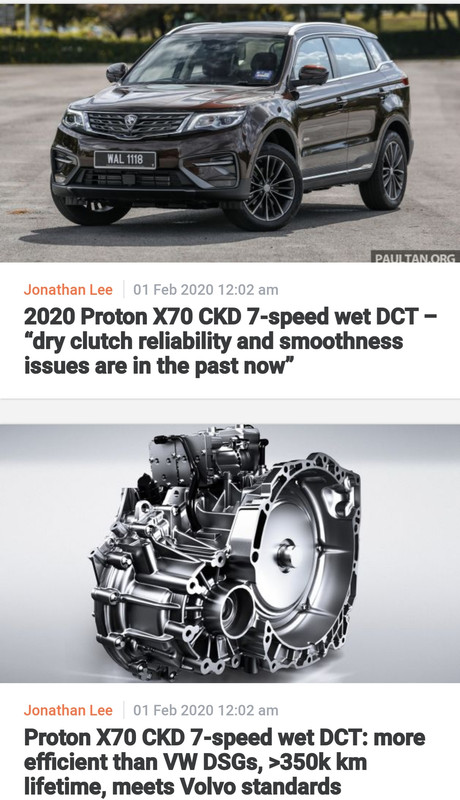
February 1st, 2020 01:28 PM #158Huge topic in malaysia now. Regarding the new wet type dct...
Geelyproton chinese media..
350,000km🏴*☠️
Originally Posted by Egan101
-
 Verified Tsikot Member

- Join Date
- Jan 2016
- Posts
- 6,813
February 1st, 2020 01:34 PM #159Yeah, FB research trumps Google [emoji75] Originally Posted by Egan101
-
Tsikoteer
- Join Date
- Oct 2012
- Posts
- 27,624
February 1st, 2020 01:52 PM #160Fb rabbit holes lol. But the number of auto shops on fb are growing which is a good thing for car guys. Originally Posted by papi smith
 Originally Posted by victorevolution

 Reply With Quote