Commodities are getting obliterated
Happy weekend

The Largest Car Forum in the Philippines
- Forums
- Discussions
- Events
- Community
Results 9,321 to 9,340 of 10726
-

 Tsikot Member Rank 4

- Join Date
- Nov 2005
- Posts
- 45,927
-
Tsikot Member Rank 4
- Join Date
- Nov 2005
- Posts
- 45,927
November 24th, 2018 10:59 AM #9322for those hoping US stocks to rally
just hope liquidity comes back
-
Tsikot Member Rank 4
- Join Date
- Nov 2005
- Posts
- 45,927
November 24th, 2018 11:21 AM #9323I've been saying the global economy is slowing down (except the US)
So the Fed keeps raising interest rates believing the US economy is strong enough to absorb higher rates
The Fed recently acknowledged that growth is slowing abroad
But as long as the US economy is doing fine, the Fed will keep raising rates UNTIL SOMETHING BREAKS
i said the US isn't immune... everything's interconnected
Something has broken in the US
i believe there will still be a rate hike next month
but going into 2019 the Fed will be more cautiousLast edited by uls; November 24th, 2018 at 11:23 AM.
-
Tsikot Member Rank 4
- Join Date
- Nov 2005
- Posts
- 45,927
-
Tsikot Member Rank 4
- Join Date
- Nov 2005
- Posts
- 45,927
November 27th, 2018 01:55 PM #9325so much for that "global synchronized growth" everybody was talking about at the beginning of the year

-
 Social Dementia
- Join Date
- Sep 2003
- Posts
- 25,189
November 29th, 2018 08:38 AM #9326DOW closes 617 pts up...
Fed's Powell, in apparent dovish shift, says rates near neutral | Reuters
Sent from my POCOPHONE F1 using Tapatalk
-
Tsikot Member Rank 4
- Join Date
- Nov 2005
- Posts
- 45,927
November 29th, 2018 11:17 AM #9327neutral rate means an interest rate where it's not high enough to choke the economy but not too low to fuel inflation
-
Trump isn't happy about Fed rate hikes
-
The current fed funds rate is 2.25%
will be 2.5% in December
i think they'll stop at 3.0% in 2019
-
 Tsikoteer
- Join Date
- Oct 2012
- Posts
- 27,624
November 29th, 2018 11:22 AM #9328Powell is proving Trump is correct...
Did Fed’s Powell ‘light the fuse’ for a year-end stock-market rally? - MarketWatch
-
Tsikot Member Rank 4
- Join Date
- Nov 2005
- Posts
- 45,927
November 29th, 2018 11:34 AM #9329Trump hated the rate hikes coz he wanted US stocks to hit all time highs everyday coz it will make him look good
the rate hikes have been making investors reprice asset prices (meaning lower)
it's not about Trump being right
it's about Trump's vanity
Trump wants soaring US stocks during his term so he can boast about itLast edited by uls; November 29th, 2018 at 11:42 AM.
-
Tsikot Member Rank 4
- Join Date
- Nov 2005
- Posts
- 45,927
November 29th, 2018 11:42 AM #9330The Fed needed to raise rates coz:
1. to prevent asset bubbles
2. to have enough ammo to fight the next recession
In a recession, central banks cut interest rates to lower borrowing cost to support their economies
if the Fed didn't get rates up from zero, when the next recession comes there won't be anything to cut
well they can go negative
meaning Fed funds rate like -0.1%
so that means your dollar savings account will have negative interest rates too
-
Tsikot Member Rank 4
- Join Date
- Nov 2005
- Posts
- 45,927
November 29th, 2018 12:23 PM #9331as the Fed raises interest rates, the higher rates get transmitted throughout the US economy
that means higher mortgage rates
so what happens?
slower home sales
US new-home sales plunged 8.9 percent in October
WASHINGTON (AP) -- Sales of new U.S. homes plummeted 8.9 percent in October, as the number of newly built, unsold homes sitting on the market climbed to its highest level since 2009.
The Commerce Department said Wednesday that new homes sold at a seasonally adjusted annual rate of 544,000 last month. New-home sales have declined in four of the past five months. Over the past year, sales of new homes have dropped 12 percent as higher mortgage rates have caused would-be buyers to back away.
home prices rise more slowly
US home prices rise more slowly amid weaker sales - News - Sarasota Herald-Tribune - Sarasota, FL
WASHINGTON — U.S. home prices increased more slowly in September from a year ago as higher mortgage rates weighed on sales.
The S&P CoreLogic Case-Shiller 20-city home price index, released Tuesday, rose 5.1 percent from a year earlier. That’s down from a 5.5 percent yearly gain in the previous month. It was the sixth straight month that home price increases have slowed.
or home prices fall
Metro Seattle home prices falling at fastest rate in U.S. | The Seattle Times
It was just this spring when Greater Seattle led the nation in home-price increases. Now, prices here are falling faster than anywhere.
Single-family home costs across the Seattle metro area declined 1.3 percent in September from a month prior, according to the Case-Shiller home-price index, released Tuesday. That follows a 1.6 percent drop the month before, and a 0.5 percent drop the month before that.
Prices haven’t fallen this fast since 2011, when the market was still bottoming out after the recession.
i said the Fed will keep raising rates until something breaks in the US economy
SOMETHING BROKE
that's why the Fed is sounding dovish now
-
Tsikot Member Rank 4
- Join Date
- Nov 2005
- Posts
- 45,927
December 3rd, 2018 10:42 AM #9332this was totally expected
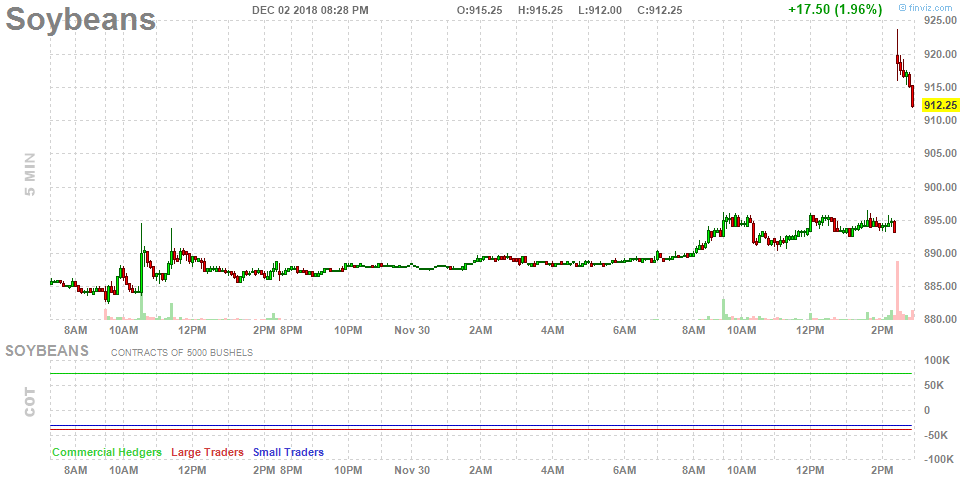
Soybean futures in Chicago led gains in agriculture markets after the White House said China agreed to start purchasing farm products from U.S. farmers immediately as part of a trade truce between the two countries.Last edited by uls; December 3rd, 2018 at 10:44 AM.
-
Tsikot Member Rank 4
- Join Date
- Nov 2005
- Posts
- 45,927
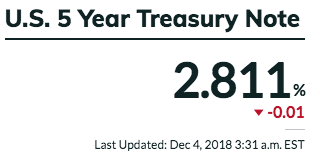
December 4th, 2018 12:25 PM #9333check out the yield spread between US 2Y and 10Y
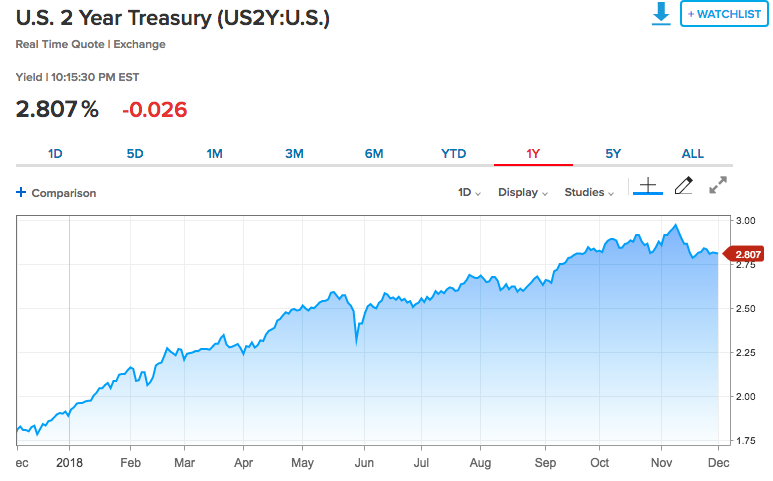
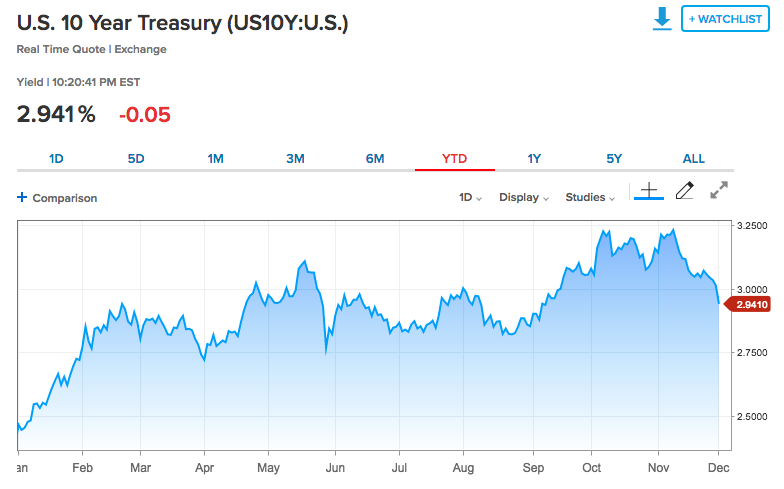
less than 14 bpsLast edited by uls; December 4th, 2018 at 12:28 PM.
-
Tsikot Member Rank 4
- Join Date
- Nov 2005
- Posts
- 45,927
-
Social Dementia
- Join Date
- Sep 2003
- Posts
- 25,189
-
Social Dementia
- Join Date
- Sep 2003
- Posts
- 25,189
December 5th, 2018 07:29 AM #9336The VIX volatility index surged 25% on Tuesday. The Fear & Greed Index, a CNN Business gauge of market sentiment, fell into “extreme fear.”
Recession gauge flashes yellow
Investors have also grown very worried in recent days about fluctuations in the bond market. The gap between short and long-term Treasury rates has narrowed significantly this week. Before almost every recession, the yield curve has inverted, meaning short-term rates are higher than long-term ones.
The difference between the 10-year and two-year Treasury yields shrank on Tuesday to the smallest since just before the Great Recession. And the less closely watched gap between three and five-year Treasury yields inverted on Monday.
“Inversion is usually the first sign of an economic slowdown,” said Kinahan. He cautioned that further evidence is needed and signs of a recession are not evident in corporate earnings.
The tightening yield curve reflects fears about a growth slowdown and concerns about whether the Federal Reserve is raising interest rates more quickly than the economy can handle. Fed chief Jerome Powell gave a speech last week that investors interpreted as signaling the central bank could slow its rate hikes. However, there is a debate over whether Powell really was telegraphing a sudden change.
Barry Bannister, head of institutional equity strategy at Stifel, predicts the Fed will pause its rate hikes because it has already made monetary policy too tight. He pointed to the slowdown in the housing market caused by higher mortgage rates.
“It’s playing with fire to be too tight and risk an inversion because you don’t know what the outcome will be,” Bannister told reporters on Tuesday. “Even if the Fed pauses, they may have already done too much.”
S&P Global Ratings warned in a report published on Tuesday that “signs of cooling could be emerging” in the US economy. The credit ratings firm raised its odds of a recession in the next 12 months to 15% to 20%, up from 10% to 15% in August. Citing higher interest rates and the fading impact of tax cuts, S&P expects US GDP growth to slow from 2.9% this year to 1.8% in 2020.
“This cycle is either in–or fast-approaching–its latter stages,” S&P said.
But Suzuki, the Richard Bernstein Advisors strategist, cautioned that the markets could be overreacting. He pointed to strong corporate profits and the fact that the yield curve has not yet inverted.
“We don’t see signs of an impending recession,” Suzuki said. “There is a widening gap between market fear of a deterioration in the fundamentals and the actual fundamentals themselves.”
Dow Plunges 799 Points On Trade, Slowdown Fears << CBS Miami
Sent from my POCOPHONE F1 using Tapatalk
-
Social Dementia
- Join Date
- Sep 2003
- Posts
- 25,189
December 5th, 2018 08:19 AM #9337
-
Tsikot Member Rank 4
- Join Date
- Nov 2005
- Posts
- 45,927
December 5th, 2018 10:18 AM #9338 Originally Posted by Monseratto

US 2Y yield 2.799%
US 10Y yield 2.915%
yield spread 11.6 basis points
lower than yesterday
-
Tsikot Member Rank 4
- Join Date
- Nov 2005
- Posts
- 45,927
-
 Verified Tsikot Member
- Join Date
- Oct 2017
- Posts
- 3,328

 Reply With Quote
 Originally Posted by uls