
This thread is about weird stuff you stumbled upon in the internet, real life or maybe your own.
I've stumbled upon this video in YouTube and I was shocked. It is possible that a mother can give birth to kids not her own. Even the DNA doesn't match. It's weird.
Someone explained later that she is a chimera. In other words, twins have merged into one physical body. The baby was not really hers, it's her twin inside her.
So weird. Watch this video:

The Largest Car Forum in the Philippines
- Forums
- Discussions
- Events
- Community
Results 1 to 20 of 100
-
 Verified Tsikot Member

- Join Date
- Dec 2017
- Posts
- 1,018
April 8th, 2018 04:49 PM #1
-
Verified Tsikot Member
- Join Date
- Dec 2017
- Posts
- 1,018
April 10th, 2018 09:53 AM #2I was in Nara last year. As I was exploring the vicinity for anything unusual, I stumbled upon this shrine:

I entered and I was rather puzzled when I saw this:

It appears to be a Roman Catholic "Sacred Heart" cross on this wooden pillar. So, I asked myself and began to wonder whether Catholic missionaries were here. But, this is a Shinto shrine built during the Edo period of Japan. The name of this Shrine is the Himuro Shrine in Nara. Knowing the culture of the Japanese people, I don't think they would allow mixture of anything "foreign" in their sacred places, what more during ancient times.
This heightened my curiosity and began exploring even more. I stumbled yet another mystery when I saw this statue of their goddess Kannon, the goddess of mercy and compassion.

I took a close up picture of what appears to be a cross again. I was like, "what the hell" moment. I seriously thought I was in a parallel universe.

Is this the Shinto version of Mother Mary? This is really odd and strange to say the least. The goddess Kannon had existed before the advent of Christ. So, the cross should not even exist.
What I found out that there's really a Christian history during the Edo period of Japan. I believe the Japanese converts or "Kirishitan" incorporated Roman Catholic icons on the goddess Kannon since Mother Mary bare the same resemblance as their goddess Kannon.
However, Christianity was suppressed during those times and as many as 3000 Japanese Kirishitan were moved to Manila in Spanish Philippines.
Some background history:
"The Shimabara Rebellion, led by a young Christian man named Amakusa Shirō Tokisada, took place against the shogunate in 1637. The rebellion broke out over economic desperation and government oppression but later assumed a religious tone. About 27,000 people joined the uprising, but it was crushed by the shogunate after a sustained campaign. The reigning shogun, Tokugawa Iemitsu, who had issued the Sakoku Edict, restricting trade and effectively isolating Japan, two years earlier, came down hard on the Christians. Many Japanese were deported to Macau or to the Spanish Philippines. Many Macanese and Japanese Mestizos are the mixed-race descendants of the deported Japanese Catholics. 400 were officially deported by the government to Macau and Manila, but thousands of Japanese were pressured into moving voluntarily. About 10,000 Macanese and 3,000 Japanese were moved to Manila.
The Catholic remnant in Japan were driven underground, and its members became known as the "Hidden Christians". Some priests remained in Japan illegally, including 18 Jesuits, seven Franciscans, seven Dominicans, one Augustinian, five seculars and an unknown number of Jesuit irmao and dojuku. Since this time corresponds to the Thirty Years' War between Catholics and Protestants in Germany, it is possible that the checking of Catholic power in Europe reduced the flow of funds to the Catholic missions in Japan, which could be why they failed at this time and not before. During the Edo period, the Kakure Kirishitan kept their faith. Biblical phrases or prayers were transferred orally from parent to child, and secret posts (mizukata) were assigned in their underground community to baptize their children, all while regional governments continuously operated fumi-e to expose Christians."
Kirishitan - Wikipedia
Interesting!
-
Verified Tsikot Member
- Join Date
- Oct 2006
- Posts
- 6,493
April 10th, 2018 10:30 AM #3There's also the theory that Buddhism was influenced by Graeco-Roman culture. Notice the flowing robes of Buddha and Kannon w/c are reminscent of flowing togas. Originally Posted by brushless

Sent from my MI 3W using Tapatalk
-
 Tsikoteer
- Join Date
- Feb 2008
- Posts
- 12,683
April 10th, 2018 11:04 AM #4Interesting. Im sure the protestants will have something to say on this.
Sent from my SM-N950F using Tapatalk
-
 Verified Tsikot Member
- Join Date
- Dec 2017
- Posts
- 2,686
April 11th, 2018 05:34 PM #5I have a book about ancient Babylon religion. Part of the discussion is a common symbol you will find among the religion around the world, the cross. You're observation about the cross is correct, and that the shrine will not be allowed to be tainted with other religion.
If you consider the date, why is it that the shrine is much older than Christ? The only answer I can think of is that the cross is based from the ancient religion.
Let's take for example the mother and child worship, the goddess Isis and her son Osiris. I think this is from Egypt. There are other examples of mother and child worship, but I can't remember. Now, the time came after the Roman Empire stopped persecuting followers of Christ, they adopted / declared that Christianity to be the official religion. Since most, if not all countries they conquered, practiced their own religion and other paganism, they "needed to merge" those practices with Christianity. One of them is the mother and child worship. What's the best way to "combine" their beliefs with Christianity is no other than Mary and her child Jesus.
Of course, we Catholics will never admit that we are worshipping Mary. We often argue that the adoration, statue, feasts, etc. are all but to show respect and not worship. I remember my teacher saying, "it's like a picture of your mother, you do not worship but show respect".
I do not intend to start a debate about religion, about Catholics versus Protestants. The examples I gave can be found from Britannica Encyclopedia and other sources. It is unfortunate that I don't have the capacity to give the exact reference right now.
Going back to the book, I remember one conclusion that "all religions and practices can be traced back to the ancient Babylon religion", and that includes some Christian practices like Christmas celebration. If I may say, it is becoming more and more difficult to distinguish a Christian to a true follower of Christ.
-
Verified Tsikot Member
- Join Date
- Oct 2006
- Posts
- 6,493
April 11th, 2018 09:08 PM #6Early Christians were actually deemed pagans by Romans for refusing to worship the Roman gods.
Sent from my MI 3W using Tapatalk
-
Verified Tsikot Member
- Join Date
- Jul 2015
- Posts
- 9,583
April 11th, 2018 10:12 PM #7https://youtu.be/PdsJs0UIm7s Originally Posted by Archerfish
ill help you out papi...iba kasi pag may visual examples..
Sent from my SM-G955F using Tsikot Forums mobile app
-
Verified Tsikot Member
- Join Date
- Dec 2017
- Posts
- 1,018
April 11th, 2018 10:44 PM #8It's not that Christianity became "paganized", rather, the pagans became "Christianized". It's the Christians introducing Christianity to the pagans and not the pagans introducing paganism to Christianity.
It's only but natural people will slowly adapt to the new religion as they embrace it. There will be hybridization, a mix of old and new. Instead of Diana/Ishtar/Inanna/Isis, they named their old goddess as Mary. Instead of Saturnus/Apollo/Baal, they named their old god as Christ. Even the Apostles were not spared and they called Barnabas as Zeus and Paul as Hermes and the crowd shouted with excitement, “The gods have come down to us in human form!” Lol!
It's not also surprising why the image of Christ does not even resemble a Jewish person.
But, let us not pass judgement, rather, let us grow in research work so we can understand even more why things are the way they are.
-
Verified Tsikot Member
- Join Date
- Jul 2015
- Posts
- 9,583
April 11th, 2018 11:00 PM #9Well, the lord jesus is a semite, if we trace his lineage from abraham, his family came from UR in mesopotamia/iraq, he'll look like a modern day arab...the modern jews has no blood relation to the abraham of the bible, notice they look caucasian.. Originally Posted by brushless
https://youtu.be/jhEtCL_zkwk
Sent from my SM-G955F using Tsikot Forums mobile app
-
Verified Tsikot Member
- Join Date
- Dec 2017
- Posts
- 1,018
April 11th, 2018 11:18 PM #10He will indeed look like an Arab due to the heat of the sun and the climate, since he travels a lot under the sun. But, he will still possess the typical Jewish look in accordance to the strict adherence of the Torah/Leviticus.
This is the trademark look of a typical Jew.

The Jews cut their hair short but with long sidelocks in accordance to Leviticus.
-
Verified Tsikot Member
- Join Date
- Dec 2017
- Posts
- 1,018
April 12th, 2018 12:30 AM #11Speaking of Babylon, I found another weird stuff.
I started to notice something strange about our time - seconds, minutes, hours, days, months and year. The Sumerians were the ones who invented the system of time. We even use it today. I find it rather strange why they divide the minutes into 60 seconds and the hours into 60 minutes and the days into 24 hours and the month into 30 days and the year into 360 days. I read that they look into the heavens as they invented the system of time.
Ref: Keeping Time: Why 6 Minutes?
I found out that the name of their god king was Ninurta or in the Roman language "Saturnus" or Saturn. Saturn is the 6th planet of our Solar System.
Ref: Ninurta - Wikipedia
Since, the ancient Sumerians practiced occult numerology, I started to calculate using their calculation system and I discovered this:
In numerology, two numbers are added together. For ex: 12. So it's 1+2=3. "3" is the number. You also add consecutive numbers, ex: 4, so it's 1+2+3+4=10=1+0=1
Take out your calculator and you're going to see a strange number pattern:
So,
Seconds
60 seconds = 6+0 = 6 or
60 seconds = 6 (omit the 0, no value)
Minutes
60 minutes = 6+0 = 6
Hours
24 hours = 2+4 = 6
Days/Month
1 month = 30 days
1+2+3+4+5+6+7+8+9+10+11+12+13+14+15+16+17+18+19+20 +21+22+23+24+25+26+27+28+29+30=465 = 4+6+5=15 = 1+5=6
or
30=3 (omit the 0)
1+2+3=6
Month/Year
12 months (1 year)
12=1+2=3
1+2+3=6
Year
1 year = 360 days = 36 (omit the 0)
1+2+3+4+5+6+7+8+9+10+11+12+13+14+15+16+17+18+19+20 +21+22+23+24+25+26+27+28+29+30+31+32+33+34+35+36=6 66
Why is the number 6 all over the place?
I believe the ancient Sumerians were actually dedicating the system of time to their god king Ninurta, after the planet Saturn - the 6th planet of our solar system. That is why the formulation of time was deliberately calculated to equal to the number 6 (Saturn).
I believe this is how they express their "worship" to glorify and honor their god king by inventing the system of time based on his name. That is why they look into the heavens (Saturn) to formulate the system of time we use today.
I'm perplexed. Even the names of our days are named after the pagan gods and goddesses.
There is really something going on with the planet Saturn and I'm curious.
-
Verified Tsikot Member
- Join Date
- Jul 2015
- Posts
- 9,583
April 12th, 2018 12:50 AM #12Well, if you cut off those locks and gave him a british accent, he'll look like sacha baron cohen Originally Posted by brushless

Sent from my SM-G955F using Tsikot Forums mobile app
-
Verified Tsikot Member
- Join Date
- Jul 2015
- Posts
- 9,583
April 12th, 2018 12:51 AM #13It goes way way back..google gobekli tepe.. Originally Posted by brushless
Sent from my SM-G955F using Tsikot Forums mobile app
-
Verified Tsikot Member
- Join Date
- Dec 2017
- Posts
- 2,686
April 12th, 2018 11:37 AM #14Thank you very much! I really appreciate this video and I just downloaded it. There are a lot of things I missed out, and I've forgotten about Nimrod. Why I haven't thought of looking for videos? Well, I know the answer, I'm not an online guy. Originally Posted by MR_BIG18
Thanks again, it's really helpful to understand it in a few minutes. I think my reference to Osiris is wrong. Anyways, the point is that all religions in the world can be traced back to this ancient Babylon religion. I think the book I'm referring to is titled, "The Mystery Babylon Religion".
-
Verified Tsikot Member
- Join Date
- Dec 2017
- Posts
- 1,018
June 12th, 2018 12:51 AM #15Nerd mode "ON". lol
I keep on wondering why the planets of the solar system are tilted weird. Even the sun is tilted at 6°.
"A jealous Planet Nine may have shoved its siblings for attention. If a massive ninth planet exists in our solar system, it might explain why the planets are out of line with the sun.
The eight major planets still circle the sun in the original plane of their birth. The sun rotates on its own axis, but surprisingly, that spin is tilted: the axis lies at an angle of 6 degrees relative to a line perpendicular to the plane of the planets."
Planet Nine may have tilted entire solar system except the sun | New Scientist

Scientists suspect that a very massive 9th planet could have caused the odd tilt of the planets as shown above. Just look at Uranus, it's spinning on its side. Venus is also an odd ball as it is the only planet that rotates clockwise, but very slowly. 1 day in Venus is about 8 months equivalent to Earth. It's so slow. Scientists have suggested that it started off rotating counter-clockwise, then slowed down to be almost static, before starting to spin clockwise like it does now.
"Because we think Planet Nine has a significant inclination, if it exists, then that means it would tilt things,” Bailey says, and by the just right amount. It’s one puzzle piece that seems to fit together, and it really seems to be in support of the Planet Nine hypothesis.”
Watch this video from Caltech if you have the time.
---
So, in other words, there is a mysterious massive object from outer space that traveled through our solar system and wrecked havoc to the planets and the sun causing the odd tilt.
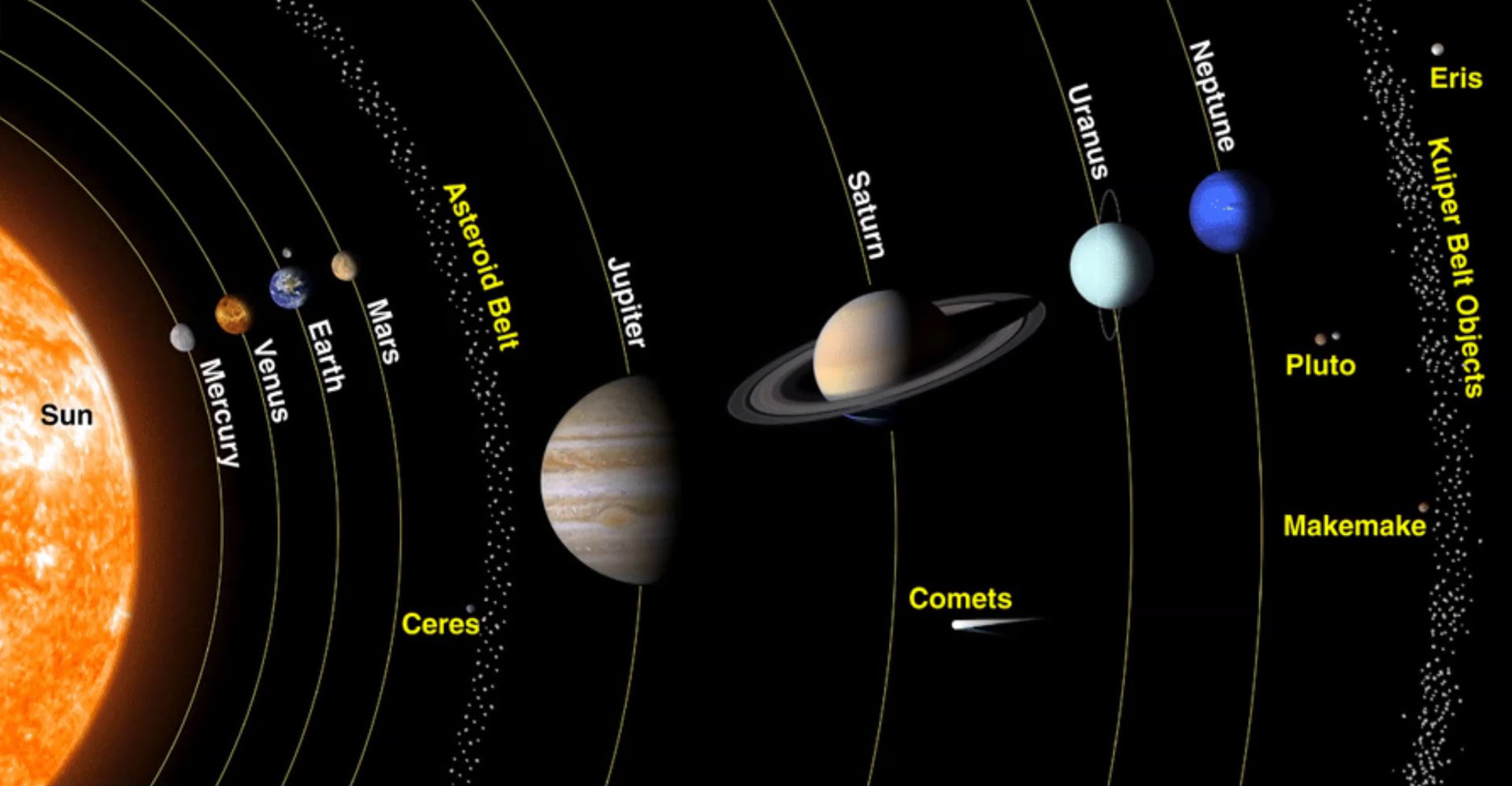
I'm also curious about the asteroid belt and how on earth did it form. It seems that science has no definite answer to that. They have theories, but, they simply don't know.
How did the asteroid belt form?
"I don't think anybody knows. The dynamics by which planets and planetoid bodies like asteroids form and wind up in the positions that they do are obscure.There are theories out there that "explain" how our solar system came to be laid out the way that it is,but with the discovery of other solar systems with very different arrangements of planets and their orbits, I think it is safe to say that we really have no idea how all of it came to be in our solar system.I think I can say that we are *not* typical in the universe, if there even is a "typical".
UCSB Science Line
---
Well, here's my theory. I believe the asteroid belt is not a remnant of a destroyed planet or a planet that failed to form due to the gravity of Jupiter, according to some theory. I believe the asteroid belt could be the debris of a gigantic object about twice the size of Jupiter that passed through our solar system between Mars and Jupiter. It left so much debris that it formed the asteroid belt we see today. It's so massive that it managed to tilt the planets as well as disturbed the spin of Venus that it spun the other way.
However, there is one important thing they fail to see. What about the planetary orbits? If the object can wreck so much havoc in our solar system, tilting the planets and making one spin the other way, I believe it can also disturb the planetary orbits. It may be massive enough to "pull" the planet earth farther away from the sun and towards Jupiter that it will cause a major ice age to occur. We may finally see snow in the Philippines as the earth will become a huge snow ball.
I don't see that this could be a blessing, however, a frozen earth could help heal the planet from global warming as it will override the damage done.
In fact, NASA aims to move planet Earth by increments, slowly but surely away from the sun to induce global freezing. I kid you not, just read this:
"NASA aims to move Earth
Scientists' answer to global warming: nudge the planet farther from Sun
Scientists have found an unusual way to prevent our planet overheating: move it to a cooler spot. All you have to do is hurtle a few comets at Earth, and its orbit will be altered. Our world will then be sent spinning into a safer, colder part of the solar system."
'The technology is not at all far-fetched,' said Dr Greg Laughlin, of the Nasa Ames Research Center in California. 'It involves the same techniques that people now suggest could be used to deflect asteroids or comets heading towards Earth. We don't need raw power to move Earth, we just require delicacy of planning and manoeuvring.'
The plan put forward by Dr Laughlin, and his colleagues Don Korycansky and Fred Adams, involves carefully directing a comet or asteroid so that it sweeps close past our planet and transfers some of its gravitational energy to Earth.
'Earth's orbital speed would increase as a result and we would move to a higher orbit away from the Sun,' Laughlin said."
Nasa aims to move Earth | Environment | The Guardian
----
I don't think NASA will have to do that. We'll just have to detect and spot the massive object from outer space in which they call "planet 9" and watch it nudge earth away from the sun and towards Jupiter. When? We do not know. It's undetectable. It could happen anytime.
Once the earth has moved away from the sun, the sunlight will not be that strong. It will be like the light when the sun is setting. It will be like the sun during winter solstice. The sun will be so small in the sky, providing the earth with little heat and light. The whole earth will be plunged into darkness and the bitterness of winter.
I'm stocking up on winter clothes, survival gears, heaters, fuel and food supplies. lol
People are just too busy with their lives but failing to look up what is going to happen on this planet. I believe this had already happened in the past. It's seasonal. The ancients left something to warn us. There are just so many things we don't know about our reality.
CQ, signing out.
-
Tsikoteer
- Join Date
- Mar 2008
- Posts
- 54,619
June 12th, 2018 07:34 AM #16to loosely quote a famous fictional scifi character, re. the enemy,
"he is intelligent. but his pattern indicates, two-dimensional thinking."
hmmm...
-
Verified Tsikot Member
- Join Date
- Dec 2017
- Posts
- 1,018
June 14th, 2018 03:28 PM #17I was doing some organizing on my hard disk and I found old video footages of my neighborhood. I remembered I was really bored that day so I decided to take some random videos just for the heck of it.
On the first footage, this is the pool where I practiced diving and swimming. However, three people died on this pool. One died while jumping on the diving board and she hit her head on the edge of the pool. Two friends apparently died of drowning as the story goes. A neighbor of mine told me that he saw someone jumping on the diving board one night but he never saw anyone surfaced. He got spooked.
On the second footage, the bench with the round wooden table in the park was the place where the two friends used to study for their exams and play around. It gives an eerie feel sitting on the bench where two people died.
On the third footage, the girl who was walking her dog in the park was the one who hit her head. I knew her for a long time. I can’t believe she’s dead.
On the fourth footage, the house with the silver car parked outside, a woman hanged herself on that tree in the wee hours of the morning. Neighbors who passed by, saw something swinging on the tree until they saw what appeared to be someone hanging. Some rumors said she was murdered and another rumor said she committed suicide. Whatever the story was, the case is still left unsolved. She was living alone in that house. Her kids were abroad and her husband left her.
I just hope there’s a time machine or a pill where you can simply delete this part of your life.
Erase and rewind, it’s screwing with my mind.
-
Verified Tsikot Member
- Join Date
- Dec 2017
- Posts
- 1,018
-
 Tsikot Member Rank 2
- Join Date
- Jan 2007
- Posts
- 3,429
-
Verified Tsikot Member
- Join Date
- Dec 2017
- Posts
- 1,018

 Reply With Quote
 Originally Posted by brushless

