
Sir DJ and Sir Yebo,
Don't stop discussing. I will post many questions for you through a new thread. I hope you will not take things personally between each other and spoil us the oppurtunity to learn from you and what you have to say. I am just a humble graduate of Diesel Mechanics and Automotive Mechanics.
You guys have two varying experiences. Military and Gas/Oil all exposed to harshes conditions and equipped with only the best training, equipment, machines and people. In your field any failure means lives and millions of $ lost.
Regards
Juan Ramon Landas a.k.a 4JG2-TC(4jgtootsie)

The Largest Car Forum in the Philippines
- Forums
- Discussions
- Events
- Community
Results 41 to 57 of 57
-

 Tsikot Member Rank 4

- Join Date
- Jan 2006
- Posts
- 1,682
June 13th, 2007 04:45 PM #41
-
Verified Tsikot Member
- Join Date
- Sep 2006
- Posts
- 51
June 13th, 2007 05:06 PM #42I take my hats off for d_j, yebo, otep and the rest of the guys here. Thank you very much for your sincerity to help. Your inputs really raises the bar of education we all can get from this forum. very well appreciated except those whose inputs made some "patutsada" that left some bad taste. vert enlightening and much appreciated. I'll just keep my options to myself.
-
Verified Tsikot Member
- Join Date
- Sep 2006
- Posts
- 51
June 13th, 2007 05:09 PM #43I take my hats off for d_j, yebo, otep and the rest of the guys here. Thank you very much for your sincerity to help. Your inputs really raises the bar of education we all can get from this forum. very well appreciated except those whose inputs made some "patutsada" that left some bad taste. very enlightening and much appreciated. I'll just keep my options to myself so I can at least help douse off the heat.
-
Tsikot Member Rank 4
- Join Date
- Jan 2006
- Posts
- 1,682
June 13th, 2007 05:13 PM #44Ikaw ang magaling Galynxmo!
Napalabas ang mga nasa palaispan ng mga taong ito! Goodluck bro kung ano man ang maging desisyon mo.
-
Tsikot Member Rank 4
- Join Date
- Jan 2006
- Posts
- 1,682
June 13th, 2007 05:29 PM #45Sir DJ,
Gusto ko sana mag test ng L2 can you give some insights.
Gapang ako sa composite vehicle reference booklet and daming data.
-
Tsikot Member Rank 4
- Join Date
- Jan 2006
- Posts
- 1,682
June 13th, 2007 06:13 PM #46Sir DJ,
Gusto ko sana mag test ng L2 can you give some insights.
Gapang ako sa composite vehicle reference booklet and daming data.
-
Verified Tsikot Member
- Join Date
- Oct 2004
- Posts
- 278
June 14th, 2007 01:20 AM #47 Originally Posted by yebo

To give the other guys a better understanding, eto po yung naka-highlight sa post ni sir yebo.... (Toyota 4A thermostat assembly)..

1. one from the water pump
2. one going back to the engine block (water pump suction line)
3. another going to the radiator OR coming from the radiator (some engines kasi before radiator ang thermostat galing engine block, some naman after ng radiator ang thermostat) .
4. Don't mind this. It is from airconditioning heater (di ko sya kinabit kasi walang ganun yung evaporator ko) - the other end is connected sa engine block, near water temp sensors (blocked).
I hope this somehow helps pa...
***Feel free to bash me of my post if i've got anything wrong....
-
 Verified Tsikot Member
- Join Date
- Nov 2006
- Posts
- 230
June 14th, 2007 01:41 AM #48Good morning sa lahat lahat
dyan ako bilid sa mga master tsikoters.......dami mo matututunan.........
ito lang share ko baka makatulong.........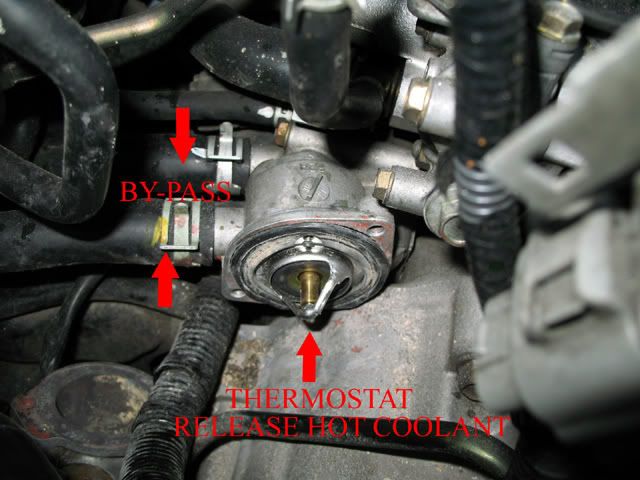
-
Tsikot Member Rank 4
- Join Date
- Jan 2006
- Posts
- 1,682
June 14th, 2007 09:13 AM #49No bashing!
The pictures i think is an example of an open/closed thermostat. The simpler type. Sir Yebo's more complex type involves two thermostat located on the same housing.
I took a picture from a book pero sobrang pangit
It is on a Cummins N14 and Series 60DDC.Last edited by 4JGtootsie; June 14th, 2007 at 09:31 PM.
-
 Verified Tsikot Member
- Join Date
- Nov 2006
- Posts
- 98
June 14th, 2007 12:21 PM #50if you have an advanced diesel experience then you should be golden. all it is (L2) is electronic/fuel/air induction/exhaust diagnostics (diesel) Originally Posted by 4JGtootsie
a good understanding on how to read schematics would be really helpful. try understand how each respective system works and their basic concept rather than memorizing. if you have any specific questions, hit me up at driftoholic1*gmail.com or start a new thread, I'll be more than willing to help out.
-
Tsikot Member Rank 4
- Join Date
- Jan 2006
- Posts
- 1,682
June 14th, 2007 04:32 PM #51Thank You sir DJ,
Celect, DDEC, PEEC concentration ko po.
Question 1) In trucks, what is a Jacobs brake system and how is different from the regular brakes?
-
Verified Tsikot Member
- Join Date
- Oct 2004
- Posts
- 278
June 14th, 2007 08:52 PM #52*4JGtootsie
On the thermostat assembly I've posted, there's only one thermostat valve... Once the valve is fully open (to let water from 3 flowing), the 1 is blocked by the valve...
Thermostat closed:

Thermostat partially open: the smaller valve on the bottom blocks the 1 passage...

Same principle as the two-thermostat valve assembly you have posted, but eto isa lang...
-
Tsikot Member Rank 4
- Join Date
- Jan 2006
- Posts
- 1,682
June 14th, 2007 09:53 PM #53Thank You sir EssB for the clarification.

If you didn't take it out from the housing medyo hindi ko maiintindihan.
Bale po the smaller valve will never close full either partial or fully open. That is why there is no bypass line.
And the bigger valve will only open when coolant inside the engine needs cooler water from the radiator.
Tama po ba?Last edited by 4JGtootsie; June 14th, 2007 at 10:06 PM.
-
Verified Tsikot Member
- Join Date
- Oct 2004
- Posts
- 278
June 14th, 2007 10:19 PM #54*4JGtootsie: The smaller valve will block the 1 when the main the thermostat valve is fully open. Thus, water from radiator going to the suction line of water pump will flow freely.
...pero syempre, lalamig na naman sya pagdaan ng water from radiator, thus, the thermostat valve open or close... probably just on partially open often times.
-
 Tsikoteer
- Join Date
- Oct 2002
- Posts
- 10,819
June 14th, 2007 10:56 PM #55er, nobody is bashing, were just discussing. i only answered d_j's post because it was partly wrong. di ba sabi ko he is correct up to a point. and in fact in his later post i agree with him, an engine without thermostats driven at low loads (answering the thread starter's question if he can drive it around with no adverse effects, at low loads that is) can and may be driven as if the thermostats were there. but i will agree with it only if that condition is maintained, otherwise i would not. sorry guys but if it seemed i was bashing, i was not. it comes with the trade kasi, in my job we either do it right or we do not do it at all. when i overhaul an engine i want it to be able to give 100% power when needed, not 1 percent less. and there are times when we even run engines at 110% for a few hours! an engine without thermostats can not do that, and that is why i did not agree with d_j.
another reason why i answered as i did was that i did not want people reading this thread will come to believe that it's ok to remove the thermostat. i prefer to give tsikot people the whole picture rather than something that is "pwede na". better decisions are made if the information is more complete, agree? i can only do that if i point out d_j's post, nothing remotely personal meant there.
hey d_j, hope i did not ruffle your feathers. sometimes i can be very undiplomatic hehehe!
-
 Tsikot Member Rank 4
- Join Date
- Jan 2006
- Posts
- 2,105
June 15th, 2007 07:25 AM #56my bro and I always disagrees on this. he belives in removing, while I believe thermostat should remain.
for diplomatic reason...
I told him that I will drill two 3mm holes in the thermostat. and he agrees... I found this idea in a number of articles in the web.
-
Verified Tsikot Member
- Join Date
- Nov 2006
- Posts
- 98
June 15th, 2007 11:35 AM #57..seems like this has already been answered, I'll check back regularly on your nwe thread and see what I can do to help out. The method that worked best for me was to read books and then I would consult more experienced techs/engineers on things that I don't quite get/understand. Originally Posted by 4JGtootsie
yebo, I can totally see where you're coming from, I would explain things again but I believe that my other post clarified that already ...no worries

 Reply With Quote
 Originally Posted by yebo
