Re: oil prices. The market tends to overshoot the downside as well as the upside. I think the $30 barrier will be tested again.
Update: it's being tested now.

The Largest Car Forum in the Philippines
- Forums
- Discussions
- Events
- Community
Results 8,801 to 8,820 of 10726
-
 Verified Tsikot Member

- Join Date
- Mar 2014
- Posts
- 355
January 25th, 2016 05:53 PM #8801
-
Verified Tsikot Member
- Join Date
- Mar 2014
- Posts
- 355
January 26th, 2016 12:12 PM #8802Brent is just resting there. At $30. Not moving... for several hours...

-
 Tsikoteer
- Join Date
- Oct 2012
- Posts
- 27,624
-
Verified Tsikot Member
- Join Date
- Mar 2014
- Posts
- 355
-
 Social Dementia
- Join Date
- Sep 2003
- Posts
- 25,189
January 26th, 2016 01:10 PM #8805Oil is drifting in and out of 30...currently 29.84...
And world stocks markets resume the march south...
Last edited by Monseratto; January 26th, 2016 at 01:12 PM.
-
Verified Tsikot Member
- Join Date
- Mar 2014
- Posts
- 355
January 26th, 2016 02:28 PM #8806Me and Dad over lunch:
Dad: Low oil price is supposed to be good for the world economy. Why are stocks falling?
Me: I told you before low oil prices caused investors to dump energy-related bonds because of default risk. Defaults by energy companies could have a wide impact that's why investors are derisking.
Dad: What else?
Me: Well, there's the thinking that very low oil price is an indication of collapsing demand which could mean a global recession is coming.
Dad: That makes sense. What else? There's more. I can see it in your face.
Me: Haha in my face? There's the strong dollar. Oil moves in the opposite direction.
Dad: What else?
Me: You're not yet satified?
Dad: No.
Me: How about this - low oil prices squeezing the budgets of oil producing countries like Saudi Arabia and Norway forcing them to sell investments from their sovereign wealth funds.
Dad: Makes sense too. What else?
Me: There's a view that asset prices around the world are being reset lower. Asset prices were boosted by Fed QE but since there's no more support from the Fed asset prices should be lower.
Dad: Hmmm. That explains Philippine stocks.
Me: Yeah, QE forced foreign investors to chase higher returns in emerging markets like the Philippines. Now they're leaving.
Dad: That's also why the peso is weak?
Me: Yes, because they have to convert their earnings to dollars so there's high demand for dollars.
-
Verified Tsikot Member
- Join Date
- Mar 2014
- Posts
- 355
January 27th, 2016 11:02 AM #8807Oil prices are bottoming. Whenever oil falls below $30 buyers bid it back up. Everybody knows 20 dollar oil will cause so much supply destruction that supply and demand will be brought to balance so why bother going there? Besides, by the time oil reaches $20 the economic pain will be so great that oil producers (both OPEC and non-OPEC) will be forced to do something.
-
Verified Tsikot Member
- Join Date
- Mar 2014
- Posts
- 355
January 28th, 2016 12:22 PM #8808So are we going to see 20 dollar oil? It's becoming less likely. Oil prices are holding up pretty well despite the latest inventory report. Oil prices are becoming immune to oversupply news. This isn't about fundamentals. It's more about sentiment. The panic has subsided. Hedge funds are reducing short positions.

-
Verified Tsikot Member
- Join Date
- Mar 2014
- Posts
- 355
January 29th, 2016 11:24 AM #8809It didn't even have to take 20 dollar oil to make Russia and OPEC start talking about cutting production. But it's a long shot. They haven't even agreed on a meeting yet. It's unlikely Russia and every OPEC member will agree to cutting production. OPEC members themselves don't even follow quotas. But who cares about reality? Oil bulls want a rally so bad they'll use any excuse to rally. Oil bears were forced to cover their shorts sending Brent to $35.
-
Social Dementia
- Join Date
- Sep 2003
- Posts
- 25,189
January 29th, 2016 10:34 PM #8810Now banks have to pay a fee to deposit in the central bank in Japan... Market boom.
The Bank of Japan on Friday introduced a negative interest rate policy, a move aimed at boosting a stumbling economic recovery and warding off deflation. Markets jumped on the intervention.
Tokyo's central bank hopes that by imposing a 0.1% fee on selected current account deposits — effectively a negative interest rate — commercial banks will be encouraged to make more loans and so stimulate economic growth. Japan's economy is forecast to grow just 1.1% in 2015 and 1.7% in 2016.
Japan's benchmark Nikkei 225 stock index immediately leaped higher on the news. It ended the trading session up 2.8% at 17,518.30. China's Shanghai composite advanced 3.1% to 2,737.60. The Japanese yen initially slid after the announcement before recovering to rise 1.7% against the dollar to 120.79.
The Bank of Japan said in a statement that it would cut rates further into negative territory if it needed to push borrowing costs even lower. It said the policy would continue as long as needed to achieve an inflation target of 2%.
Japan has experienced widespread deflation, or falling prices, for decades. By lowering borrowing costs, the central bank is hoping that consumers will spend more and stimulate inflation, or rising prices. Members of the Bank of Japan's monetary policy board voted by 5-4 to adopt the lower rates.
"A week ago Bank of Japan Governor (Haruhiko) Kuroda suggested (at the World Economic Forum) in Davos that further easing was on the cards, (but) a move to negative rates was not expected," said Simon Smith, chief economist at FxPro Insights, an online trading broker, in emailed comments.
Regional European indexes saw broad-based gains Friday. Britain's FTSE 100 index added 1.1%. Wall Street was on track to open higher by a similar amount. Later Friday the U.S. government will unveil its first estimate for fourth-quarter economic growth. Forecasters expect a modest figure of 0.8%.Last edited by Monseratto; January 29th, 2016 at 10:42 PM.
-
Verified Tsikot Member
- Join Date
- Mar 2014
- Posts
- 355
January 30th, 2016 10:32 AM #8811Japan joins the negative interest rate club (ECB, Switzerland, Denmark and Sweden). The surprise move sent the yen falling and equities rallying. The scary thing is that negative interest rates have become a central bank monetary policy tool instead of remaining a theoretical exercise.
-
Verified Tsikot Member
- Join Date
- Mar 2014
- Posts
- 355
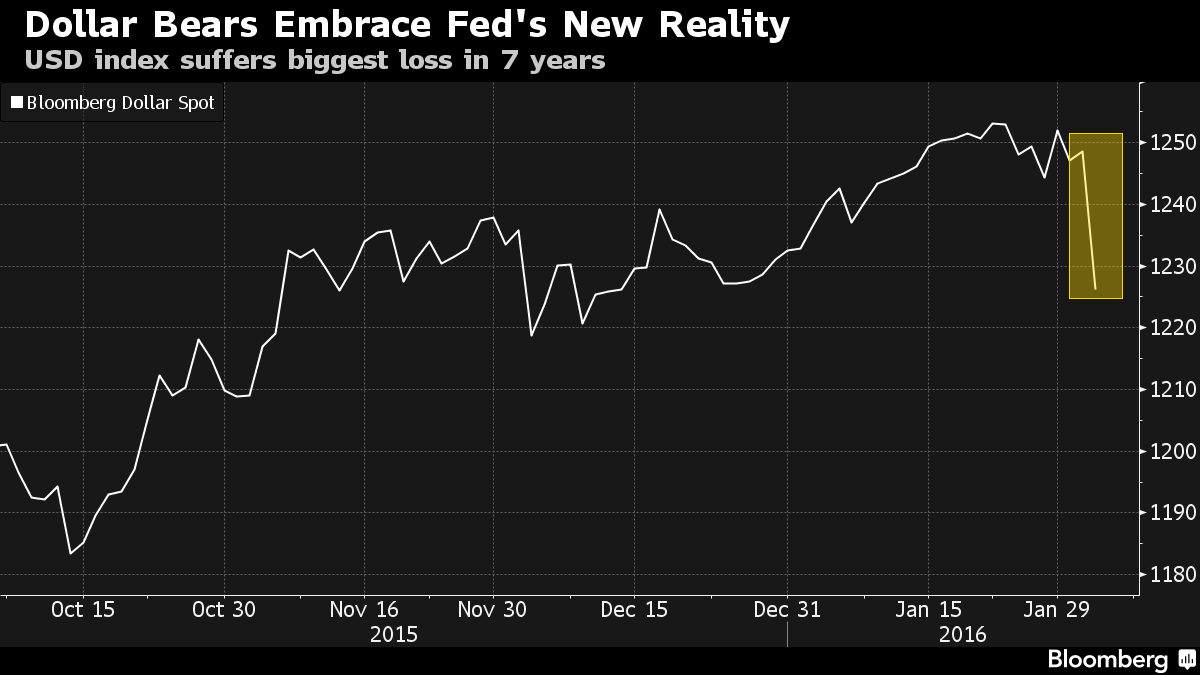
February 3rd, 2016 11:20 AM #8812I only have to look at one chart to find out what the mood of the market is.

And it looks like the market is in a bad mood.
-
Verified Tsikot Member
- Join Date
- Mar 2014
- Posts
- 355
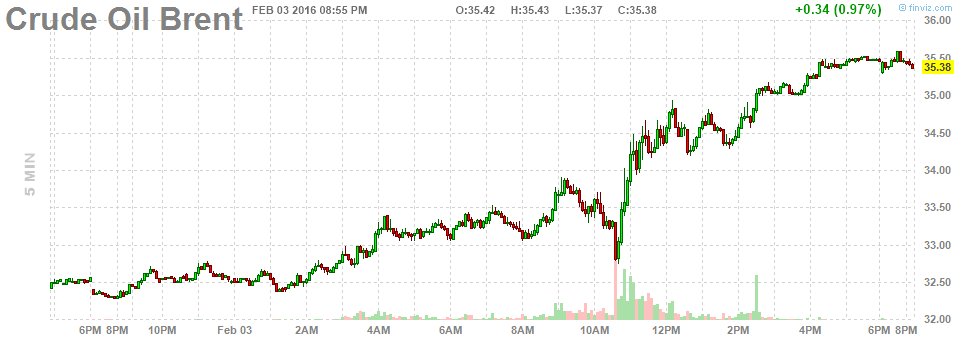
February 4th, 2016 11:21 AM #8813U.S. crude, gasoline inventories swell to record highs: EIA | Reuters
You'd think oil prices would plummet after that report came out but we got a rally instead. Oil prices are definitely bottoming.U.S. crude oil and gasoline inventories jumped more than expected last week to record highs, data from the Energy Information Administration showed on Wednesday.
Crude inventories rose 7.8 million barrels in the week to Jan. 29 to 502.7 million barrels, compared with analysts' expectations for an increase of 4.8 million barrels, as imports jumped and refiners trimmed throughput.

-
Social Dementia
- Join Date
- Sep 2003
- Posts
- 25,189
-
Verified Tsikot Member
- Join Date
- Mar 2014
- Posts
- 355
February 4th, 2016 04:05 PM #8815Last night the U.S. dollar fell big against all major currencies because Fed rate hike expectations are pushed further into the future (Goldman Sachs now sees a June rate hike instead of March). The selloff was largely technical as the magnitude of the decline triggered stops resulting in a selling cascade.
-
Social Dementia
- Join Date
- Sep 2003
- Posts
- 25,189
February 5th, 2016 12:27 PM #8816GoPro is in a massive tailspin - Feb. 4, 2016
GoPro is in a massive tailspin
by David Goldman *DavidGoldmanCNN
February 4, 2016: 9:31 AM ET
Layoffs, new cameras and a strategy shift. Nothing seems to be working for GoPro, which has plummeted to yet another all-time low.
After posting a huge loss last quarter, the company fired its chief financial officer and slashed its product lineup to just three different cameras.
Investors don't seem to care. They sent the stock down 12% in premarket trading. Shares have now fallen 89% from their high in September 2014, just a few months after the company's IPO.
GoPro (GPRO, Tech30) said Wednesday that it had lost $34.5 million last quarter, after sales slowed dramatically towards the end of the year. The company had to take a writedown on $57 million worth of excess GoPros that stores had ordered, and unwanted GoPros sitting on store shelves.
There weren't many GoPro stocking stuffers over the holidays, either. Sales fell by 31% over the past year.
CEO Nicholas Woodman said he knows how to solve the company's woes.
On a conference call with investors, Woodman acknowledged concerns that GoPro can't expand beyond its niche market of people who want action cameras. He said that he's not concerned about GoPro being a niche -- instead, he says the company is focused on helping make GoPros easier to use for existing customers.
"We recognize the need to develop software solutions that make it easier for our customers to offload, access and edit their GoPro content," he said.
He also said GoPro would only sell just three cameras in the future: Hero 4 Black, Hero 4 Silver, and Hero 4 Session. It's killing off its cheapest, $130, camera called the Hero. It will also stop making the Hero+ LCD and the Hero+.
But the company isn't totally giving up on expansion. GoPro will continue with its plans to launch the Hero 5 this year as well as its new Karma drone. It also is working on virtual reality products.
"In 2016 we are committed to delivering a breakthrough -- the breakthrough experience we've all be waiting for," Woodman promised. "It's against this commitment that you can judge our performance this year."
After laying off 7% of the staff last year, the next shoe to drop turned out to be GoPro CFO, Jack Lazar. The company named Brian McGee its new CFO, effective March 11. McGee joined GoPro from Qualcomm last year.
CNNMoney (New York)
First published February 4, 2016: 9:31 AM ETLast edited by Monseratto; February 5th, 2016 at 01:05 PM.
-
Verified Tsikot Member
- Join Date
- Oct 2015
- Posts
- 922
February 5th, 2016 12:53 PM #8817^ subrang tibay daw ng go pro. Kaya hindi pa nasisira. Kaya wala pang bumibili ng bago.. wala tuloy sales ang go pro.. aside pa doon sa nag lalabasang murang action cam na almost 3x lower the price of gopro..
-
Verified Tsikot Member
- Join Date
- Oct 2015
- Posts
- 922
February 5th, 2016 01:15 PM #8818Grabing pag aaral sa market gingawa ng mga tao sa forum na ito.. pero good point.. nag aaral din ako ng stock market ngayon.
-
Verified Tsikot Member
- Join Date
- Mar 2014
- Posts
- 355
February 5th, 2016 05:10 PM #8819Speculators sold U.S. dollars aggressively on the view that recent market developments have dialed back the Fed's rate hike plans. The only hope for the dollar now is the jobs report tonight. If the report surprises to the upside we could see the dollar recover some losses.
-
Verified Tsikot Member
- Join Date
- Mar 2014
- Posts
- 355
February 5th, 2016 09:37 PM #8820Friday evening thoughts:
Germany should be concerned about Deutsche Bank. Loss-ridden DB is the least capitalized megabank in the world. Judging by the performance of its share price, preferred stock, contingent convertible bonds (CoCos), and credit default swap spread, the market is telling the bank it needs to raise more capital. It's only a matter of time DB suspends payment on the CoCos.

 Reply With Quote