
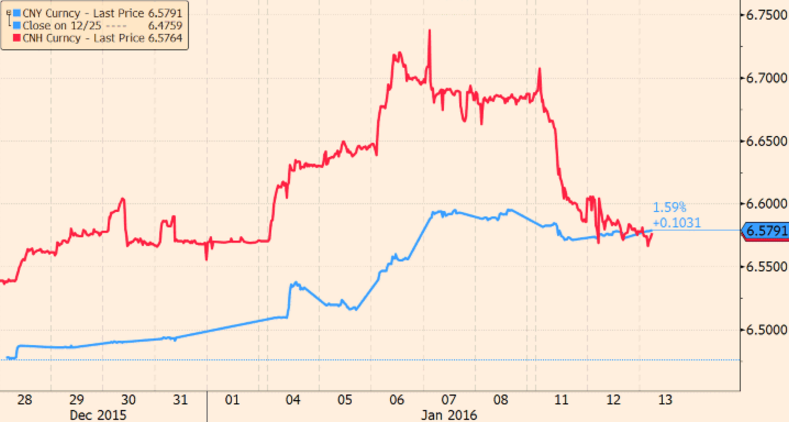
China stabilizes the exchange rate. That's all it took to bring back risk appetite.
And this is pretty much what China wanted to communicate when they intervened in the offshore RMB market.


The Largest Car Forum in the Philippines
- Forums
- Discussions
- Events
- Community
Results 8,781 to 8,800 of 10726
-
 Verified Tsikot Member

- Join Date
- Mar 2014
- Posts
- 355
January 13th, 2016 03:17 PM #8781
-
Tsikoteer
- Join Date
- Mar 2013
- Posts
- 6,160
-
Verified Tsikot Member
- Join Date
- Mar 2014
- Posts
- 355
January 14th, 2016 11:44 AM #8783Brent (the international benchmark) is now lower than WTI (the U.S. benchmark). Everyone's focused on Saudi Arabia and Iran but there's another OPEC member everyone should be watching: Libya. Libya's production is currently on hold due to political instability and violence. After the removal of Gaddafi rival groups have been competing for power. But there's hope that a unity government will be formed and Libyan oil will flow again this year. That scenario has added another layer of uncertainty to the oil market.
As oil prices fall so do bonds issued by energy companies. The bond market is pricing in a high default rate.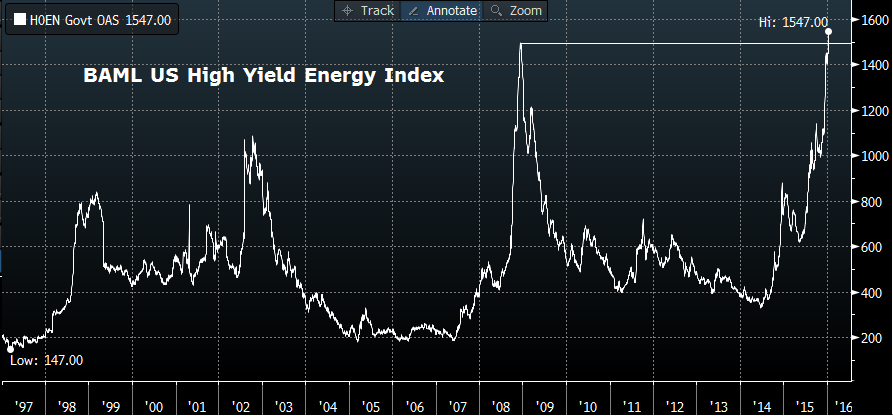
-
 Social Dementia
- Join Date
- Sep 2003
- Posts
- 25,189
January 16th, 2016 09:51 AM #8784Oil plunges below $29 on prospects of more Iran crude, China worries - Yahoo Finance
NEW YORK (Reuters) - Oil prices crashed 6 percent on Friday to close below $30 a barrel for the first time in 12 years, resuming this year's breathtaking rout as Chinese stock markets fell further and traders braced for an imminent rise in Iran's exports.
After closing higher for the first time in eight sessions on Thursday, U.S. and Brent crude futures plumbed new lows, taking this year's losses to more than 20 percent, the worst two-week decline since the 2008 financial crisis.
The slump was not over yet, some analysts warned, as the lifting of sanctions on Iran opens the door to a wave of new oil. The International Atomic Energy Agency (IAEA) is expected on Saturday to issue its report on Iran's compliance with an agreement to curb its nuclear program, potentially triggering the lifting of Western sanctions.
Shares in China, the world's No. 2 oil consumer, tumbled on Friday, with the Shanghai index ending down 3.5 percent to its lowest close since December 2014 and the yuan weakening sharply offshore. Adding to fuel demand concerns, U.S. data showed retail sales fell and industrial production weakened in December.
Brent (LCOc1) settled down $1.94, or 6.3 percent, at $28.94 a barrel, sticking below the pivotal $30 a barrel mark after briefly dipping below that level in the previous two days. It fell as far as $28.82, the lowest since February 2004.
U.S. crude (CLc1) ended $1.78, or 5.7 percent, lower at $29.42, after hitting a contract low of $29.13, its lowest since November 2003, earlier in the session.
The oil market is oversold after two weeks of almost unrelenting selling, some traders said. The relative strength index (RSI) fell this week to below 30, a technical level often regarded as signaling a market that has fallen too far.
-
Social Dementia
- Join Date
- Sep 2003
- Posts
- 25,189
January 16th, 2016 10:42 AM #8785
-
Verified Tsikot Member
- Join Date
- Mar 2014
- Posts
- 355
January 16th, 2016 10:42 AM #8786BAML HY energy index above 08/09 peak.

The concern is not only with bondholders but also banks.
Banks Brace for Bigger Losses After Oil Drops Below $30 - Bloomberg Business
Broken support usually becomes resistance. Brent used to bounce off $30 but it broke through and now $30 has become resistance.The Wall Street banks that financed the U.S. shale boom are facing growing losses as oil falls below $30 a barrel.
Losses are spreading from bondholders to banks amid the worst oil crash in a generation. Wells Fargo & Co., Citigroup Inc.and JPMorgan Chase & Co. have set aside more than $2 billion combined to cover souring energy loans and will add to that safety net if prices remain low, the companies reported this week. Losses are mounting as more oil and natural gas producers default on debt payments and declare bankruptcy. Wells Fargo lost $118 million on its energy portfolio in the fourth quarter and Citigroup lost $75 million.
-
Verified Tsikot Member
- Join Date
- Mar 2014
- Posts
- 355
January 17th, 2016 03:19 PM #8787Sunday thoughts:
Emerging market dollar denominated debt:
1. Years of loose monetary policy by the Fed drove down borrowing cost and the value of the dollar.
2. Low borrowing cost and the weak dollar encouraged companies to borrow
3. But low borrowing cost meant lower returns for investors.
4. Investors were forced to look for higher returns elsewhere.
5. Demand for higher returns meant lots of investors for emerging market bonds.
6. Emerging market companies took advantage of the opportunity and borrowed trillions of dollars.
7. Emerging market companies were betting interest rates and the dollar will stay low.
8. Investors were betting they would be paid back.
9. The Fed started to tighten monetary policy and the dollar strengthened.
10. Investors dump emerging market bonds on default fear.
11. We are here.
Shale oil companies debt:
1. Years of loose monetary policy by the Fed drove down borrowing cost and the value of the dollar.
2. Low borrowing cost and the weak dollar encouraged companies to borrow
3. But low borrowing cost meant lower returns for investors.
4. Investors were forced to look for higher returns elsewhere.
5. Demand for higher returns meant lots of investors for energy HY bonds.
6. Shale oil companies took advantage of the opportunity and borrowed billions of dollars.
7. Since commodities prices are inversely correlated to the dollar, oil prices rose as the dollar fell.
9. Shale companies were betting oil prices will stay high, interest rates and the dollar will stay low.
9. Investors were betting they would be paid back.
10. The Fed started to tighten monetary policy, the dollar strengthened and oil prices fell.
11. Investors dump energy HY bonds on default fear.
12. We are here.
The Fed giveth, the Fed taketh away.
-
BANNED BANNED BANNED
- Join Date
- Sep 2014
- Posts
- 8,492
January 17th, 2016 03:37 PM #8788 Originally Posted by Lady Bathory

Here's something that investors fail to see when they dump and run on emerging markets.
Emerging markets have energy. Energy is prime mover of the economy not movement of money.
The reason why Europe is experiencing their problems now is because they have become too lazy, they don't even want to breed because they don't want responsibility, they just want to stay happy and abundant like Japan. And look at where Japan ended. And that's why the refugees are being let in to restart the economy. New hoards of people who would work for small wages to get by. The rape part is just needed to tell women their place in society, to make babies, not show off in miniskirts and skimpy outfits and then through that dominate European men coz they're somehow protected by internal activists.
So he next time investors say will dump and collect their money from emerging country like Philippines, someone is bound to take their place, another investor who totally understands it.
So I don't think there will be a doomsday bubble, but nevertheless there will be a bubble on specific sectors like for example the car market, it will correct itself, but not big enough to bring down the Philippine economy
-
Social Dementia
- Join Date
- Sep 2003
- Posts
- 25,189
January 17th, 2016 06:11 PM #8789The Ayatollahs in Iran to dump more oil in the market... Oil tankers at the ready with their load.
Oil industry braced for re-entry of Iran - FT.com
Although some market observers say Iran’s return is already priced in, others warn of another bearish headwind for oil prices.
Shipbrokers say there are around 24 of the biggest oil tankers — with names such as Serena, Amber, Destiny and smaller vessels such as Argo — waiting off the coast of Iran ready to resume business with the world. They hold as much as 50m barrels of oil.
“Key to watch short-term is how quickly Iran unloads the oil — in fact, mainly condensate — in storage,” said Robin Mills, head of consulting at Manaar Energy.
Tehran has said it is keen to sell more oil to its traditional customers, from Asian buyers such as those in India that it continued to trade with under sanctions, to former partners in Europe.
“The immediate impact is on Russia and Saudi Arabia for sales in Europe,” said Fereidun Fesharaki chairman at Facts Global Energy, a consultancy, alluding to the rival producer countries that have muscled in.Last edited by Monseratto; January 17th, 2016 at 06:14 PM.
-
Verified Tsikot Member
- Join Date
- Mar 2014
- Posts
- 355
January 18th, 2016 03:10 PM #8790Right now market sentiment is extremely bearish. Well, it’s easy to be bearish after reading articles telling us that it's 2008 all over again and that we should sell everything. I did sell everything at the end of July last year to lock in profits but right at this moment i don't feel bearish after seeing the selloff last week... specially after seeing the selloff last week. Majority of U.S. stocks are already below their 200 day moving average. The contrarian in me says buy. Am i calling a bottom? A temporary one maybe.
-
Verified Tsikot Member
- Join Date
- Mar 2014
- Posts
- 355
January 19th, 2016 01:05 PM #8791China GDP Slows to Weakest Since 2009 on Manufacturing Slide - Bloomberg Business
Though China's official numbers are questionable there's no question China's economy is slowing. China was growing at 10 to 12 percent years ago and the world's commodities suppliers invested heavily in production capacity to meet China's demand. With China slowing there's now overcapacity. Global production capacity built for 12% growth is now producing too much for 7% growth. The result is this:China’s economy slowed in December, capping the weakest quarter of growth since the 2009 global recession, as the Communist leadership struggles to manage a transition to consumer-led expansion.
Industrial production, retail sales and fixed-asset investment all slowed at the end of the year, while gross domestic product rose 6.8 percent in the fourth quarter from the same period of 2014. GDP increased 6.9 percent -- the least since 1990 -- for the full year, in line with the government’s target of about 7 percent.
-
Verified Tsikot Member
- Join Date
- Mar 2014
- Posts
- 355
January 19th, 2016 09:27 PM #8792Posting this before U.S. market open. Risk appetite is in the air. Funding currencies (EUR, JPY) are weak across the board, Brent is rallying. I have to say this about Brent -- the lifting of sanctions shouldn't have driven Brent lower because everybody knew sanctions would be lifted. Falling oil prices in recent weeks meant the market has already been discounting the lifting of sanctions.
I believe the relentless selling in the first two weeks of the year is overdone. The pendulum swung too far.
-
Verified Tsikot Member
- Join Date
- Mar 2014
- Posts
- 355
January 20th, 2016 10:32 PM #8793Risk aversion returns. The yen is strongest across the board. The U.S. 10Y is yielding below 2%. U.S. equities are set for a crappy open. Apparently the pendulum has farther to swing.
-
Social Dementia
- Join Date
- Sep 2003
- Posts
- 25,189
January 21st, 2016 08:43 AM #8794Any gains in the past 2 years wiped out...

Wall Street tumbles to 2014 low as oil prices sink - Yahoo Finance
-
Verified Tsikot Member
- Join Date
- Mar 2014
- Posts
- 355
January 21st, 2016 10:35 AM #8795Last night there was an impressive intraday bounce that erased half of the Dow's 500+ point loss. I think it signals a short term bottom.
-
Verified Tsikot Member
- Join Date
- Mar 2014
- Posts
- 355
January 21st, 2016 06:34 PM #8796Friend: Will you please stop calling a bottom?!
Me: Hahaha... no. It's near. I can feel it.
Friend: You've been calling a bottom since last week and stocks still keep falling!
Me:
-
Verified Tsikot Member
- Join Date
- Mar 2014
- Posts
- 355
January 22nd, 2016 11:23 AM #8797
That's JPY futures. The yen is my ever-reliable indicator of where U.S. equities are going. The level i'm watching is 86. If the yen pulls back from 86 equities will rally but if the yen breaks above 86 there will be more downside pressure on equities.
-
Verified Tsikot Member
- Join Date
- Mar 2014
- Posts
- 355
January 22nd, 2016 05:14 PM #8798In less than 24 hours, oil prices rallied from $27 to $30. Nothing has changed fundamentally. U.S. crude oil inventories even increased by 4 million barrels according to the EIA which should have sent oil prices lower. I believe the recent drop in oil prices (from thirties to twenties) has been driven purely by emotion. I think maximum pessimism has been reached. Originally Posted by Lady Bathory
-
Verified Tsikot Member
- Join Date
- Mar 2014
- Posts
- 355
January 23rd, 2016 11:31 AM #8799Many people believe the recent drop in oil prices was due to the lifting of sanctions on Iran. Now people are wondering why oil prices rallied $5 in two days. Nothing has changed fundamentally. Iran will still exports its oil. The supply glut is still there. The issue about Iranian oil returning to market has been around for months so it's highly unlikely it hasn't been priced in yet. The market is always advanced. The supply glut isn't 2016 news. The supply glut has already been priced in last year. The selloff since the start of 2016 wasn't based on fundamentals. It's pure emotion. The mainstream media has conditioned people into thinking that oil is entirely a supply and demand story. Everyone forgot that crude oil is a risk asset like equities. Risk assets are sold when the market is fearful and bought when the market is greedy regardless of fundamentals. The market has reached maximum fear and fear now turns to greed. That's the way the pendulum swings.
-
 Tsikoteer
- Join Date
- Nov 2008
- Posts
- 879
January 23rd, 2016 11:59 AM #8800And someone once said that for lack of a better term, "greed is good". :-D

 Reply With Quote
 Originally Posted by Lady Bathory
