
Originally Posted by tidus1203

The logic is faultless. But this argument is best suited in a classroom and not the real world. It's basically letting the chips fall where they may. Too many innocent casualties (innocent being the "widows & orphans" who are nowhere near greedy but invested their money in mutual funds).
Like i said, unless you actually pay amortization on your own home (or something significant), i could actually say that you have no idea what you're wishing for.
Guys, gotta rush to a mtg. See you guys here tonight or tom.

The Largest Car Forum in the Philippines
- Forums
- Discussions
- Events
- Community
Results 781 to 800 of 10726
-

 Verified Tsikot Member

- Join Date
- May 2006
- Posts
- 155
December 4th, 2008 03:00 PM #781
-
 Wheelin and Dealin'
- Join Date
- Feb 2008
- Posts
- 14,181
December 4th, 2008 03:17 PM #782*emanzano
Dami mong sinabi teka isa isanhin natin.
Regarding house prices falling and interest rates: I am not only talking about the Fed here but the whole government interfering in the markets. In fact, its so obvious naman that they are trying to inflate the house prices back up again against the wishes of the markets for it to go down. Falling prices is very good, now its starting to match economic realities but the government wants to prop it up.
Regarding the period of interest rate increases between 2004-2006: Yes alam ko they were increasing rates 25 bps at a time. I know because naabutan ko sya and I was already trading back then. But the thing is they kept it at 1% far too long and didn't increase it fast enough. I was never discounting the banks and consumers greed in the mess but I have said before and I will say it again the Fed created the environment necessary for the bubble to occur and my fear is we are having deja vu again right now from 2003.
Regarding monetary policy having an effect: Yun na nga this is all part of the interference in the markets. Now people feel good again and are refinancing again when in reality they probably could not have afforded that house when they sign the dotted line back during the hey days. I have nothing against refinancing as long as you have the financial capability to back it up but I again this could be deja vu and entice people who can't afford it to do something nasty again. Yes they have an effect NOW. But in the long term it will just cause even bigger problems if my fear is right so in general I should rephrase my statement by saying that monetary stimulus would make it even WORSE rather than have no effect
Regarding the SM bonds: Good for them. As I say the free markets is functioning, it will reward good companies and punish bad companies. There could be turbulence but if you are really strong you will survive this.Last edited by tidus1203; December 4th, 2008 at 03:19 PM.
-
Wheelin and Dealin'
- Join Date
- Feb 2008
- Posts
- 14,181
December 4th, 2008 03:29 PM #783Maybe you are right! But then again I never fancied buying things that I couldn't afford or go into debt just to be able to afford it. So again I am a fiscal conservative not just in thoughts but in deeds as well! Originally Posted by emanzano
By the way sir, I want to thank you for the lively debate. May iba kasi sasabihin na lang sayo na walang kwenta opinyon mo porke bata ka or walang kang credentials so I respect you sir for debating fair
-
 Tsikot Member Rank 4
- Join Date
- Nov 2005
- Posts
- 45,927
December 4th, 2008 03:37 PM #784ya ok si Sir emanzano...
he's cool.
--
add to my last post...
AIG was also at fault...
insuring toxic stuff
their risk management people were sleeping on the job
or if they were relying on computer risk models...
na-black swan sila
--
ECB rate cut comingLast edited by uls; December 4th, 2008 at 03:41 PM.
-
Wheelin and Dealin'
- Join Date
- Feb 2008
- Posts
- 14,181
December 4th, 2008 04:02 PM #785Yep thats why takot ako pumasok sa FX markets right now. Masyado talagang volatile when you have interest rate decisions, prices just dance everywhere and you will be cut out before you know it.
ECB is expected to cut by a whooping 75 basis points. The Bank of England is expected to cut by 150 basis points . Everyone is debasing their currency and is racing to reach the finish line Only the JPY is a safe haven.
-
Tsikot Member Rank 4
- Join Date
- Nov 2005
- Posts
- 45,927
December 4th, 2008 05:23 PM #786hey check this out:
Merriam-Webster's word of the year: BAILOUT
http://www.merriam-webster.com/info/08words.htm
hahahaMerriam-Webster's Word of the Year 2008
With politics and the economy foremost on the minds of many, it is no wonder that bailout—a word ubiquitously featured in discussions of the presidency and fiscal policy—took home honors as Merriam-Webster's Word of the Year for 2008.
Bailout, defined in Merriam-Webster's Collegiate® Dictionary, Eleventh Edition as "a rescue from financial distress," received the highest intensity of lookups on Merriam-Webster Online over the shortest period of time. As evident from the 2008 Word of the Year contenders list below, the presidential campaign and financial issues factored heavily in the concerns of our online visitors throughout the year.
-
 Social Dementia
- Join Date
- Sep 2003
- Posts
- 25,189
December 4th, 2008 06:34 PM #787China already getting anxious with US "investments"... another of Peter Schiff's prediction?
http://news.yahoo.com/s/afp/20081204...g_081204022500China urges Washington to protect its investments
BEIJING (AFP) – China's top envoy to high-level economic talks with the United States urged Washington Thursday to make sure Chinese investments in the US economy were safe.
"We hope the US side will adopt every necessary measure to stabilise its economy and financial markets and ensure the safety of China's assets and investment in the United States," Vice Premier Wang Qishan said.
He made the remark in prepared comments at the start of two days of Sino-US economy talks in Beijing that he is co-chairing with US Treasury chief Henry Paulson.
At the end of September, China officially became the largest holder of US government bonds, owning 585 billion dollars' worth of Treasuries and overtaking Japan as Washington's top creditor.
China is spending a large part of its bulging trade surplus on buying US government debt, but criticism is emerging in Chinese academic and policy circles that this type of investment is not as safe as it used to be.Last edited by Monseratto; December 4th, 2008 at 07:13 PM.
-
Wheelin and Dealin'
- Join Date
- Feb 2008
- Posts
- 14,181
December 4th, 2008 06:59 PM #788The prediction being that the Chinese will in the end will get burned and they will stop investing in US assets and thus make the dollar go down.
-
Social Dementia
- Join Date
- Sep 2003
- Posts
- 25,189
December 4th, 2008 07:28 PM #789Jobs data bukas ng gabi...
In an ominous sign for the holiday shopping season, the private sector lost 250,000 jobs last month, the largest decline in six years, according to the ADP National Employment Report.
Separately, labor consultancy Challenger, Gray & Christmas said layoffs announced by employers in November rose to 181,671 as job cuts for the year officially surpassed one million for the first time since 2005.
The grim job figures highlighted weakening economic activity across the United States over the past several weeks.
Most economic sectors faced pressure, the Federal Reserve said in its Beige Book report Wednesday to be used by Fed policymakers for their December 15-16 meeting on interest rates,
The unemployment data also came ahead of the Labor Department's release of its weekly jobless claims report on Thursday and overall employment data Friday, which according to analysts could show 325,000 jobs lost in November and the jobless rate rising to 6.8 percent from 6.5 percent in October.Last edited by Monseratto; December 4th, 2008 at 07:31 PM.
-
Wheelin and Dealin'
- Join Date
- Feb 2008
- Posts
- 14,181
December 4th, 2008 08:51 PM #790Heavyweight yang non-farm payrolls, definitely a market mover. Some people expect as much as 400,000 job losses for the month of November alone. Consensus is around 360,000 job losses. And we have only December left and if December also paints negative then that means for the whole calendar 2008 the US economy slashed jobs.
Unemployment is expected to climb to 6.8%
-
Wheelin and Dealin'
- Join Date
- Feb 2008
- Posts
- 14,181
December 4th, 2008 09:21 PM #791The Bank of England has cut the interest rates by 100BPS taking the interest rate of Sterling to 2%. That is a 57 year low for interest rates in the UK. The European Central Bank will follow soon...
-
Tsikot Member Rank 4
- Join Date
- Nov 2005
- Posts
- 45,927
December 4th, 2008 10:12 PM #792Kahit hindi i-predict ni Peter Schiff yan... Originally Posted by Monseratto
it's obvious naman kung baket kinakabahan ang China sa US treasury holdings nya
Savings nila yan... tapos pinautang nila sa US
nakikita nila baon na sa utang ang US, at lalo pa nagpapabaon sa utang
the credit worthiness of the US will come into question
the value of US debt paper will come into question
the USD will weaken
the US is a declining economic power
If i was China, i would be anxious too
di naman pwede basta basta i-dump ng China ang mga holdings niya
that would cause the value of treasuries to drop
China would be shooting itself in the foot
in a way, China is stuck
China is held hostage by the US
Kaya all it can do is hope the US doesnt screw up
--
China will be nursing its economy now
China won't be adding to its US treasury holdings
it has to spend a lot of money on stimulusLast edited by uls; December 4th, 2008 at 10:53 PM.
-
Tsikot Member Rank 4
- Join Date
- Nov 2005
- Posts
- 45,927
-
Wheelin and Dealin'
- Join Date
- Feb 2008
- Posts
- 14,181
December 4th, 2008 11:05 PM #794ECB takes down interest rates by a record 75 BSP. That is the highest rate cut in ECB history (they have only been here since 1999
). Thus the cash rate in the Eurozone (the economic block which uses the Euro as their currency) is now at 2.5%.
-
Wheelin and Dealin'
- Join Date
- Feb 2008
- Posts
- 14,181
December 4th, 2008 11:06 PM #795Yeah Sweeden cutted by 175 BSP. But then the SEK is not really a major currency so no one is paying too much attention! Originally Posted by uls
-
Wheelin and Dealin'
- Join Date
- Feb 2008
- Posts
- 14,181
December 4th, 2008 11:33 PM #796(CNN) -- Armored cars patrolled the streets of Zimbabwe's capital and residents flocked to banks Thursday after limits on cash withdrawals were lifted in the inflation-ravaged African nation.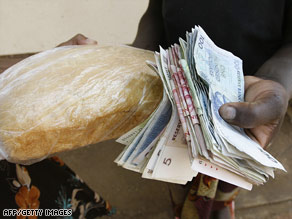 With prices rising even more than once a day, shopping is a mathematical proficiency test for Zimbabweans.

The Reserve Bank of Zimbabwe had capped maximum daily withdrawals at 500,000 Zimbabwean dollars -- about 25 U.S. cents, and about a quarter of the price of a loaf of bread. But faced with mounting chaos in a country already in economic free fall, the bank decided last week to raise that limit to 100 million dollars ($50 U.S.) per week.
Soldiers were deployed to all banks in anticipation of throngs of people lining up to withdraw money Thursday, when the increase took effect. Wednesday, police chased depositors away and arrested union leaders who planned to protest the limits.
Zimbabwe's inflation rate of 231 million percent is the world's highest. In addition, the country is faced with a growing outbreak of cholera that its government declared a national emergency Thursday.
The outbreak has killed at least 565 people and sickened more than 11,000, the U.N. Humanitarian Affairs Office said. Medical professionals blame the resurgence of the water-borne disease on the lack of safe water in many parts of the country.
The Zimbabwe Congress of Trade Unions said 69 people were arrested across the country during Wednesday's demonstrations. Amnesty International has demanded to know the whereabouts of human rights activist Jestina Mukoko, whom it said was abducted at dawn Wednesday by armed men in plainclothes posing as police.
And angry, unpaid soldiers clashed with foreign currency exchangers and some civilians Monday, three days after troops who had failed to get cash from their banks looted shops they suspected to be illegally dealing in foreign currency.
http://edition.cnn.com/2008/WORLD/af...sts/index.html
-
Tsikot Member Rank 4
- Join Date
- Nov 2005
- Posts
- 45,927
December 4th, 2008 11:49 PM #797talk about Zimbabwe...
the Reserve Bank of Zimbabwe actually commends the US and UK for following its path
i'm not kidding... basahin nyo
http://www.rbz.co.zw/pdfs/2008%20MPS/AprilMPS2008.pdf
see the above quote on page 8 and 9As Monetary Authorities, we have been humbled and have taken heart in the realization that some leading Central Banks, including those in the USA and the UK, are now not just talking of, but also actually implementing flexible and pragmatic central bank support programmes where these are deemed necessary in their National interests.
That is precisely the path that we began over 4 years ago in pursuit of our own national interest and we have not wavered on that critical path despite the untold misunderstanding, vilification and demonization we have endured from across the political divide.Last edited by uls; December 4th, 2008 at 11:59 PM.
-
Wheelin and Dealin'
- Join Date
- Feb 2008
- Posts
- 14,181
December 5th, 2008 10:07 AM #798Hahahahaha.... Yan na nga takot ko din eh with the way they are monetizing their debts and inflating the money supply they are going into the direction of Zimbabwe. However, I say they won't be like Zimbabwe but 20% inflation rate is not out of this world given how they have accumulated so much debt in such a short time frame. And 20% inlftaion rate is a very scary thing to happen, social unrest yan and the poor will suffer the most.
-
Tsikot Member Rank 4
- Join Date
- Nov 2005
- Posts
- 45,927
December 5th, 2008 11:04 AM #799credit crisis indicator, no confidence indicator:
3 month treasuries yield: .0050%
http://finance.yahoo.com/q?s=%5EIRX
let's just call that zero13-WEEK TREASURY BILL (Chicago Options: ^IRX)
Index Value: 0.0050Last edited by uls; December 5th, 2008 at 11:18 AM.
-
Wheelin and Dealin'
- Join Date
- Feb 2008
- Posts
- 14,181
December 5th, 2008 11:24 AM #800http://www.platts.com/Metals/News/60...srssheadlines1Executives from the three major US auto companies Thursday again
petitioned the US Senate for help in weathering sharp declines in sales and
tightening credit.
In reports released earlier this week, Ford, Chrysler and General Motors
requested a total of $34 billion in loans for general purposes, and their
CEOs petitioned the US Senate Banking Committee Thursday to make those funds
available as quickly as possible.
General Motors CEO Richard Wagoner, Chrysler CEO Robert Nardelli and Ford
CEO Alan Mulally promised the panel that if they received the funds they would
make a slate of changes, including increasing the share of their offerings
devoted to small cars with better gasoline mileage than the sport utility
vehicles US auto manufacturers have traditionally favored.
Wagoner said that GM had made decisions in the past that were "right for
the times," including its hefty investment in SUVs. He pointed to a plan GM
submitted to Congress on Tuesday which promised mileage of 37.5 mpg for cars
and 27.5 mpg for trucks by 2015.
Nardelli, who drove from Detroit in a Chrysler-built hybrid, likewise
promised that his company's plans would "support out country's energy
efficiency and environmental goals."
Ford's Mulally, likewise, pledged that company was "committed to building
a sustainable future for the benefit of all Americans," including improving
fuel economy for cars and trucks by 36% by 2015.
The three shared a panel with Mark Zandri, chief economist at Moody's
Economy.com, part of the analytics division of Moody's Investors Service, who
said to the senators, "I think you need to help them, now."
However, Zandri added that he thought it would be likely that the
companies would come back and request more funding in a few months. He placed
the true cost of returning Detroit to viability at $75 billion to $125
billion, and said that Congress should make $34 billion available in the
coming months to the industry, but should make further help contingent on
meeting reorganization benchmarks. "Make if very clear that if they don't, the
next step is bankruptcy," Zandri said.
Committee Chairman Christopher Dodd said he favored offering the help.
"We need to act," the Connecticut Democrat said, adding the aid would be "not
for the purpose of protecting a handful of companies. If that were the extent
of the issue, I would let them fail."
Allowing one or more of the so-called Big Three to enter bankruptcy would
be to "play Russian roulette with the entire US economy," Dodd said, because
it would obligate the financial markets that insure the industry to step in,
putting further pressure on them and reducing the availability of credit
across the economy.
The Ranking committee Republican, Richard Shelby, meanwhile, expressed
doubt that the loans requested by the companies would allow them to become
profitable, rather than simply buying time. Shelby noted that the
auto industry had already increased its request to Congress from $25 billion
two weeks ago to $34 billion. "Today's witnesses need to assure this committee
and the American people that their plans can account for the unexpected which
seems to be the norm rather than the exception in today's economy," he said.
Pay special attention to the boldface that I highlighted. That is what I fear, we all know that while they are asking for a bridge loan we all know that GM and Chrysler (Ford might not be)are zombie companies. Zombies don't make money, they will always keep asking for more. So that is why I am against bailing the zombies because while I understand the potential job losses of about a million. I am more concerned with the 350M American taxpayers for getting themselves, their children and even their grandchildren into such high risk and high debt.
 Originally Posted by tidus1203

 Reply With Quote