
Particularly with the Chinese starting local assembly.
Well, at least they're doing some sort of assembly (SKD, I think)... many of those who lobbied to have Subic and Port Irene imports have not increased local production at all.

The Largest Car Forum in the Philippines
- Forums
- Discussions
- Events
- Community
Results 141 to 153 of 153
-

 SobrangBilisMagType!

- Join Date
- Aug 2004
- Posts
- 22,702
March 27th, 2013 09:35 AM #141
Ang pagbalik ng comeback...
-
 Tsikoteer
- Join Date
- Oct 2002
- Posts
- 29,354
March 27th, 2013 10:14 AM #142 Originally Posted by niky

If you think about it, why should they increase production? People who are buying SURPLUS cars from Subic and Port Irene are not the ones who would be buying brand new cars.
-
SobrangBilisMagType!
- Join Date
- Aug 2004
- Posts
- 22,702
March 27th, 2013 08:54 PM #143Their lobbying for the restriction of Subic and Port Irene cars (which, I agree, don't compete with them at all), came with the promise of increasing local production. You scratch my back, I scratch yours. Originally Posted by ghosthunter
Guess what, their backs are well and truly scratched, but they haven't reciprocated.
Ang pagbalik ng comeback...
-
 Tsikot Member Rank 3
- Join Date
- Jun 2007
- Posts
- 2,857
June 20th, 2013 09:24 PM #144BOI approves ‘Pioneer’ tax incentives for E-jeepney project of PHUV
By Bernie Cahiles-Magkilat
Published: June 9, 2013
source: http://www.google.com/url?sa=t&rct=j...48175248,d.aGcPhilippine Utility Vehicle Inc. (PHUV) was granted tax and fiscal incentives by the Board of Investments for its pioneering project as new domestic producer of electric vehicles e-trikes and e-jeepneys in the country.
The PHUV project has a project cost of P19.90 million only but this 100 percent Filipino-owned firm is the lone manufacturer of its kind in the country.
Its manufacturing facilities will be located at the Cavite Light Industrial Park. It will start commercial operation began in May 2013 and the company employs 97 personnel. PHUV plans to produce 6,000 units of E-Trikes and 200 units of E-Jeepneys annually.
E-jeepneys run purely on electric power engine instead of a diesel engine. They are designed to be equipped with either a 5 kilowatt (kW), 72-volt electric motor or a 7 kW, 84-volts. They use 12 6V 220AH batteries which will be charged for eight hours at a cost of P150. A fully charged E-Jeepney can run for a maximum range of 55 kilometers and a top speed of 35 kilometers per hour (kph).
E-trikes have maximum range of 25 km and top speed of 20 kph. Their batteries require only four hours to fully charge at a cost of P100. Once the battery runs out of power, the bikes can still be operated with the use of a reserved battery pack. They are ideal for use in beach resorts and other recreational spots. It can also carry massive loads.
PHUV Inc. has already partnered with different local government units to promote the Climate Friendly Cities program, which aims to use energy from organic wastes from the wet markets, business establishments, household and farms to power environment-friendly public transportation system, such as e-jeepneys and e-trikes.
These environment-friendly vehicles are expected to substantially reduce air pollution and greenhouse gas emissions in the cities of the Philippines.
PHUV is a member of the Electric Vehicle Association of the Philippines (EVAP) which supports the roll-out of the E-Trikes program of the Asian Development Bank.
The manufacture and assembly of motor vehicle is one of the priority activities in the country’s Investments Priorities Plan (IPP), which is annually reviewed by an inter-agency body spearheaded by the BOI. The IPP is specially formulated to attract
-
Tsikoteer
- Join Date
- Oct 2002
- Posts
- 29,354
June 21st, 2013 11:34 AM #145Who is going to buy it aside from the LGUs who are trying to look "green" while they are stealing our tax payers money?
-
 Verified Tsikot Member
- Join Date
- Feb 2006
- Posts
- 204
June 21st, 2013 06:15 PM #146hindi hazard mga yan? considering pag umuulan/baha baka "koryente" abutin pasahero...will battery last 4-5hrs in metromanila traffic?
-
Tsikoteer
- Join Date
- Oct 2002
- Posts
- 29,354
June 21st, 2013 06:20 PM #147Advantage of electric cars, if you are not moving, you are not consuming power. Originally Posted by cuecraftsman
Of course this does not consider you having the radio, lights and AC turned on. Patay!
-
SobrangBilisMagType!
- Join Date
- Aug 2004
- Posts
- 22,702
June 21st, 2013 07:39 PM #148Consider E-Trikes have no AC...
Properly insulated EVs should not be any more hazardous than an inundated gasoline car. Originally Posted by cuecraftsman
Note the word: "properly"
Ang pagbalik ng comeback...
-
Tsikot Member Rank 3
- Join Date
- Jun 2007
- Posts
- 2,857
-
Tsikoteer
- Join Date
- Oct 2002
- Posts
- 29,354
July 10th, 2013 09:22 AM #150 Originally Posted by jpdm
It is just a glorified golf-cart with a customized fiberglass shell.
No crash safety for it's occupants.
Sardine-can seating.
The traditional jeepney is more comfortable because it has more space for real people.
-
 Tsikoteer
- Join Date
- May 2012
- Posts
- 1,042
September 10th, 2013 06:34 PM #151saw this kanina. akala ko revo but the tires gave it away. galing talaga ng pinoy. hehehe...
sorry for the poor quality pics as mahirap kumuha ng photo habang nagmamaneho.


Last edited by cpsolt; September 10th, 2013 at 06:40 PM.
-
Tsikot Member Rank 3
- Join Date
- Jun 2007
- Posts
- 2,857
March 3rd, 2014 10:56 AM #152
http://upload.wikimedia.org/wikipedi...-TECO_Logo.png

http://www.ejeepney.com.ph/wp-conten...mages/phuv.gif
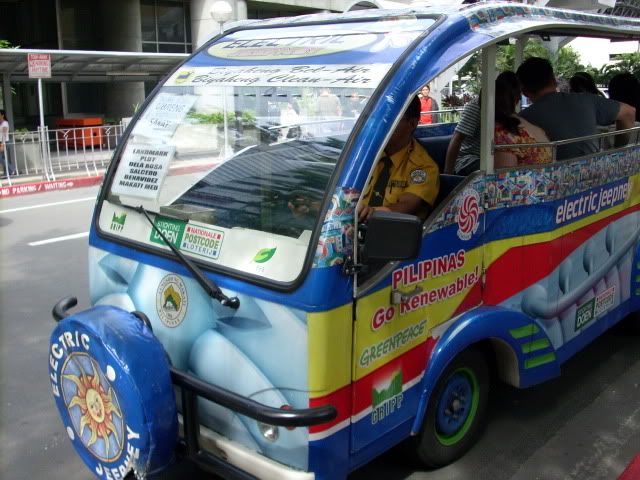
http://i297.photobucket.com/albums/m...m/DSCI0076.jpg
E-jeepney maker eyes foreign markets
https://www.google.com.ph/url?sa=t&r...hZPjBCm6-PrKGAPHILIPPINE Utility Vehicle, Inc. (PhUV) is in talks with prospective Taiwanese investor TECO Electric & Machinery Co. Ltd. to increase production of electric jeepneys and, eventually, sell them elsewhere in Southeast Asia.
“We’re in talks with TECO. They want to have a piece of the pie in electric vehicle (EV) production in the Philippines. Hopefully in the next month or so we will be able to finalize the agreement,” PhUV President Ferdinand I. Raquelsantos told reporters on the sidelines of the last day on Friday of the two-day 3rd Electric Vehicle Summit in Pasig City.
“PhUV will have new shareholders if they get to come in. We [PhUV] produce electric vehicles but we buy electric motors from TECO because TECO is an electric motors maker. The plan is to focus on production of electric jeepneys for export,” he said, adding PhUV will still have the majority stake.
PhUV, according to its Web site, was the first to locally design, fabricate, and assemble electric jeepneys in the country that were then sold to Quezon City and Puerto Princesa governments, the House of Representatives, Plantation Bay Resort and Spa in Cebu, De La Salle University-Dasmariñas, and Bangko Sentral ng Pilipinas, among others.
Mr. Raquelsantos said PhUV has produced less than 200 electric jeepneys in the last six years. With TECO as new investor, he said PhUV should be able to increase production and export electric jeepneys to neighboring countries in Southeast Asia.
“Our main goal is to export,” said Mr. Raquelsantos, adding that PhUV aims to make the Philippines “the EV hub in the region.” -- Daryll Edisonn D. Saclag

Last edited by jpdm; March 3rd, 2014 at 11:03 AM.
-
Tsikot Member Rank 3
- Join Date
- Jun 2007
- Posts
- 2,857
March 3rd, 2014 11:09 AM #153Attachment 20755
http://www.teco.com.tw/fa/image/banner.jpg
Teco to put up e-jeepney chassis facility in Phl
By Louella D. Desiderio
(The Philippine Star)
Updated March 3, 2014
(edited)
source: https://www.google.com.ph/url?sa=t&r...54HdskGgnaSgMAMANILA, Philippines - Teco Electric and Machinery Co., Ltd. of Taiwan is set to invest P300 million for the manufacture of chassis for electric jeepneys this year as it is in talks for a joint venture with local firm Philippine Utility Vehicle Inc. (PhUV).
Teco special assistant for business development Jay Huang said in an interview the firm intends to manufacture rolling chassis for e-jeepneys at its facility in Subic in Zambales.
“We are looking at maybe 200 to 300 units per month because we need to deliver a thousand within one year,” he said, citing orders received from a jeepney operator here.
“We are going to build the rolling chassis without body in Subic and then we give chassis to PhUV and then they will build the jeepney,” he said.
PhUV president Ferdinand Raquelsantos told reporters his firm is currently in talks with TECO for a joint venture for the manufacture of other electric vehicles such as jeepneys.
“Hopefully, in the next month or so, we would be able to finalize the joint venture,” he said.
Huang said production at the TECO’s facility in Subic may start in September.
At present, TECO imports parts supplied to the local market from China and Taiwan.

 Reply With Quote
 Originally Posted by niky


