


eto ang intindi ko dyan. kung ang takbo mo ay laging high rpm, mas maganda ung higher bypass valve pressure.Originally Posted by timykoo


The Largest Car Forum in the Philippines
- Forums
- Discussions
- Events
- Community
Results 1,001 to 1,020 of 3899
Hybrid View
-

 Tsikoteer

- Join Date
- Jul 2011
- Posts
- 1,181
April 24th, 2013 01:04 AM #1
-
Verified Tsikot Member
- Join Date
- Oct 2004
- Posts
- 278
April 24th, 2013 04:04 PM #2I disagree... That's good for the oil (more being filtered), but bad for the engine (can cause oil starvation specially on high rpms/high load conditions). Originally Posted by s10pao
-
Tsikoteer
- Join Date
- Jul 2011
- Posts
- 1,181
April 24th, 2013 08:50 PM #3sir assuming that the oil filter is not yet clogged, what causes oil starvation during high rpm/load conditions? Originally Posted by EssB
-
Tsikoteer
- Join Date
- Nov 2010
- Posts
- 369
April 24th, 2013 09:34 PM #4Did some research on which is better. 14PSID vs 20PSID. this filters have a bypass valve. So that when the filter is already clogged, magoopen up eto so that oil would still be supplied to the engine (unfiltered though). In a 14PSID limit filter. That valve opens once the pressure is higher than 14PSID. Same applies for 20PSID. So meaning it would take a longer time for the 20PSID to open when clogging occurs (takes more debris before it clogs compared to a 14PSID.
If you're on high rpm sabi nga ni sir EssB, that valve wont open up easily even though the oil pump works harder.
The question now would be the 6PSID difference be a big factor? or is it negligible?
-
Tsikoteer
- Join Date
- Nov 2010
- Posts
- 369
April 24th, 2013 09:39 PM #5Pasagot naman ng tanong ko sir! kung ang b173-s ay pwede instead of b1402?
I checked my filter under the hood and it's C-415, so it should be b1402 in its counterpart.
-
Verified Tsikot Member
- Join Date
- Oct 2004
- Posts
- 278
April 24th, 2013 09:35 PM #6It would be better to have unfiltered oil flowing inside the engine than having everything filtered (with too much pressure differential in & out of the filter) but too restricted flow (then so some parts of the engine would lack lubrication). The lower the bypass valve pressure opening, less chance of that happening. Originally Posted by s10pao

-
 Chicken at Itlog
- Join Date
- Nov 2008
- Posts
- 4,642
April 25th, 2013 01:19 PM #7BT223 (8PSID) vs B178 (30PSID), which one is better for a Vios? Mas mahaba yung B178 at 5inches vs 3 inches BT223. Kaso nakakaworry lang yung PSID rating medyo magkalayo. I'm on BT223 now btw.
-
 Moderator
- Join Date
- Nov 2010
- Posts
- 25,276
April 25th, 2013 01:27 PM #8Afaik dapat not more than 6psid ang difference, so hindi puwede yan. Originally Posted by Chikselog
Sent from my WT19i using Tapatalk 2Fasten your seatbelt! Or else... Driven To Thrill!
-
Tsikoteer
- Join Date
- Nov 2010
- Posts
- 369
April 27th, 2013 12:01 AM #9Tama. Stick with 223. Besides yan din gamit sa fortuner. So confidence mo mataas na dapat. Haha. Originally Posted by Ry_Tower
-
 Mr. Filter
- Join Date
- Jan 2012
- Posts
- 905
April 27th, 2013 03:15 PM #10i dont think there is a general rule on PSID value. kung lesser or X greater than the stock. most after market oil filter have higher PSID than stock ones. Originally Posted by Ry_Tower
The smaller value on PSID the quicker the filter goes on bypass mode, but this will only happen if you get to clog the actual filter. the good thing about heavy duty oil filters is that it has 4 times dirt holding capacity than regular filters. so if you run it for 10,000 to 12,000 km most likely you have not clogged the actual filter. pwede safe KM interval lang yun. if you push it to 20,000 then there are higher chances that you will clog the actual filter then thats the time it goes on bypass mode.
at 8 PSID - it goes on bypass quicker IF and when the filter gets clogged already, at 30 PSID mas matagal before it goes on bypass,
so unless you are planning to go EXTREME oil change interval on a BT223 or B178 like , 20,000 KM interval, i think thats the only time you should be worried about either using an 8 PSID or 30 PSID. to be on the safe side, just stick with the safe interval of 10,000 to 12,000 on the said filters.
Last edited by bayen; April 27th, 2013 at 03:18 PM.
-
Chicken at Itlog
- Join Date
- Nov 2008
- Posts
- 4,642
April 27th, 2013 02:58 AM #11Thanks sir Ry. Originally Posted by Ry_Tower
How about for a Civic EK PH15 engine? Will B1402 be good enough? Vic C415 ang filter nya ngayon, and B1402 ang counterpart nya sa Baldwin.
-
Verified Tsikot Member
- Join Date
- Jul 2009
- Posts
- 13
May 9th, 2013 03:21 PM #12What's recommended filter for Gen 2 Hyundai Santa Fe 2.2L CRDi VGT edc16? I'm currently using Mobil 1 TDT FS 5w40 + Ceratec on OEM filter on 6,800km OCI. Want to extend this to 10~12k,
OEM filter I got is Hyundai 26310 27420. JS filter gave me a fleetguard LF3568 equivalent, which gave me a Baldwin B178.
Now, has someone used this with his santa fe?
-
 Verified Tsikot Member
- Join Date
- Jul 2010
- Posts
- 230
April 29th, 2013 01:45 PM #13Ok so im now using bt223 for my vnt 2.5L d4d fort. How much km should i expect my oil to darken.. Oh btw im using delo gold ultra
Is there other much better than bt223 or taller more filter media surface as long as it fits perfectly snug-fit in my car
-
 Verified Tsikot Member
- Join Date
- Sep 2010
- Posts
- 30
April 29th, 2013 03:31 PM #14bakit wala tayong B109...

Last edited by SpeedDzel; April 29th, 2013 at 03:32 PM. Reason: misspelled
-
 Driven
- Join Date
- Jul 2007
- Posts
- 2,848
-
Mr. Filter
- Join Date
- Jan 2012
- Posts
- 905
April 29th, 2013 08:33 PM #16Yes. A good upgrade to the BT223 is the B178. Its longer than the BT223, more filtering surface. Outer diameter is practically the same (<=3 inches). i have yet to see the filter mounting on the D4D engine, given a 1.5 inches more vertical or horizontal clearance, the B178 would be a perfect filter for the Fortuner D4D engine. Originally Posted by TheGreenThing


Heres the actual side by side comparison of the 2.


-
 Tsikot Member Rank 4
- Join Date
- Oct 2002
- Posts
- 3,012
-
Verified Tsikot Member
- Join Date
- Sep 2010
- Posts
- 30
-
Verified Tsikot Member
- Join Date
- Jul 2010
- Posts
- 230
-
Mr. Filter
- Join Date
- Jan 2012
- Posts
- 905
May 1st, 2013 05:35 PM #20Thats just the bypass. If the filter is blocked or clogged which again will most not likely to happen as these filters have 4 times dirt holding capacity, plus if you follow a 10,000 to 12,000 km oil change interval then you are perfectly safe from getting the filter cloged. Originally Posted by MrQ5
if the bypass is closed oil simply bypasses the filter and circulates normally. Besides, the philippines is a tropical country, with the ambient temperature we have here in the Philippines the oil is always at a free flow state, unless maybe it starts to get really really cold. and when i say cold, negative degrees which will NEVER happen here in the PH, unless the ice caps starts to melt. hehehe! even in baguio cold temperature there would not be enough to cause the oil to be on a non flow state. so worrying about oil starvation should not be the reason with using a filter having a 30 PSID.
its perfectly safe to use a filter having a 30 PSID. just make sure you follow a 10,000 to 12,000 oil change interval then you should be fine. Originally Posted by TheGreenThing
Heres how a bypass valve works. (copy paste from Bob is the oil guy)
The oil enters the oil filter under pressure through the holes on the perimeter of the base plate.
The "dirty" oil then passes through the filter media where it is "cleaned". It then flows to the central tube and back into the engine through the usually threaded hollow center mounting stud
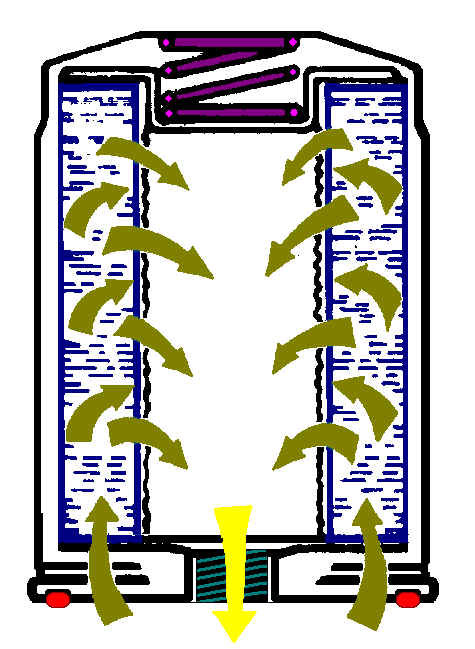
Oil Filter Flow Diagram
The only thing that holds the "spin-on" oil filter to the engine and keeps the oil from leaking is the base gasket (shown in above picture in red).
The Bypass Valve
Under ideal conditions, the bypass valve will never open. When it opens, the oil by passes the filter and goes on through to the motor, obviously unfiltered. It is a safety valve. However, in real operation, it opens often.
One example is when you start the motor when cold. The oil is thick and does not pass easily through the filtration medium, thus building up to a high pressure drop. So, the bypass valve opens to prevent oil-starvation of the motor. How long it stays open is dependent on how cold the oil is and how long it takes to get near operating temperature. When the pressure drop across the filtration medium drops below the bypass valve setting.
Another example can occur when the motor is fully warmed. At idle, the oil pressure is about 15 to 20 psi, and the pressure drop across the filter is about 1 or 2 psi. You take off towards the redline, and quickly build oil pressure. During that full-throttle acceleration the pressure drop across the filter will exceed the bypass setting, and send unfiltered oil to the motor, until the pressure across the filter has time to equalize. During a drag race, shifting through the gears, the bypass will open several times.
A third example, which you should never experience with frequent oil and filter changes, is when a filter becomes clogged. A spin-on filter can commonly hold 10 to 20 grams of trash before it becomes fully clogged. The bypass valve opening is the only way to keep the motor from becoming oil-starved if the filter becomes clogged.
According to Purolator, the Honda OEM filter bypass setting is 12 to 14 psi. WIX (NAPA Gold) builds their oil filters with a bypass setting of 8 to 11 psi, while AC Delco builds theirs to a setting of 11 to 17 psi. How much do these differences matter? I don't think anyone knows, even the engineers, and each has its own set of advantages and disadvantages.
If you do lots of racing, you're probably better off with a higher bypass setting.
If you do lots of *cold* starting, especially in the winter, or seldom change your filter, I think you're better off with a lower bypass setting. However, with few exceptions, bypass pressures for spin-on filters run in the 8 to 17 psi range, and any of them should work acceptably.
Here is a picture of the breakdown on some oil filters anatomy
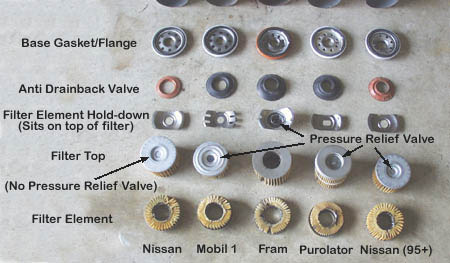
As you can see, some bypass valves are built directly in the middle of the filter while a few do not have one.
Here is a cutaway of Bosch's and how each component is located in a filter.
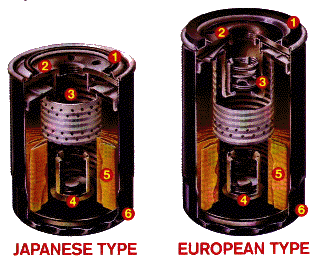
1) Rubber seal
2) Steel baseplate
3) Anti-drainback valve
4) The bypass valve
5) Filter media
6) Filter can
Hopefully this gives you a better idea about filters and how they flow.
Hope this helps in clarifying how bypass valves work.
 Originally Posted by timykoo

 Reply With Quote


