
thanks to oyil for inviting me here. Glad to see a forum dedicated at this.
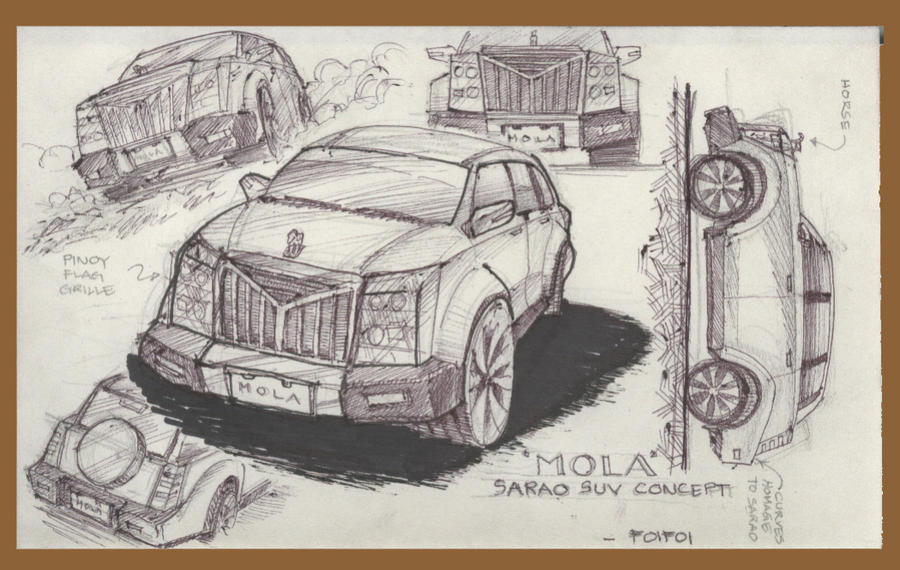
as a start here is one of my concepts i posted * motioncars.com: sarao "Mola"
help, why cant i post a new thread?

The Largest Car Forum in the Philippines
- Forums
- Discussions
- Events
- Community
Results 1 to 20 of 81
-

 Tsikoteer

- Join Date
- May 2007
- Posts
- 932
May 30th, 2007 11:20 PM #1Last edited by foifoi05; May 30th, 2007 at 11:24 PM. Reason: add query
-
 BANNED BANNED BANNED
- Join Date
- Aug 2006
- Posts
- 1,488
May 31st, 2007 12:35 AM #2Hi foifoi,
welcome!
you got something there. very good presentation. but......lets clear some things:
your mola concept drawing: is this a future jeepney, OTJ(Owner-type jeep), or PhUV? there are differnet threads for each of the vehicle types mentioned.
thanks for joining and hope to see some more of your designs.Last edited by dprox; June 18th, 2007 at 08:16 AM.
-
Tsikoteer
- Join Date
- May 2007
- Posts
- 932
May 31st, 2007 01:21 AM #3thanks for the clarification, i guess the Mola wont fit since its intended for a concept sarao revival (bec of the horse). Originally Posted by OyiL

my apologies for that. Anyway, PM me for a quick tour on the following threads in this section, mukhang mali ata yung post ko sa isang thread. Interesting talks back there that i got carried away and got lost kung ano popost ko, and its late anyway. peace
peace
Last edited by dprox; June 18th, 2007 at 08:16 AM.
-
Tsikot Member Rank 4
- Join Date
- Jan 2003
- Posts
- 1,403
June 2nd, 2007 11:08 AM #4Here's one from http://education.guardian.co.uk/high...674780,00.html
Robot car: streets ahead in cities of the future
[SIZE=3]· Architects and engineers rethink auto technology
· 'Easy to drive, stackable vehicle for people to share'[/SIZE]
[SIZE=2] Alok Jha, science correspondent
Thursday December 29, 2005
The Guardian
[/SIZE]
[SIZE=1]The MIT Smart Cities research team's car. Image: Franco Vairani/MIT Department of Architecture
[/SIZE]
It is not every day that a concept car re-writes the rules of more than 100 years of motoring. In development for four years by a team of architects and engineers led by William Mitchell, former head of the school of architecture at the Massachusetts Institute of Technology (MIT), as part of his Smart Cities research group, a new MIT car is borne of a complete rethink of people's relationship with their cars in the ever-expanding cities of the future.Prof Mitchell expects we will share cars that will be easier to drive in congested cities, will be pollution-free and can be customised at will.
The city car concept, with styling input by architect Frank Gehry, will be completed and delivered by MIT to General Motors early next year.
"Primarily we're interested in urban living," says Ryan Chin, an architect and engineer at MIT's media lab and a member of Prof Mitchell's research group. "Everything scales down from what we think the city of the future is."
The Smart Cities group focused on how cars could be better adapted to get round familiar problems of city life, namely congestion, pollution and parking. Motor companies are well aware of the issue. But the group felt the companies had missed the point, even with city cars such as the Smart, the iconic two-passenger cars introduced by Swatch and Mercedes in 1998.
"We have to think of city cars as not just small-footprint vehicles that can squeeze into tight spaces but ones that can work in unison and also be almost like a parasite that leeches on to mass-transit systems," says Mr Chin. While Smart changed the way people think about parking and size, the MIT engineers felt that, as it had not been widely adopted and congestion and pollution problems had got no better, its success had been limited.
So the MIT team started from scratch to come up with their own concept: a stackable, shareable, electric, two-passenger car. "Imagine a shopping cart - a vehicle that can stack - you can take the first vehicle out of a stack and off you go," says Mr Chin. "These stacks would be placed throughout the city. A good place would be outside a subway station or a bus line or an airport, places where there's a convergence of transportation lines and people."
The precedent for this type of shared personal transport is demonstrated with bicycle-sharing schemes in European towns and the ZipCar and FlexCar projects on the east and west coasts of the US respectively.
The MIT concept car is a complete re-think of vehicle technology. For a start, there is no engine, at least in the traditional sense. The power comes from devices called wheel robots. "These are self-contained wheel units that have electric motors inside," says Mr Chin. "The interesting thing is that the wheel can turn a full 360 degrees so you can have omni-directional wheel movements. You can rotate the car while you're moving, any direction can be front or back and you can do things like crabbing or translate sideways. It's almost like you imagine yourself driving a computer chair."
The wheel robots, complete with their own suspension, remove the need for a drive shaft and even the engine block, freeing up designers to make new use of the space in the car.
"Essentially the car will comprise four wheel-robots plus a customisable chassis," says Chin. "The frame can be built specifically for each customer."
Add wafer-thin, programmable displays that cover the interior and exterior of the car like a layer of paint, and you have a vehicle that can be customised at will. "You can imagine signalling being not just a static signal light but something more dynamic," says Mr Chin, who suggests the words "reversing" or "turning left" could roll across the car's body to declare the driver's intentions. "From a heating and cooling point of view, you might want your car to be darker or lighter depending on weather. On the interior, you can customise your dashboard for each person. If I'm an elderly person, I probably want a very large speedometer so I can see it; if I'm a race-car driver, maybe all I want is a tachometer."
The close proximity of cars in cities increases the risk of accidents, and the MIT car has a host of radical ideas to deal with this problem. Chief safety features include responsive seats that do away with the need for seat belts and air bags: these are based around a spine at the back of the seat with a number of "fingers" to embrace a passenger and hold them in place if the car detects that it is involved in an accident. And the cabin would absorb the impacts of crashes using new materials. "There is a new development in fluids that can be magnetised so that they move from liquid to solid state within a nanosecond. You can imagine using these fluids as a way of absorbing energy in an impact."
Over the next few months the MIT team will complete the final design and present their results to General Motors, which will build the first prototype. Beyond that, Mr Chin is already trying to arrange a public test in the Far East. "We might do this in Hong Kong or in Singapore," he says. "The interest in those places is that they are very dense, have mass transit and limited range. An island like Hong Kong would be a perfect place to test this because you have all those conditions."
Whether the city car concept appears on garage forecourts as designed by the Smart Cities group or whether the technologies are taken forward individually remains to be seen. Chin says the group would be happy with either outcome.
-
 Ignore
- Join Date
- Oct 2006
- Posts
- 5,994
June 2nd, 2007 12:28 PM #5i'm sure drey would wanna see this one in person and drive one
 Damn, son! Where'd you find this?

-
Tsikot Member Rank 4
- Join Date
- Jan 2003
- Posts
- 1,403
June 2nd, 2007 12:39 PM #6More like modify the design and build one himself, that is, if he can get away from his babysitting chores these days.
-
Tsikot Member Rank 4
- Join Date
- Jan 2003
- Posts
- 1,403
June 2nd, 2007 12:43 PM #7Here's another, from http://www.treehugger.com/files/2007...uture_is_h.php
The Future is Here: Aptera's Prototype Unveiled
by Collin Dunn, Seattle on 03.15.07
Cars & Transportation (cars)

When we first encountered the Aptera diesel-electric hybrid last year, it was another pie-in-the-sky concept with amazing performance specs (330 mpg, 0.055-0.06 drag coefficient) but a concept nonetheless. Happily, last week at the TED Conference, the curtain was lifted over the real thing, and a working prototype of the spacey ride was unveiled. Delivering slightly less than originally calculated, the three-wheeled hybrid still sips fuel to the tune of 230 miles per gallon while humming along at 55 miles per hour. The production of the prototype is a hopeful first step for Aptera, whose company, Accelerated Composites (aka Aptera Motors), is making tentative plans to sell it for about $20,000 apiece. Hit the jump for more pics, and stay tuned for details about when you can get one for yourself. ::Aptera Motors via ::Wired and ::Engadget


-
Ignore
- Join Date
- Oct 2006
- Posts
- 5,994
June 2nd, 2007 02:00 PM #8WHAT??!!! drey's a baby sitter?! ahw... i don't want to be in his shoes right now. i even thought he was a REALLY COOL guy.
Damn, son! Where'd you find this?
-
Tsikot Member Rank 4
- Join Date
- Jan 2003
- Posts
- 1,403
June 2nd, 2007 02:37 PM #9Actually he is back home vacationing and just being a good son, taking on household chores. BTW, are you in Manila already?
-
Ignore
- Join Date
- Oct 2006
- Posts
- 5,994
June 2nd, 2007 03:46 PM #10OT: nope, i'll be back to manila on 10.
Anyways, he better be back with the bamboo fiber sheet he promised to me. hehehe
Damn, son! Where'd you find this?
-
 Tsikot Member Rank 5
- Join Date
- Mar 2006
- Posts
- 3,346
June 2nd, 2007 05:52 PM #11huh?! did I promised you a bamboo fiber sheet? Originally Posted by safeorigin

BTW, the baby sitting is no longer a baby... She grew 7 already and im giving her tutor classes.
At the same time, im catching fish for new ideas on our PhUV.iam3739.com
-
Tsikot Member Rank 4
- Join Date
- Jan 2003
- Posts
- 1,403
June 2nd, 2007 06:06 PM #12Drey - fish as in fish or just fishing for ideas? Come to think of it - maybe we can name the PhUV Ghoti (pronounced fish - Gh as in lauGH, O as in wOmen, and ti as in nation). Old English lesson from the Jesuit priests.

-
Tsikot Member Rank 5
- Join Date
- Mar 2006
- Posts
- 3,346
June 2nd, 2007 06:41 PM #13im fishing for ideas... ocasionally lurking around town... I might post some pictures of hardcore jeepney use here...
iam3739.com
-
Tsikot Member Rank 4
- Join Date
- Jan 2003
- Posts
- 1,403
June 2nd, 2007 07:20 PM #14Pox is coming back for a vacation. Maybe you can start modifying the hipmobile? Am still leaning towards getting the trima gt model. Maybe we can use bamboo fiber for the panels?
-
Tsikot Member Rank 5
- Join Date
- Mar 2006
- Posts
- 3,346
June 3rd, 2007 06:58 PM #15wow! bibili na kayo ng Original Pinoy Vehicle??? Seryoso na to'!? Well, I can help sir pox with the Hip Mobile... Suspension all independent dapat syempre o kaya old school beetle suspension???... Rides high as the Beetle para sakto lang. Interior would be leather in beige color plus illuminating door lights in blue. Instrument panel would be Pagani like... Modernish classic... Hmmm... Let me take a look at my classic car mag. Originally Posted by architect
iam3739.com
-
Tsikot Member Rank 4
- Join Date
- Jan 2003
- Posts
- 1,403
June 3rd, 2007 07:02 PM #16Pox is back in Manila for a vacation. Haven't talked to him about his plans re the hipmobile. As for me, I am simply waiting for July, if you know what I mean.
-
Tsikot Member Rank 4
- Join Date
- Jan 2003
- Posts
- 1,403
June 3rd, 2007 07:05 PM #17Drey, btw I pre-ordered the plans for this car -
http://www.rqriley.com/xr3.htm
[SIZE=3] The XR-3 Hybrid
A Three-Wheel Super-Mileage Plug-In Hybrid Vehicle
[/SIZE]
[SIZE=3] Plans, Instructions, and Design Details
Scheduled for Release in [/SIZE] July 2007

[SIZE=2][SIZE=3]The XR-3 Hybrid is a super-fuel-efficient two-passenger plug-in hybrid that achieves 125 mpg on diesel power alone, 225 mpg on combined diesel and electric power, and performance like a conventional automobile. [/SIZE][SIZE=3] The design of the XR-3 Hybrid focuses on existing technologies and a vehicle “personality” that makes conserving energy a fun driving experience. It showcases the design ideas explored in Robert Q. Riley’s book, Alternative Cars in the 21st Century.
[/SIZE]
At just 1300 pounds, this high-performance design combines lightening-fast acceleration, a maximum speed of 85 mph, and fuel economy of 125- to over 200-mpg.
Its clam-shell canopy and three-wheel platform boldly differentiates the XR-3 from conventional passenger cars. The vehicle’s hybrid power system, diesel engine, and low curb weight are the main ingredients of its super-high fuel economy and excellent performance. Acceleration equal to that of a conventional car and a maximum speed of 85 mph make the XR-3 Hybrid equally at home on freeways and surface streets.
Advanced safety features of a production XR-3 Hybrid will include occupant protection and crash avoidance systems. Enabling technologies already exist, and nothing new has to be invented.
Plans will enable readers to build a duplicate of the XR-3 Hybrid prototype, or convert their own car into a significantly more fuel-efficient vehicle. Readers will understand the factors that influence fuel economy, and learn how to make any car achieve greater fuel economy. The XR-3 Hybrid gives enthusiasts and experimenters the opportunity to significantly reduce their transportation expenses and have fun doing it. On a broader level, the vehicle is a highly visible example of the kinds of vehicles [/SIZE][SIZE=3]that could help reduce personal mobility energy on a global scale.[/SIZE][SIZE=3]
Styling Makes an Implied Promise
[/SIZE][SIZE=3] The driving experience is defined by the vehicle’s layout and styling – it's “theme" or "personality.” The vehicle theme says: “This is what I am and this is what I do." It’s a statement that’s on a visual level, and it’s maintained throughout the ambiance of the vehicle. Mechanical design simply supports that statement. “Once we decide on the basic architecture of the vehicle, styling is the first thing that’s done,” says Riley. “It’s the most intangible quality of the design, but it provides a visual marker for what we are trying to achieve through mechanical design. Styling makes an implied promise, and then it’s up to the mechanical designers to deliver on that promise.” [/SIZE][SIZE=3]
[/SIZE][SIZE=3]The Technology of Fuel Economy[/SIZE][SIZE=3]
[/SIZE][SIZE=3] The vehicle’s performance and fuel economy comes from a combination of two fundamental design factors. First, it’s essential to keep the vehicle as light as possible in order to reduce the amount of mechanical "work" that has to be done. The method of getting rid of unwanted mass while still keeping the car’s mechanical benefits demands good design and modern materials. Once the amount of "work" has been minimized, then the other part of the equation is to do the remaining "work" as efficiently as possible. And that’s where the hybrid power system comes in. So the fundamental approach is very simple. The key is in the execution.
New types of products that rely more on vehicle packaging and market positioning could play an important role in reducing global energy demand. Significantly downsized vehicles - smaller, lighter, highly fuel-efficient personal mobility products - could help turn the tide against escalating energy demand and open new markets in the process.
[/SIZE][SIZE=3] Consumer Perceptions and Choices
[/SIZE] [SIZE=4] [SIZE=3]Everyone understands that small, super-efficient cars would help the environment and reduce imported oil. But industry has been slow to see marketing opportunities and create products of this category that capture the imagination of consumers.The XR-3 Hybrid is designed to explore vehicle packaging and styling, with an eye toward creating a new design theme and market positioning for alternative personal transportation products. We call it a “Personal Mobility Vehicle.” [/SIZE][SIZE=3]
[/SIZE][SIZE=3]To paraphrase the lead quote from John Locke, the ideas and images in the minds of designers invisibly guide them toward particular design options. A product’s “character” naturally emerges from the collective mind-set of its designers. Consumer appeal of any alternative mobility product depends on the ideas and images in the minds of its creators, not on the core idea of saving energy and emissions through size/mass reduction. In order to enjoy success in a consumer market, significantly different vehicle types - Personal Mobility Vehicles - must be rendered in ways that create new appeals of their own. And energy savings and emissions reduction must be positioned as secondary benefits. Or stated differently, a consumer vehicle’s environmental benefits can be an effective motivator only in terms of providing a rationale for a purchase that is, in fact, based largely on the product’s emotional appeal.
The XR-3 focuses on the power of “design” to influence consumer perceptions and choices. It points to a new category of personal mobility products that are neither automobiles nor motorcycles. [/SIZE]
[/SIZE]Last edited by architect; June 3rd, 2007 at 07:16 PM.
-
Tsikot Member Rank 4
- Join Date
- Jan 2003
- Posts
- 1,403
June 3rd, 2007 07:07 PM #18[SIZE=3] The Power of Design
[/SIZE] [SIZE=3] The idea that vehicle theme or personality - vehicle “design” - has the power to influence global energy demand goes against conventional thinking. Consider, however, that in the 1990s vehicle personality influenced automobile energy intensity in the negative with lifestyle vehicles that pushed energy use upward. The popularity of SUVs is a good example of how an "image" can influence choices, and those choices can lead to significantly higher fuel consumption.** Hardly anyone buys an SUV to go trailblazing. Consumers are turned on to the personality of SUVs, the vehicle theme, and they buy them to drive around the city. New-car average fuel economy has plunged in recent years, mainly because of the power of design to shift purchasing choices toward trucks. As of year 2000, light trucks accounted for roughly half of all new car sales. This same dynamic can work in the reverse.
[/SIZE] [SIZE=3] **It might be argued that greater utility, rather than vehicle design, is responsible for the popularity of SUVs. But consider that station wagons and panel trucks have been around almost since the inception of the automobile. And it was only when carmakers connected with consumers through “design” that trucks began to replace family sedans in the personal mobility market. [/SIZE][SIZE=3]
Plug-In Hybrid Architecture
[/SIZE] [SIZE=3] The XR-3 is designed as a “plug-in hybrid.” This makes it possible to drive on battery power alone on trips of about 40 miles. In other words, on short trips you never have to turn on the diesel engine. And when both the diesel and the battery-electric systems are used together, and the car is driven conservatively, fuel economy increases to over 200-mpg. Fuel economy is about 125-mpg on diesel power alone.
Today’s hybrids are called “mild hybrids” or “charge-maintaining hybrids”. They use the electric system to help with acceleration. You can drive on battery power alone, but only for a short distance – around the block, for example. The battery pack is typically used to provide bursts of power for brief periods of acceleration. The combustion engine then recharges the battery between periods of acceleration. But fuel economy suffers while the battery is being recharged. That’s why today’s hybrids do not provide much advantage in fuel economy over a well-designed conventional car.
In order to get the full benefits of a hybrid power system, you have to switch to a plug-in hybrid architecture like the XR-3. Plug-ins will be the next generation of hybrid vehicles. A plug-in hybrid simply means that part or all of the vehicle’s energy is taken from the grid system where it is cleaner and less costly to produce. Most of the world’s automakers are now working on plug-in hybrids. [/SIZE][SIZE=3]
Virtually Unlimited Options for the Builder
[/SIZE] [SIZE=2][SIZE=3] The plug-in power system architecture also allows much greater flexibility in power system choices. With a mild hybrid, like the Honda Insight and the Toyota Prius (also called “charge-maintaining hybrids”), proper control of the power system depends on the fact that the subsystems - the internal combustion engine (ICE) and electric systems - are selected in advance and controlled by a computer. The computer, however, has to be programmed for the specific output characteristics of the two systems. Any modification in either of the power systems (electric or ICE) causes a mismatch with the control system. The computer control system cannot, on its own, account for changes in the power system. So whenever a change is made, the computer has to be reprogrammed to account for the change.
With a plug-in hybrid system, configured like the system in the XR-3, you are free to add a larger or smaller ICE, or even switch to a gasoline engine, without having to reprogram the control system. You can also build the car as a conventional ICE-powered car, or a full battery-electric car. So the options are greatly expanded with the plug-in hybrid power system.
With the XR-3, the two front wheels are powered by the ICE engine, and the single rear wheel is electric powered. The two power systems are not integrated within the vehicle. The connection between the ICE and the electric power systems is provided by the ground. Proper phase-in between the two power systems is handled by a simple throttle mechanism, and a dash-mounted switch to select between ICE power, electric power, and dual power modes. In the dual power mode, the XR-3 will have lots of burst power for outstanding acceleration. If you were to use this acceleration potential to its fullest, fuel economy would be reduced to something on the order of 150 mpg over a 70 mile trip. Fuel economy will vary according the particular components chosen for the power system, and how heavy you are on the throttle pedal. Performance figures quoted here are for a system configured just like the prototype. Plans will provide the information necessary for you to select different components if you want to.[/SIZE] [/SIZE]
-
Tsikot Member Rank 4
- Join Date
- Jan 2003
- Posts
- 1,403
June 3rd, 2007 07:08 PM #19[SIZE=3]Removable Front Clip & Canopy
[/SIZE] [SIZE=3] The canopy and the entire front of the body are removable. Removing the front body section provides complete access to engine and suspension components for major servicing.
This removable front clip can be restyled and extended to provide additional forward space for a more powerful engine. With a larger engine you can have big-engine performance and still retain the ability to run on battery power alone. The existing 65-pound (29.5 kg) transmission will handle up to 300 horsepower (223 kW). [/SIZE][SIZE=3]
The removable canopy provides another level of freedom. A different windshield can be installed to create an open-air roadster effect.[/SIZE][SIZE=3]
Safety Features
[/SIZE] [SIZE=3] The front portion of the front clip is foam-filled to absorb low-speed frontal impacts. It also serves as an easily replaceable sacrificial element in the event of a frontal collision. The sides of the vehicle are filled with foam to provide side intrusion protection. This foam-filled region, varying in thickness from 5 inches to more than 10 inches, extends from the front wheel wells to the rear bulkhead of the passenger zone, and vertically from the canopy parting line to the bottom of the passenger zone. The design is significantly more resistant to side intrusion than the doors of conventional cars.
A composite roll bar is built into the perimeter of the panel that defines the rear of the passenger zone. In addition, the canopy is equipped with a tubular steel perimeter frame which is reinforced by steel “A” pillar members. This provides excellent rollover protection.
An open interior having no conventional instrument panel or steering column provides forward excursion space for occupant deceleration during a frontal collision. Controlled deceleration is provided by conventional seat belts. [/SIZE][SIZE=3] Air bags are unnecessary due to the lack of nearby interior structures.
There is no conventional steering column. The steering wheel is supported from the side. The supporting structure is designed to break away in a frontal collision. It is not designed to resist/carry the loads that would typically be imposed by the forward excursion of the driver. This design eliminates the inherent danger of an air bag without compromising safety.[/SIZE][SIZE=3]
[/SIZE] [SIZE=3] (During a frontal collision, air bags prevent occupants from impacting the interior of the vehicle. But air bag deployment can cause serious injury or death to children and out-of-position occupants. Air bags are unnecessary in the absence of nearby interior structures that may be impacted by forward excursion of occupants.)
Plans
[/SIZE] [SIZE=3] The XR-3 Standard Plans Package is priced at $170. The package will include 15 or more D-size (24 x 36 inch) drawing sheets and a construction/technical manual of approximately 120-150 pages with approximately 150 photos and illustrations.
The XR-3 Deluxe Plans Package is priced at $200. The Deluxe version includes everything from the Standard version plus a CD-ROM and DVD.
The CD-ROM will include electronic 2D CAD files (SolidWorks drawing files, e-Drawing files, and dxf files), 3D models in SolidWorks and e-Drawing formats, links to free viewers, and a construction manual set up to run in a web browser with click-to-enlarge color photos, video clips, iges files for CNC machining, and more.[/SIZE][SIZE=3]
[/SIZE][SIZE=3]The DVD will have 1 to 1-1/2 hours of video of the vehicle being built.[/SIZE][SIZE=3]
Kits
[/SIZE] [SIZE=3] Although the XR-3 can be built just as the prototype was built, kits are on the agenda. The XR-3 can be constructed using the same techniques used to build Tri-Magnum. Click on FRP/foam composite for a document that shows the composite system used to build the body for Tri-Magnum. The XR-3 body may be built of carbon fiber over foam or conventional fiberglass over foam. Both systems are designed for the home craftsman using virtually identical techniques.
[/SIZE][SIZE=3] However, kits will follow the release of plans by about 6 to 8 months. If you purchase a kit, the amount you paid for plans will be applied to the price of a kit. Initially, we will provide frame kits and body kits having only those components that you would otherwise have to specially build.
A knocked-down body kit consisting of pre-molded panels provides the greatest benefit at the least cost. So body kits will be supplied as unassembled panels that builders can simply bond together. In addition to cutting the price by more than 60 percent, this type of kit also makes it possible to nest multiple panels in relatively small cartons and hold shipping costs to a minimum. Frame kits will be configured in a similar way. The goal is to deliver the greatest benefit at the lowest possible price, and avoid supplying parts that you can purchase locally. We are, however, considering the option of setting up a supply chain wherein most of the components can be purchased from a single source.[/SIZE][SIZE=3]
The price of kits has not been established.[/SIZE][SIZE=3]
Completed Vehicles
[/SIZE] [SIZE=3] Information not available at this time.[/SIZE]
-
Tsikoteer
- Join Date
- May 2007
- Posts
- 932
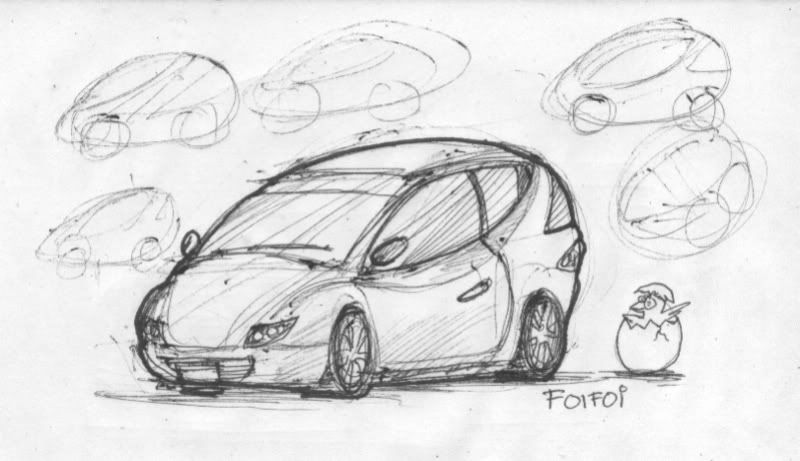
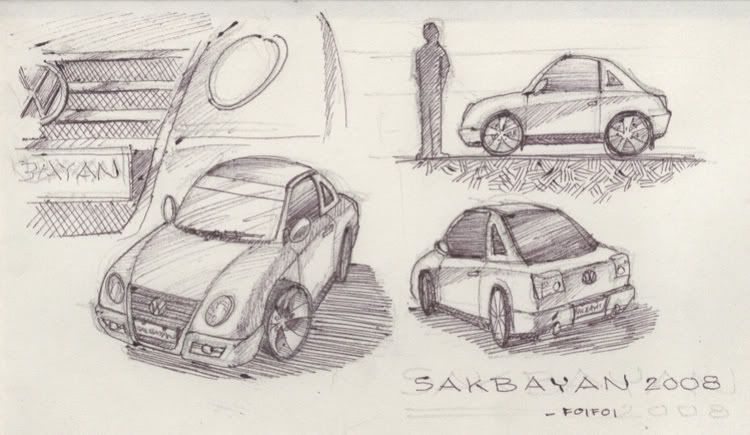
June 15th, 2007 10:25 PM #20i dunno if this was discussed, my design is kinda off topic, but i think we also should consider reinventing the owner types into sort of smartcar, jap kei cars, etc. Developing sumthing out of the old small suzukis, daihatsu engines, like that. I believe there is also a big market sa mga nag ooffice lalo na sa mga outsorcing companies.
some of my old stuff....
balut concept:
sakbayan 08(ignore the vw badge):

 Originally Posted by OyiL
