


Sharing an article that interested me because it gives a better perspective of the socioeconomic picture of the Philippines:
Who are the middle class?
Some thoughts on the article:
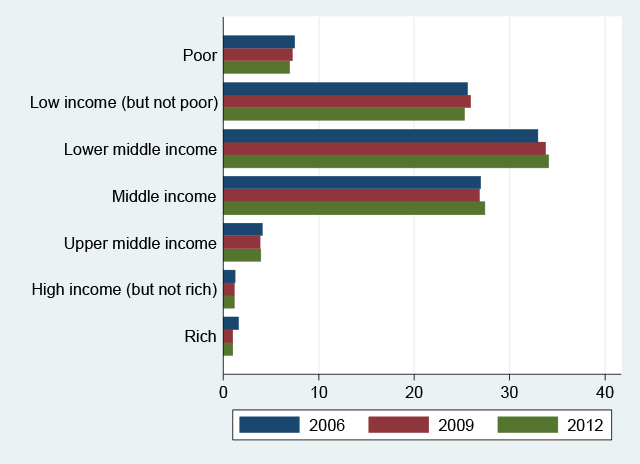
1. Most, if not all Tsikot members with their own cars are part of the Upper Middle Income, Upper Income, and Rich income classes. That is, the top 3.6%. Anyone with a monthly income of 150k and up is already part of the top 1%.
While we might think that we're small fry compared to the people around us, remember that there are literally tens of millions of Filipinos who are worse off. The middle class is not that guy with his newly loaned car stuck in EDSA traffic, working a corporate job to pay off his home loan; the middle class is that guy stuck in the hour-long queue to get on the MRT, trying to get to the office to earn enough to pay for the rent of their tiny apartment.
I used to get frustrated at how low my salary is compared to the income of my friends with their own businesses, considering I work just as hard as they do. But using the same argument, there are millions of Filipinos who put in just as much effort in their own jobs, but earn less than I do as well.
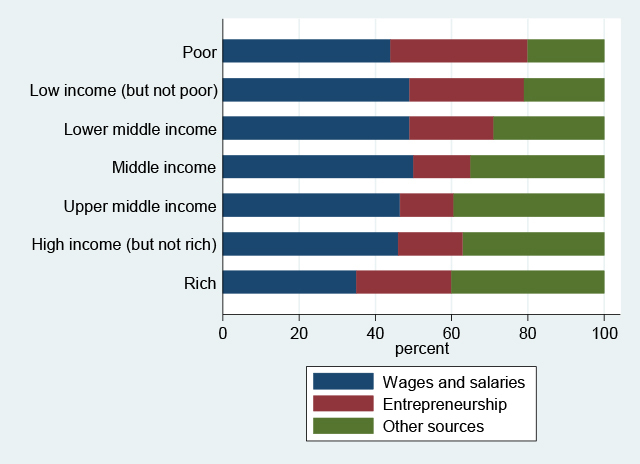
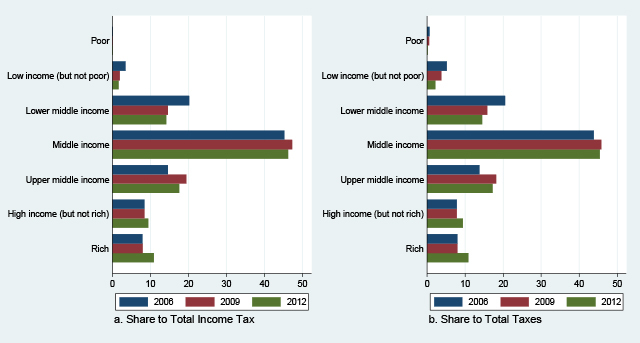
2. The middle income classes, more specifically the salaried among them, contribute the largest share of taxes. The simple graph shows how small a percentage of their total income the rich pay in taxes compared to the average office worker. It highlights the dire need for tax reform, specifically to move the tax burden away from the middle classes by making the rich contribute their rightful share of taxes too.
The notable increase in the total taxes collected from the Upper Income and Rich income classes are reflective of the reforms being undertaken by the BIR. While there's a lot further to go, at least we're headed in the right direction. A lot of the businessmen I interact with are unhappy that they can't get away with their taxes as easily as before, but concede in the same breath that on a macro perspective it should be better for the country.
3. The common stereotype of an OFW working abroad and being able to buy a car, a house, and give his family back in the Philippines a relatively comfortable life is not as common after all. Majority of OFWs are working their butts off in a foreign land to keep their families back home barely afloat. Without their comparatively higher income from abroad, these households face the possibility of falling below the poverty threshold.
In light of the coming elections, I look forward to a government that will push to expand the middle class by more equitable taxation and more job opportunities for those in the lower income classes to move up.

The Largest Car Forum in the Philippines
- Forums
- Discussions
- Events
- Community
Results 1 to 16 of 16
Hybrid View
-

 Dalek
Dalek

- Join Date
- Dec 2006
- Posts
- 17,314
March 3rd, 2016 02:52 PM #1
-
 Tsikoteer
- Join Date
- Feb 2008
- Posts
- 12,683
March 3rd, 2016 03:18 PM #2Bro, do the values above represent the gross monthly income for a family of 5? Using the data for a rich person as an example and assuming 25% for tax plus 2 outstanding loans (car and house) with 4 kids going to primary schools would probably net to somewhere between 400K and 600K p.a. Is that what a rich family save in a year?
Sent from my SM-N910C using Tapatalk
-
Dalek
- Join Date
- Dec 2006
- Posts
- 17,314
March 3rd, 2016 03:47 PM #3Yup, that's the income for a family of 5. Originally Posted by dreamur

On a monthly basis, a car loan would be about 20k/month, housing loan of 40k/month, tuition of 120k per year spreads out to 10k/month per student. The rest will be for day to day expenses (utilities, allowances, food, etc).
Sent from my SM-N910C using Tapatalk
-
 Verified Tsikot Member
- Join Date
- Jun 2009
- Posts
- 2,515
March 3rd, 2016 04:00 PM #4I share your wish, jut. But I'm not so optimistic that the current crop of candidates will be so reform-minded in terms of taxation and growing the middle class. Originally Posted by jut703
The basic constraint is still structural, in terms of how wealth is generated and distributed in the country. The old adage that the rich is getting richer and the poor is getting poorer still rings true in our country. Income inequality hasn't substantially changed over the last 50 years, even when our economy has improved. Yes there has been growth, but the growth has been for the rich.
See World Bank data here

Poverty & Equity Data | Philippines | The World Bank
We have the most unequal economy and society in Asia.
A quote from an article linked below:
"In 2012, Forbes Asia announced that the collective wealth of the 40 richest Filipino families grew $13 billion during the 2010-2011 year, to $47.4 billion--an increase of 37.9 percent. Filipino economist Cielito Habito calculated that the increased wealth of those families was equivalent in value to a staggering 76.5 percent of the country's overall increase in GDP at the time. This income disparity was far and away the highest in Asia: Habito found that the income of Thailand's 40 richest families increased by only 25 percent of the national income growth during that period, while that ratio was even lower in Malaysia and Japan, at 3.7 percent and 2.8 percent, respectively. (And although critics have pointed out that the remarkable wealth increase of the Philippines' so-called ".01 percent" is partially due to the performance of the Filipino stock market, the growth of the Philippine Composite Index during that period would not account for such a dramatic disparity from neighboring countries.) Even relative to its regional neighbors, the Philippines' income inequality and unbalanced concentrations of wealth are extreme."
The Grim Reality Behind the Philippines' Economic Growth - The Atlantic
Yes the middle class has grown to some extent in our country but it couldve been substantially more numerically and distributed widely across the country, especially in rural areas.
Tax reform will help; sincere implementation of the anti-trust law will help; reducing corruption will help. But these are just scratching the surface. Asset reform should be the key. Unfortunately, no presidential candidate is even talking about this fundamental problem.
-
 Ignore
- Join Date
- Oct 2006
- Posts
- 5,994
March 3rd, 2016 05:05 PM #5yet no one is asking how the quality of life of the poorest filipinos is compared to the richest filipinos a century ago...
Damn, son! Where'd you find this?

-
 Hoosier'ed Hotspur
- Join Date
- Dec 2005
- Posts
- 39,174
March 3rd, 2016 05:13 PM #6
As I was telling my dear wifey earlier (this week)...
"Hindi mo ma-i-imagine kung gaano kahihirap ang mga mahihirap, at gaano kayayaman ang mga mayayaman....."
Ano kaya iyong "other sources"??? 40% of the richest and increasing % as you go up the scale...

"The measure of a man is what he does with power" LJIOHF!
29.0K _/_/_/_/_/:jazzybass:_/_/_/_/_/
Last edited by CVT; March 3rd, 2016 at 05:20 PM.
-
Verified Tsikot Member
- Join Date
- Jun 2009
- Posts
- 2,515
March 3rd, 2016 05:42 PM #7From the 2006 survey form-- Originally Posted by CVT
OTHER INCOME:
CASH RECEIPTS, GIFTS, SUPPORT, RELIEF AND OTHER FORMS OF ASSISTANCE FROM ABROAD
CASH RECEIPTS, SUPPORT, ASSISTANCE AND RELIEF FROM DOMESTIC SOURCE
RENTALS RECEIVED FROM NON-AGRICULTURAL LANDS, BUILDINGS, SPACES AND
OTHER PROPERTIES
INTEREST
PENSION AND RETIREMENT, WORKMEN’S COMPENSATION AND SOCIAL SECURITY BENEFITS
DIVIDENDS FROM INVESTMENT
OTHER SOURCES OF INCOME NOT ELSEWHERE CLASSIFIED
1. Sale of real property
2. Sale of personal property
3. Loans from other families
4. Loans from business firms (including sari-sari stores)
and government institutions
5. Payments received for loans granted to others
6. Withdrawals from savings/business equity
7. Net winnings from gambling, sweepstakes and raffle
8. Profits from sale of stocks, bonds and
real and personal property
9. Back pay and proceeds from insurance
10. Inheritance 930110
11. Other receipts (tax refund, dowries, etc.)
-
Verified Tsikot Member
- Join Date
- Jun 2009
- Posts
- 2,515
March 3rd, 2016 05:15 PM #8And why is that relevant? The poorest Indios a century ago are far more comfortable than the richest cave dwellers 5 centuries ago. Originally Posted by safeorigin
And so?
-
Ignore
- Join Date
- Oct 2006
- Posts
- 5,994
March 3rd, 2016 06:10 PM #9it questions the statement: "The poor are getting poorer." Originally Posted by anonemus
Damn, son! Where'd you find this?
-
 Одна из черт возьми
- Join Date
- Oct 2002
- Posts
- 15,528
March 3rd, 2016 06:16 PM #10bottomline.....appreciate what you have for there are so many people who cannot afford to eat three times a day.
minsan iniisip ko yan eh..... nagrereklamo ako sa traffic.... pero when i look at the people commuting, or the people standing sa loob ng bus and sa queues ng MRT, iniisip ko, hwag na magreklamo... at least, ako naka aircon.
most of the time kasi, mahirap makuntento ang tao.
but looking at the political side, the middle class is the most heavily taxed, one of the most contributing sectors in the country (OFWs included). but they are not enjoying the benefits of their contribution to the economy.Last edited by 1D4LV; March 3rd, 2016 at 06:20 PM.
-
Dalek
- Join Date
- Dec 2006
- Posts
- 17,314
March 3rd, 2016 06:25 PM #11In that sense, we've actually just moved from an agricultural feudal system to a capitalist feudal system. But with much of our infra development (which will spur the growth for other sectors) relying heavily on PPPs, you really can't expect anyone to bring down the hegemony. Originally Posted by anonemus
I find it unfair though to blame the current administration for it - every one of my friends working in government right now says that there is genuine effort from the inside to reform the system. But how do you fix something so deeply entrenched into society?
Not even BS-spewing Duterte has offered a sensible, radical solution.
Sent from my SM-N910C using Tapatalk
-
Ignore
- Join Date
- Oct 2006
- Posts
- 5,994
March 3rd, 2016 08:22 PM #12the difference is that capitalism elevated the quality of life for everyone even at the bottom-most strata.
it's not a perfect system but it's certainly a heck lot better than communism.
and before suggesting further regulations, think about how the poor will uplift themselves out of poverty if you increase the barrier of entry into the work force and starting up a small venture.
regulations such as minimum wage have good intentions but ends up harming those it intends to help.
employers would be more reluctant to hire new workers with higher wages for relatively the same productivity and less margin.
in turn, those who have less skills and experience suffer the most because they can't compete for the same spot.Damn, son! Where'd you find this?
-
Hoosier'ed Hotspur
- Join Date
- Dec 2005
- Posts
- 39,174
March 4th, 2016 12:22 AM #13It is better to have a job than do nothing at all...
And if the company is multinational, they just ship out to more cost effective sites.... That's what happened to a lot of companies here...
-
Ignore
- Join Date
- Oct 2006
- Posts
- 5,994
March 4th, 2016 12:50 AM #14^c'est la vie
that's what happens when social justice warriors strangle the goose that lays the golden eggs
 Damn, son! Where'd you find this?
-
Verified Tsikot Member
- Join Date
- Oct 2015
- Posts
- 922
March 7th, 2016 12:03 AM #15Para sa akin hindi masusukat ang yaman ng tao sa laki ng kita niya at taas ng expenses niya. Ang tunay na mayaman. Kayang huminto ng trabaho anytime at kayang mabuhay ng same lifestyle hangang sa ma dead..
Sent from my SM-E700H using Tapatalk
-
Dalek
- Join Date
- Dec 2006
- Posts
- 17,314
March 7th, 2016 12:17 AM #16This thread is about income classes, not wealth per se. Doesn't matter where you spend your income or how much of it you have left. [emoji4] Originally Posted by dishcom
Sent from my iPhone using Tapatalk


 Reply With Quote
 Originally Posted by dreamur

