Good day to all!
i want to ask your knowledge regarding the advantages and disadvantages of naturally aspirated over turbocharged engines
1. same engine displacement ( different power output )
2. same power output ( different displacement)

The Largest Car Forum in the Philippines
- Forums
- Discussions
- Events
- Community
Results 1 to 20 of 43
-
 Verified Tsikot Member

- Join Date
- Jul 2011
- Posts
- 58
July 12th, 2019 04:12 PM #1
-
 Tsikoteer
- Join Date
- Oct 2012
- Posts
- 27,624
-
Verified Tsikot Member
- Join Date
- Jul 2011
- Posts
- 58
-
 Tsikoteer
- Join Date
- Jan 2006
- Posts
- 12,608
-
Tsikoteer
- Join Date
- Oct 2012
- Posts
- 27,624
July 12th, 2019 04:50 PM #5mazdas turbo engines produce more power but it does sacrifice fuel economy. Originally Posted by dropzone

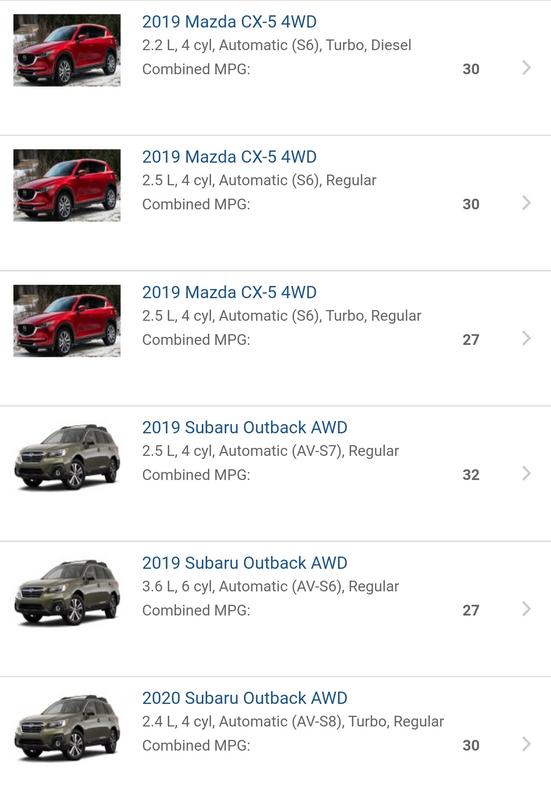
their normally aspirated skyactiv 2.5 is good but when they used a turbo on it. fuel economy took a hit. this is their generation 1 turbo petrol 2.5 engine. Better wait for the second generation turbo petrols.
mazda improved on their diesel turbo engines. i hope they replicate their success on their petrols.
-
Tsikoteer
- Join Date
- Oct 2012
- Posts
- 27,624
-
 Verified Tsikot Member
- Join Date
- Jul 2013
- Posts
- 7,394
July 12th, 2019 06:25 PM #7Hmmm. Naturally aspirated vs Turbocharged
As I posted earlier... For me depende yan sa use mo ng car. Kung majority ng trip mo is highway, then turbo all the way... Kung matraffic ka lang sa EDSA, you may want to consider a naturally aspirated engine.
Using the 2019 Civic as an example.
1.8 is (strangely) lighter
Mas mataas nga HP and Torque nung 1.5 RS, but max output yun, never binaggit yung output nya at less than 2000RPM
So, the 1.5L engine from standstill will need more gas para pagalawin yung sasakyan.
-
Tsikoteer
- Join Date
- Oct 2012
- Posts
- 27,624
July 12th, 2019 06:32 PM #8agree, sa metro manila itll be better having NA ICE... no boost necessary sa traffic lol Originally Posted by ice15
-
Verified Tsikot Member
- Join Date
- Jul 2013
- Posts
- 7,394
July 12th, 2019 06:41 PM #9^palagi kong napapanood sa Q&A about cars...
Q: kailangan ba i-idle ng 2-5mins yung turbo charged na engine bago patayin?
A: kapag high rev driving at gumana yung turbo - yes, kapag city driving at low RPM lang, di na kailangan since di naman gumana yung turbo
-
Verified Tsikot Member
- Join Date
- May 2014
- Posts
- 1,320
July 12th, 2019 06:58 PM #10For me, NA is fine within City and if just cruising leisurely on the highway. The problem for NA (especially if smaller displacement) is when "fully loaded" or going uphill or both. =)
And in those scenarios, I'd really want to have a turbo on hand to tap into to get the power out from the engine.
If from my experience, you'd be fine with turbo'd engines within the city even if you are worried with consumption, as long as you try to avoid engaging the "boost" from the turbo, so keep those revs below 1800rpm. Hehe!
But my experience with turbo'd engines is for diesel pickup or SUV only. Don't have any idea about turbo gas engines if it "applies" as well. Since good torque is available for those diesels at around 1500rpm, sometimes lower (with some Isuzu engines).
I think with the 2.2 Ecoboost Mustang (or was it the Explorer) before, in City when not in boost, it was more fuel efficient that the 3.5L non Ecoboost version. But once the boost did kick in, you were actually better off with the non Ecoboost model. I can't remember exactly the article I read it from.
-
 Verified Tsikot Member
- Join Date
- Jan 2015
- Posts
- 12,396
July 12th, 2019 07:06 PM #11Wanna turbo an NA? Here's what it takes...[emoji4]
How To Turbo Your Miata! - YouTube
Sent from my SM-G970F using Tapatalk
-
Tsikoteer
- Join Date
- Apr 2008
- Posts
- 6,235
July 12th, 2019 07:14 PM #12Turbo petrols are still rather scarce in our market. What we have a lot of are turbo diesels. And in my experience with these, normally aspirated engines are pretty much always more fuel efficient than turbocharged engines, just because they are physically incapable of consuming more fuel with the absence of forced induction. Originally Posted by dropzone
Closest real life example I can quote is my former daily driver, a Toyota Revo 2.4 diesel 5MT and current daily driver, a Hyundai Santa Fe 2.2 CRDi 5AT.
Revo: 7-8 city,12-14 highway
Santa Fe: 5-6 city, also 12-14 highway
Highway for me entails maintaining speeds mostly around 100-120km/h. Though the Revo screams its head off running 100 at 3200rpm and 120 at 3800rpm, while the Santa Fe does 100 at just 1900rpm and 120 at 2100rpm. I would've expected the Santa Fe to be significantly thriftier, but consumption ended up more or less the same when driving out of town.
Sent from my SM-G955F using Tapatalk
-
 Tsikot Member Rank 4
- Join Date
- Nov 2005
- Posts
- 45,927
July 12th, 2019 07:24 PM #13having boost is more fun
hearing the turbo spool up, hit boost, rev to redline, shift, hear the sound of the blow off valve...
puts a smile on your face
-
Tsikoteer
- Join Date
- Jan 2006
- Posts
- 12,608
July 13th, 2019 01:24 AM #14I used to drive daily solely turbo gas vehicles. I have no issues driving them thru traffic every day.
Sent from my iPhone using Tapatalk
-
Verified Tsikot Member
- Join Date
- Jul 2011
- Posts
- 58
July 13th, 2019 10:25 AM #15salamat po sa inyong lahat,
im learning new things here
- - - - - - - - - - - - - - - - - - - - - -
salamat po sa inyong lahat,
im learning new things here
-
Tsikoteer
- Join Date
- Jan 2006
- Posts
- 12,608
July 13th, 2019 10:59 AM #16What turbo gas vehicle are you looking at? I would suggest Subaru vehicles. Originally Posted by dropzone
Sent from my iPhone using Tapatalk
-
Verified Tsikot Member
- Join Date
- May 2014
- Posts
- 1,320
July 13th, 2019 11:12 AM #17With the new extended warranty of Subaru up to 5 years now, which is 2 years more than its Japanese counterparts here (and I think matches the 2 Koreans now - I'm not sure if Kia has the 5 year warranty here like Hyundai), it is definitely a good consideration if the owner is concerned about mechanical parts prematurely failing. =) Originally Posted by Egan101
Question though, I haven't personally owned/maintained Subaru's but previous readings (we're talking about 5 to 7 years ago) mentioned that the boxer engines tend to burn engine oil quicker than comparable engines? Is this true now with the current lineup?
Should this be true, does it mean that even if we use Fully Synthetic, a top up should be in order every 5k kms or 6mos, even if you don't reach the mileage much? Thanks.
-
Tsikoteer
- Join Date
- Jan 2006
- Posts
- 12,608
July 13th, 2019 11:19 AM #18The oil burning issue was with the older EJ25 engines (local WRX STi model and they are not covered by the 5-year warranty). There are no reported such issues with the newer FB16, FA20, and FA25 turbo engines. Originally Posted by 17Sphynx17
Sent from my iPhone using Tapatalk
-
Verified Tsikot Member
- Join Date
- May 2014
- Posts
- 1,320
-
Verified Tsikot Member
- Join Date
- Jul 2011
- Posts
- 58
July 13th, 2019 12:21 PM #20good day sir! Originally Posted by Egan101
i have a 2012 forester xs (pre cvt era)and a 2017 forester xt, i prefer the feel of naturally aspirated here in the city but i think parang bitin sa akin ying 2.0, NA, but when i drive the xt, parang too much power naman, parang may whiplash ako,
parang iba din yung boxer engine sound ng NA ( which i like it more) compared to the XT
im thinking kung sana lng may 2.5 NA na forester dito sa pilipinas

 Reply With Quote
 Originally Posted by StockEngine