
hehe, nakuha pa magreklamo eh kasalanan din naman nila.Originally Posted by Monseratto


The Largest Car Forum in the Philippines
- Forums
- Discussions
- Events
- Community
Results 6,061 to 6,080 of 10726
-

 Moderator

- Join Date
- Nov 2010
- Posts
- 25,276
September 20th, 2011 10:58 AM #6061Fasten your seatbelt! Or else... Driven To Thrill!
-
 Tsikot Member Rank 4
- Join Date
- Nov 2005
- Posts
- 45,927
September 20th, 2011 12:28 PM #6062China bank stops FX swaps, forwards with some European banks -sources | Reuters
China bank stops FX swaps, forwards with some European banks -sources
BEIJING, Sept 20 | Mon Sep 19, 2011 10:07pm EDT
(Reuters) - A big market-making state bank in China's onshore foreign exchange market has stopped foreign exchange forwards and swaps trading with several European banks due to the unfolding debt crisis in Europe, two sources told Reuters on Tuesday.
-
Tsikot Member Rank 4
- Join Date
- Nov 2005
- Posts
- 45,927
-
Moderator
- Join Date
- Nov 2010
- Posts
- 25,276
September 21st, 2011 10:51 AM #6064Swan to Europe, US: get your acts together - Yahoo!7
Another warning....Fasten your seatbelt! Or else... Driven To Thrill!
-
Tsikot Member Rank 4
- Join Date
- Nov 2005
- Posts
- 45,927
September 21st, 2011 11:17 AM #6065Republicans sent Bernanke a letter
tells Bernanke to NOT do anything
Dear Chairman Bernanke,
It is our understanding that the Board Members of the Federal Reserve will meet later this week to consider additional monetary stimulus proposals. We write to express our reservations about any such measures. Respectfully, we submit that the board should resist further extraordinary intervention in the U.S. economy, particularly without a clear articulation of the goals of such a policy, direction for success, ample data proving a case for economic action and quantifiable benefits to the American people.
It is not clear that the recent round of quantitative easing undertaken by the Federal Reserve has facilitated economic growth or reduced the unemployment rate. To the contrary, there has been significant concern expressed by Federal Reserve Board Members, academics, business leaders, Members of Congress and the public. Although the goal of quantitative easing was, in part, to stabilize the price level against deflationary fears, the Federal Reserve’s actions have likely led to more fluctuations and uncertainty in our already weak economy.
We have serious concerns that further intervention by the Federal Reserve could exacerbate current problems or further harm the U.S. economy. Such steps may erode the already weakened U.S. dollar or promote more borrowing by overleveraged consumers. To date, we have seen no evidence that further monetary stimulus will create jobs or provide a sustainable path towards economic recovery.
Ultimately, the American economy is driven by the confidence of consumers and investors and the innovations of its workers. The American people have reason to be skeptical of the Federal Reserve vastly increasing its role in the economy if measurable outcomes cannot be demonstrated.
We respectfully request that a copy of this letter be shared with each Member of the Board.
Sincerely,
Sen. Mitch McConnell, Rep. John Boehner, Sen. Jon Kyl, Rep. Eric Cantor
-
Tsikot Member Rank 4
- Join Date
- Nov 2005
- Posts
- 45,927
September 22nd, 2011 10:38 AM #6066Fed no QE3
interest on excess reserves -- no change
Fed to buy $400B long term debt, sell $400B short term debt
Fed to buy maturities 6-30 yr , sell maturities to 3 yr
______________________________________________
US 30 yr yield
-
 Social Dementia
- Join Date
- Sep 2003
- Posts
- 25,189
September 22nd, 2011 10:46 AM #6067Feds runs out of fixes for the US economy. It's wallowiing in too much debt.
NEW YORK (AP) — The Federal Reserve did what investors expected Wednesday — it said it would buy Treasury bonds to help the economy. But stocks fell anyway. The reason? The Fed made it clear that it thinks a full economic recovery is years away.
-
Tsikot Member Rank 4
- Join Date
- Nov 2005
- Posts
- 45,927
September 22nd, 2011 11:19 AM #6068the Fed is forcing down interest rates to make loans cheaper to encourage borrowing
the 10 yr yield is already at record low
THAT IS NOT THE PROBLEM
-
Tsikot Member Rank 4
- Join Date
- Nov 2005
- Posts
- 45,927
-
Tsikot Member Rank 4
- Join Date
- Nov 2005
- Posts
- 45,927
-
Social Dementia
- Join Date
- Sep 2003
- Posts
- 25,189
September 22nd, 2011 11:02 PM #6071Equities taking a pounding. CAC and FTSE down 4%. Dow, S&P and Nasdaq plunged 3+% at the opening. Even GOLD prices, which was a darling of sort; also dropped 3% to US$ 1,739...Red in the dominant color.
-
 Wheelin and Dealin'
- Join Date
- Feb 2008
- Posts
- 14,181
September 22nd, 2011 11:07 PM #6072Walang takas except USD and Bonds (Treasuries)... Volatility continues...
-
Tsikot Member Rank 4
- Join Date
- Nov 2005
- Posts
- 45,927
September 22nd, 2011 11:14 PM #6073rumor Fed cutting rates on FX swap lines
(i doubt it)
euro bounce
-
Tsikot Member Rank 4
- Join Date
- Nov 2005
- Posts
- 45,927
September 22nd, 2011 11:26 PM #6074want some more evidence the global economy is slowing?
from Rio Tinto, one of the biggest mining companies in the world
Media releases - Rio Tinto Investor Seminar - Rio Tinto
Rio Tinto's order books are full and commodity prices remain robust. However, customer sentiment is now more cautious and physical markets are softer than they were six months ago, reflecting concerns over the health of the OECD economies and persistent volatility in financial markets.Rio Tinto chief executive Tom Albanese said "We've been saying for quite some time that we expected to see patterns of increased price volatility amidst turbulent financial markets and that scenario is playing out.
"Our order books are full and pricing is strong, but it is noticeable that markets are somewhat weaker than they were six months ago. We are realistic and well-positioned for any number of scenarios - our high-quality growth programme is in full swing to capture the expected increases in longer-term demand, and our balance sheet is very strong and well able to withstand any near-term decline.
-
Tsikot Member Rank 4
- Join Date
- Nov 2005
- Posts
- 45,927
-
Wheelin and Dealin'
- Join Date
- Feb 2008
- Posts
- 14,181
September 23rd, 2011 07:04 AM #6076As H-P's CEO, Whitman an imperfect fit - Yahoo! FinanceSAN FRANCISCO (AP) -- Hewlett-Packard Co.'s decision to fire CEO Leo Apotheker after just 11 months and replace him with former eBay chief Meg Whitman is another dizzying turn of the executive merry-go-round at a company whose leadership issues are tearing it apart.
Swapping Apotheker, who has now been ousted from two high-profile CEO jobs in two years, with Whitman, a billionaire who is best known for the decade she spent building eBay and her run for California governor, is a decision designed to stem investor fury over a series of questionable strategy moves.
Whitman's star-power could be an asset for a company that struggled to gain credibility under Apotheker, who was previously little-known outside of the business software world. HP is no stranger to celebrity CEOs. But Carly Fiorina's run as leading lady, from 1999 to 2005, ended in shambles.
Despite Whitman's success at eBay, she is untested when it comes to running a sprawling company such as HP.
Meg Whitman becomes new HP CEO!
-
Social Dementia
- Join Date
- Sep 2003
- Posts
- 25,189
-
Social Dementia
- Join Date
- Sep 2003
- Posts
- 25,189
September 23rd, 2011 12:30 PM #6078Tawag ngayon ng Generation X is Generation U for unemployed/underemployed. Trending in many developing countries, many 20-30s are still living or returning to live with their parents, some with families of their own. Many adults are delaying or foregoing marriage and children because of financial realities. Many of the growing unemployed are college degree holders.
http://video.app.msn.com/watch/video...ardest/6q4sxz0
What effects can a second recession have here? The developed nations are helpless already as it is, with their hands tied by debt created from trying to fix the first recession...
Bottom Line - Recession's second act would be worse than the first
Recession's second act would be worse than the first
By John W. Schoen, Senior Producer
Fresh evidence of a global economic slowdown has raised fears that governments around the world may be powerless to reverse it. If the world does fall into back into recession, it could be much harder to escape than the contraction that ended in 2009.
With banks still recovering from a decade-long credit bubble, governments slashing spending to cope with unsustainable debt, and unemployment at levels not seen in decades, a new recession would be “disastrous,” according to Roger Altman, a senior Treasury official in the Clinton administration.
“We could be in for a repeat of the experience of 1937, when America fell back into recession after three years of recovery from the Great Depression,” he wrote in the Financial Times.
Altman was referring to the fact the global downturn of the 1930s technically included two U.S. recessions, from 1929 to 1933 and again from 1937 to 1938. U.S. unemployment peaked at over 20 percent in the 1930s, according to historical estimates, and did not decline significantly until factories began gearing up for World War II.
Two years after the latest U.S. recession technically ended, evidence continues to build that the weak recovery is stalling out. The U.S. economy stopped producing new jobs in August after a string of mostly meager monthly job gains that failed to bring the unemployment rate below 9 percent.
On Thursday, fresh data showed the Eurozone's service sector contracting for the first time in two years; a separate index of the manufacturing sector, which has provided much of the region’s growth, slowed for the second month in a row.
A global stock sell-off that dragged market indices to their lowest level of the year spread to the U.S., where the Dow Jones industrial average was down nearly 400 points.
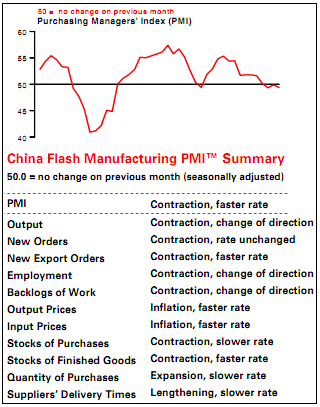
Until recently, there were hopes that emerging economies in places like China and Brazil could prop up global growth until a stronger recovery took hold elsewhere. But China’s two biggest export markets -- Europe and the United States -- are struggling, and that has cut into demand for Chinese goods. A report out Thursday showed that China’s factories slowed for the third month in a row.
"There is a global slowdown,” Jeavon Lolay, head of global research at Lloyds Banking Group, told Reuters. “There is no doubt the risks of a global recession have grown."
That’s also the opinion of Federal Reserve policymakers, who said Wednesday they saw "significant downside risks" to the U.S. economy after deciding to launch an unusual program of reshuffling $400 billion in Treasury holdings to try to push interest rates lower.
But with interest rates already at record lows, few expect the program to do much to increase the demand for loans. Businesses face weak demand for their products and services and consumers are continuing to work to pay down their debts. Though mortgage rates remain at record lows, millions of homeowners are unable to refinance their higher rate loans because they owe more than their home is worth.
Some analysts argue that the Fed’s latest move (dubbed Operation Twist because it “twists” the relationship between short- and long-term rates), will hurt economic growth because it will squeeze bank profits and lower the income consumers earn on their savings. Public and private pension funds, already under strain, will be even more badly underfunded because they’ll have to set aside more money to generate the same amount of cash to pay retiree benefits.
“In a couple of weeks (Operation Twist) will be a subject for economic history, and the main discussion will be that the Fed is grasping at straws,” former Fed governor William Poole told CNBC. “I think that they have thrown lead into the life preserver, and they are sinking.”
‘Slow motion train crash’
European central bankers appear increasingly unable to contain a widening banking crisis, sparked by the threat of bond defaults in Greece and Italy, Europe’s third-largest economy.
The International Monetary Fund warned Tuesday that Europe and the United States could slip back into recession next year without bold action
"We are seeing a slow-motion train crash in the euro area, where credit contraction risks leading to a new recession by Christmas unless governments face up to the task swiftly and forcefully," Martin Enlund, market strategist at the Swedish bank Handelsbanken told Reuters.
Policymakers in China, the world’s third largest economy behind the U.S. and EU, face their own set of tough choices. Rapid growth rate has fueled inflation that is running at a double-digit rate, according to analysts -- much higher than official targets. To contain inflation, Beijing has raised interest rates five times and lifted banks' reserve requirements nine times since October. If it clamps down too hard, though, a deeper economic slowdown could reverse China's efforts to lift hundreds of millions of people out of poverty.
China is also coping with a banking hangover of its own, after years of massive government lending for expansion of state-owned enterprises an infrastructure upgrades.
"There is a two-tier system within China and I think the lending that's taking place and the percentage of nonperforming loans is now at a level that is disturbing," David McAlvany, chief executive at McAlvany Financial Group told CNBC. "Ultimately, (China's banks) will have to see some comeuppance."
-
Tsikot Member Rank 4
- Join Date
- Nov 2005
- Posts
- 45,927
September 23rd, 2011 01:10 PM #6079less demand for goods from AsiaWhat effects can a second recession have here? The developed nations are helpless already as it is, with their hands tied by debt created from trying to fix the first recession...
China PMI signal contraction
-
Tsikot Member Rank 4
- Join Date
- Nov 2005
- Posts
- 45,927
September 23rd, 2011 01:34 PM #6080since we're on the topic (signs of global economic slowdown)...
Fedex
FedEx Corp. Reports Higher Revenue and Earnings | FedEx Global Newsroom
MEMPHIS, Tenn., September 22, 2011 ... FedEx Corp. (NYSE: FDX) today reported earnings of $1.46 per diluted share for the first quarter ended August 31, compared to $1.20 per diluted share a year ago, a year-over-year increase of 22%.
“Revenue and earnings increased significantly in the quarter due to strong FedEx Ground performance, improved FedEx Freight results and the continued success of the company’s yield management actions,” said Frederick W. Smith, FedEx Corp. chairman, president and chief executive officer. “While the economic environment is challenging, we remain confident FedEx will improve earnings, margins and cash flows this fiscal year.”
First Quarter Results
FedEx Corp. reported the following consolidated results for the first quarter:
• Revenue of $10.52 billion, up 11% from $9.46 billion the previous year
• Operating income of $737 million, up 17% from $628 million last year
• Operating margin of 7.0%, up from 6.6% the previous year
• Net income of $464 million, up 22% from last year’s $380 million
During the quarter, improved FedEx Ground and FedEx Freight results offset the effect of slowing global economic growth, which especially impacted volume levels and drove lower productivity at FedEx Express. Results also reflect wage increases, higher funding of incentive compensation programs and the reinstatement of full 401(k) company-matching contributions.
Outlook
FedEx projects earnings to be $1.40 to $1.60 per diluted share in the second quarter and $6.25 to $6.75 per diluted share for fiscal 2012, compared to the company’s previous full year forecast of $6.35 to $6.85 per diluted share. This guidance assumes the current market outlook for fuel prices and moderate growth in the global economy. The company reported earnings of $0.89 per diluted share in last year’s second quarter, which included charges of $0.27 per diluted share. The capital spending forecast for fiscal 2012 remains $4.2 billion.
“The U.S. and global economy grew at a slower rate than we anticipated during the quarter,” said Alan B. Graf, Jr., FedEx Corp. executive vice president and chief financial officer. “While FedEx Ground and FedEx Freight achieved improved operating results despite lower than expected growth, the more rapid decline in demand for FedEx Express services, particularly from Asia, outpaced our ability to reduce operating costs. We have slightly reduced our earnings forecast to reflect current business conditions and are aggressively working to adjust our cost structure to match demand levels.”
The company plans to begin acquiring FedEx common shares. A total of 5.7 million shares may be repurchased under existing share repurchase authorizations. The repurchases will be subject to market conditions and will be made from time to time either in the open market or through private transactions in accordance with the requirements of the Securities and Exchange Commission. The company’s repurchase program may be suspended, discontinued or resumed at any time.
2012 Rate Increases
FedEx Express will increase shipping rates by a net average of 3.9% for U.S. domestic, U.S. export and U.S. import services effective January 2, 2012. The full average rate increase of 5.9% will be partially offset by adjusting the fuel price threshold at which the fuel surcharge begins, reducing the fuel surcharge by two percentage points. The FedEx Ground and FedEx SmartPost pricing changes for 2012 will be announced later this year. FedEx Freight implemented a 6.75% general rate increase on September 6, 2011.
 Originally Posted by Monseratto

 Reply With Quote

