
Hence why diesel first before hydrogen. Electrics are nice and all but the practicality of setting up the infrastructure and getting cars to a degree of economic reach and reliability are suspect. It is easier to go into a hydrogen economy once certain milestones are met. After all, Hydrogen isn't particularly geo-politically dependent.Originally Posted by niky


The Largest Car Forum in the Philippines
- Forums
- Discussions
- Events
- Community
Results 221 to 240 of 292
-
 Tsikoteer

- Join Date
- Aug 2005
- Posts
- 553
October 23rd, 2012 11:48 AM #221
-
 SobrangBilisMagType!
- Join Date
- Aug 2004
- Posts
- 22,702
October 23rd, 2012 01:34 PM #222The only cheap source of hydrogen is natural gas. Which we can already burn straight in an internal combustion motor, and which IS geopolitically dependent. As are the platinum needed in fuel cells, if we go that route. And if we go that route, the fuel cell will be basically acting as an expensive battery.
Hydrolysis is not cheap. Not at all. Once you've spent all the money necessary to install a hydrogen fuel infrastructure, you will have spent enough resources and energy to install a refueling infrastructure for both CNG and electric vehicles combined.
Hydrogen's only appeal is it allows you to use familiar ICEs and it has decent energy density if you spend a crapload of money on your storage medium. But the fuel tank / battery problem is an order of a magnitude more difficult to solve than either electrics or CNG and a hydrogen economy will always be an energy negative economy with one extra conversion step (loss) than electricity.
Ang pagbalik ng comeback...
-
 Tsikot Member Rank 4
- Join Date
- Nov 2005
- Posts
- 45,927
October 23rd, 2012 02:59 PM #223oil, natgas, coal
those are and will be the main global energy sources for years to come


-
Tsikot Member Rank 2
- Join Date
- Jan 2008
- Posts
- 4,725
October 23rd, 2012 03:34 PM #224time will come na converting water to hydrogen will be easy, simple and cheap... we just don't know how to do it yet..
-
SobrangBilisMagType!
- Join Date
- Aug 2004
- Posts
- 22,702
October 23rd, 2012 03:47 PM #225It's already easy. It's already simple. But thanks to the immutable laws of physics, it will never be cheaper than recharging a battery. Originally Posted by yapoy86


Last edited by niky; October 23rd, 2012 at 03:53 PM.
Ang pagbalik ng comeback...
-
Tsikot Member Rank 2
- Join Date
- Jan 2008
- Posts
- 4,725
October 23rd, 2012 04:09 PM #226that's when you need Research and Development... you don't stop because you already know!! there will always be a better way...
-
SobrangBilisMagType!
- Join Date
- Aug 2004
- Posts
- 22,702
October 23rd, 2012 04:52 PM #227Call me back when Research and Development find a way to break the Laws of Physics and Thermodynamics. Because so far, we haven't been able to do so, yet. Making hydrogen production just as energy efficient as simply producing electricity would effectively be invoking perpetual motion.
Again. Making hydrogen is simple. Running a car on hydrogen is simple. Making it more efficient than an electric car is impossible.
Let's make it much, much simpler.
You live on an island and there is only corn and pigs. You used to have coconuts (oil!), which you didn't have to cook, but the coconut trees are all gone. Now you not only have to work your ass off to farm pigs or corn, but you have to spend to cook your food, too, as well as make expensive clay cooking pots to cook it in.
To feed all the people, you can feed them corn. Some of the corn goes bad or gets wormy, so you can only eat 86% of the corn harvested. For every four kilos of corn harvested, you get 3.44 kilos of corn to eat. This is the energy efficiency of battery-electric.
But, conversely, you can feed the corn to pigs, and the people can eat the pigs. For each kilogram of corn you feed them, pigs return one kilogram of meat. That's about the same as the 25% efficiency you get from converting electricity to hydrogen.
But as more people are born, food becomes scarce.
So, what do you do? Do you keep feeding your corn to the pigs and the pigs to the people, or do you simply feed people corn?
There are no two ways about it. Hydrogen is pork. And the sooner we veer away from the idea that hydrogen is some magical, primary source of energy (because if you don't have a fusion reactor, no... it isn't), then the sooner we can figure out how to efficiently power our automobile fleets, whether it be with grid-based electricity, biofuels, waste biofuels or something else.Last edited by niky; October 23rd, 2012 at 04:57 PM.
Ang pagbalik ng comeback...
-
 Tsikoteer
- Join Date
- Oct 2002
- Posts
- 29,354
October 23rd, 2012 04:55 PM #228Electrolysis is simple and easy but energy needed for it is NOT cheap. Originally Posted by yapoy86
If we solve the cheap energy issue for electrolysis, we probably not need electrolysis to fuel our cars.
- - - Updated - - -
Call me when you have a matter-antimatter reactor working. Originally Posted by yapoy86
-
Tsikot Member Rank 2
- Join Date
- Jan 2008
- Posts
- 4,725
October 23rd, 2012 05:12 PM #229think out of the box boyz.... youre only focused on water, electrolysis, hydrogen, internal combustion engine etc etc.... its like yesterday when people think going to the moon is impossible....
i will not call you coz i'm not into R&D or doing anything to develop those... but if one day i find a better way, i will share it with you...
now you are all saying its "impossible"... for now maybe...
we are using fossil fuels that was also converted using enormous amounts of energy and that energy used to convert those dead matter to fossil fuel is free (nature)...
-
Tsikoteer
- Join Date
- Oct 2002
- Posts
- 29,354
October 23rd, 2012 05:25 PM #230 Originally Posted by yapoy86
Going to the moon is possible, just like mass market electric cars... it is just not economically feasible...
With the exception for the die-hard "greenies", there is little incentive for the common driver to use an expensive energy/fuel source when there are cheaper and easy to obtain options to choose from.Last edited by ghosthunter; October 23rd, 2012 at 05:27 PM.
-
Tsikot Member Rank 2
- Join Date
- Jan 2008
- Posts
- 4,725
October 23rd, 2012 05:55 PM #231i hope you get my point.... continuous research, try and test
you say going to the moon is possible because it was tried...
for example to those people at the time of Magellan, going to the moon for them is impossible!! even circum navigating the earth is impossible not until tried by Ferdinand Magellan...
-
Tsikoteer
- Join Date
- Oct 2002
- Posts
- 29,354
October 23rd, 2012 06:10 PM #232 Originally Posted by yapoy86
Even Magellan needed financial backing for his trip, specifically the King of Spain.
The king of Spain needed a shorter route to get to the Spice Islands.
Magellan's primary purpose in his voyage to find a shorter route, not to prove the world is round.
Hence it has to prove to be a economically feasible or in the least, a good gamble for potential investors.
I hope you also get my point.
Electric cars will not happen just for the sake of "cleaning the environment".
Continuous research costs lots of money.
Someone will still have to profit from it if it's going to happen.
-
SobrangBilisMagType!
- Join Date
- Aug 2004
- Posts
- 22,702
October 23rd, 2012 06:20 PM #233Going to the moon was not impossible. Even befote we did it, people already knew how much power was needed to go to the moon. It was a simple matter of physics. Jules Verne's moon cannon actually had enough power for escape velocity... It was just technically unfeasible.
Seems you fail to grasp the problem with the idea. The problem is not one of ability, technology or a lack of understanding of physics. The problem is simply one of economics.
Similarly, our lives would all be better if we built enoughg solar power stations to power our entire planet. Do we have the technology? Yes. Do we have the knowhow? Yes. do we have enough money and raw materials to do it? No way, jose.
At least solar has a payback period. With hydrogen, you keep paying down the line due to te negative efficiency. Again... If we have all this corn, why don't we eat it instead of feeding it to the pigs?
That's the qeustion you need to answer. Don't tell us research will magically make hydrogen possible. It's already possible. Tell us how we are to make it more economical than all the other alternatives, which don't require that extra energy step, at all.Last edited by niky; October 23rd, 2012 at 06:28 PM.
-
Tsikot Member Rank 2
- Join Date
- Jan 2008
- Posts
- 4,725
October 24th, 2012 09:42 AM #234now do you have any idea?? money is not a problem, the problem is "will"
again you are focusing on hydrogen etc.... my point is there is another way around the problem.... not just hydrogen..
Btw, using fossil fuels how much energy we use to refine these to different types of fuel??
for example palm oil, there is continuous research on how to develop palm oil to other use..
solar panels, there are developments that focus sunlight to the photovoltaic cells which makes them cheaper, smaller yet can generate more power for residential use..
now this is Research and Development.. you don't stop because you already know!!
-
Tsikoteer
- Join Date
- Oct 2002
- Posts
- 29,354
October 24th, 2012 11:00 AM #235Focused sunlight on photovoltaic cells has been around since the first generation solar cells. The main issue is with heat which rapidly degenerates the efficiency of the solar cells as well as it's useful life. Current systems employ a radiator for each panel to keep it cool. Downside, the array needs to be motorized in two axis to accurately follow the sun's arc through the sky. Such are expensive and have limited applications due to cost, complexity and long term maintenance issues. Originally Posted by yapoy86
Residential solar power will be in low cost fixed solar panel installations.
Money is the issue. If there is no potential profit, it is just akin to burning cash in an open pit.
-
SobrangBilisMagType!
- Join Date
- Aug 2004
- Posts
- 22,702
October 24th, 2012 11:28 AM #236Do I have any idea? Do I have any idea of the billions of dollars of money that have gone into research and development for hydrogen, already? Yes. I do. The fact that most of the major manufacturers continue to sink untold billions into hydrogen research indicates there is no lack of "will" Originally Posted by yapoy86
I'm not the one who first brought up hydrogen. Sorry for answering the suggestion with a realistic assessment of the probabilities. Originally Posted by yapoy86
Currently, Fossil fuels have a return on energy investment of about 15:1. New generation oil shale is less than 10:1. Biofuels, at best, are at 5:1. Originally Posted by yapoy86

(Wow... I actually still remembered).
This means that you use 1 barrel of oil to produce 20 barrels of useable oil.
Hydrogen is energy negative, meaning you consume the equivalent of 4 barrels of oil to produce the energy of 1 barrel of oil equivalent from hydrogen.
But biofuels. Corn ethanol is barely break even. Palm oil can possibly get past 3:1 (best biofuel is currently sugarcane), and you can burn the solid wastes to power the plants. But it gets iffy when you start to consider transport and refining. I've been avidly following biofuel development here and abroad, and the problem really is pricing. The production price of most biofuels is equal to the sale price of current diesel or gasoline. In other words, the retail price will have to be some 10-20 pesos higher. And don't forget. The tractors used in farming and the machines used in refining still consume oil or electricity generated by oil. You can offset a little bit by using methane generated from organic wastes in the harvesting, but you're not going to get much beyond the 5:1 EROEI.
I have been actively involved in studying solar power for Rotary Foundation projects and institutional use. Solar cells are nothing new. And more effective solar cells are not forthcoming. Basically, we are close enough to the theoretical limit on energy return from solar cells, so the focus now is on making them cheaper. Originally Posted by yapoy86
The main development in solar cells over the past few years is the introduction of Chinese cells, which have brought the prices crashing down. This is part of what brought down the US company Solyndra recently.
Prices are almost at the break even point. Wherein you can recoup the investment before the cells lose power (25 years). Though you are bound to break even, anyway, as cells remain productive up to 35 years or more, despite the 25 year guarantee on most cells. The question is whether it's worth keeping the cells that long or upgrading to more effective ones at that point.
-
And at no point did I say we should stop research. The real issue is that if you spend billions of dollars in research chasing white elephants and holy cows ( ), then you spend less money on research on things that actually WILL benefit us.
Research on solar? Good. Research on biofuels? Good. Research on hydrogen? Dead end. Do something else. Leave hydrogen development to the aerospace companies, where it makes more sense.
Ang pagbalik ng comeback...
-
Tsikoteer
- Join Date
- Aug 2005
- Posts
- 553
October 24th, 2012 12:39 PM #237Here's the problem. Hydrogen is, on a small lab scale -a viable fuel. Its getting it up to larger scales of implementation that buggers the equation.
Being able to produce Hydrogen as a fuel or a medium of energy storage is the problem and that will require research funding.
How does that compete with the rest or our energy options and how soon will returns be realized is a business plan that needs to be justified.
Focused Photovoltaics are reaching commercial viability. Companies in Australia give or take funding availability have demonstrated this to be feasible.
Investment in this sector is cyclical to fuel prices. That is why government support through policies are needed to subsidize and at times guarantee their viability. Solar power for instance have preferred status on feed in tariffs, whereby a fixed rate is paid for the power generated by renewables and are given priority on the spot market during peak hours. Which in the case of solar is pretty obvious given its cycle availability.
-
Tsikot Member Rank 4
- Join Date
- Nov 2005
- Posts
- 45,927
October 24th, 2012 12:54 PM #238just follow the money
where is the big money going?
oil and gas exploration and extraction parin
coal mining parin
solar, hydrogen... just side projects
-
SobrangBilisMagType!
- Join Date
- Aug 2004
- Posts
- 22,702
October 24th, 2012 02:40 PM #239The big money is in oil and will continue to stay there until EROEI goes below 5:1. Then it will shift maybe towards biofuel and waste-derived fuels (landfill methane or waste veggie oil).
-
A lot of people are saying the oil crisis is over. There's a crapload of oil in oil shale. Well... yes and no. Part of the increase in supply is because formerly uneconomic wells, shut down because they made no sense to operate on $60 oil, are now feasible in a post-$100 oil economy. And shales won't work at all below $80. But we know that. What is more alarming is this:
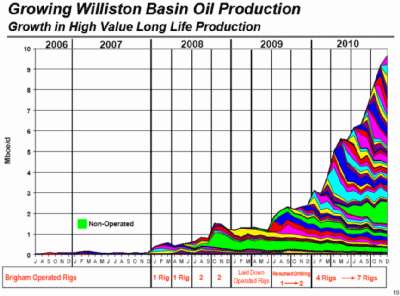

Oil from new unconventional sources like Oil Shale and tar sand show steeper decline in production after just one year than conventional oil wells do. In other words, we have to keep drilling more and more new wells, faster and faster to keep up. This means more investments upfront for the same amount of product. A vicious cycle that is bound to lead to collapse, as companies run to keep up.
-
Solar investments are long-term thinking. Hard to get investors to sink money into projects that, on-paper, are NEVER going to be money-positive, even if they end up energy-positive in the long term. And the sad part is... money spent researching newer and more effective cells might never matter if those more effective cells aren't cheaper.
If a research group produces a new cell that is only half-as-efficient as the state of the art, but costs less than a tenth as much, then we might see a boom in solar installations. Here's to hoping.
Ang pagbalik ng comeback...
-
Tsikoteer
- Join Date
- Aug 2005
- Posts
- 553
October 24th, 2012 03:39 PM #240Yep, hydrocarbons are here to stay for a loooooong time. It really just depends on our willingness to recognize the impact this has to our environment, the long term costs vs the short term gains.
The strange thing about some uneconomic wells are that they are strangely replenishing themselves. This lends a bit of credence to the abiotic theories for oil. But it is interesting to note that ultra-deep well drilling in Vietnam and the likes have yielded ridiculous amounts of oil well below the fossil layer. Fodder for conspiracy theorists I'm sure.
For larger scale power generation I'm betting on nuclear. If laws allow it, factories could invest in a micro-nuke plant that will last for 30 years. Thing is the size of a railroad cart and can be chained together for increased output. Relatively low maintenance for their operational lifetimes.
 Originally Posted by niky

 Reply With Quote
