How to check the transmission and discover possible transmission problem when buying a used car.
• How to check an automatic transmission when buying a used car
• How to check manual transmission
• How to check automatic transmission fluid
• Checking CV joints
Please note, the information below is designed to give you an initial idea about what to look for when buying a used car and may help you to eliminate some used cars with potential problems, but it can not substitute detailed mechanical inspection performed by a professional. As a final step before purchase, take the car to a mechanic of your choice for thorough mechanical inspection.
An automatic transmission becomes more reliable these days, but still it's most-easy-to-break and most-expensive-to-fix part of the vehicle. If heavily abused, the automatic transmission can be easily destroyed within half an hour. For example, a friend of mine burnt the automatic transmission in 20 minutes when he was trying to free his shiny Audi from the snow in the next day after he bought it! it cost him about $2000 to rebuild it and after one year it broke down again.
Also, an automatic transmission is very sensitive to the fluid quality and condition. Improper fluid type can damage the transmission. A person I know added a gear oil into the automatic transmission, guess what - 30 minutes of driving was enough to destroy the transmission. Obviously, when buying a used car, the automatic transmission is one of the most important parts to check. Make sure to have the car inspected by a mechanic before you made final decision, it will well worth it.
At the beginning
First, check the used car history records; it may save you some time and money. If the history report shows that the car you want to buy was used as a rental vehicle or has been involved in an accident, there is no point to even look at it.
How to check a used car history report
Ask the previous owner or salesperson if any repair has been done to the transmission.
If the automatic transmission is already rebuilt, try to avoid buying such a car. It's not like all rebuilt transmission will have problems - some of them work even better than before. The problem is that not all transmission shops can do equally the same high-quality job. And since there is no way to verify if it was rebuilt properly or not, it's better not to take chances. Another thing to be concern about, ask if the car you are looking for was used for towing a trailer. I've seen many cars that were used for towing a trailer with excessively worn transmission.
How to check an automatic transmission
Automatic transmission fluid
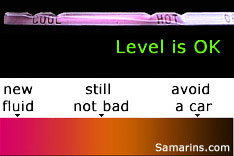
First, check the transmission fluid level and condition. If you don't know how to do it, here is an illustration:
How to check the automatic fluid
With the engine idling, transmission in "Parking" (some car may have different procedure, refer to owner's manual) remove the automatic transmission dipstick and wipe it out with the tissue. Then insert it back and pull out again. Look at the fluid very closely. It helps to drip the fluid on a white paper to be able to see fluid condition. The fluid on the paper should be clean and transparent, without any metal filings or black flakes. New fluid comes red. Over the time and use it become more brownish, but it shouldn't be black. Look at the image on the left.
Try to smell the fluid. It should not have a burnt smell.
All this may seem to be difficult for you but when you check few similar cars, you'll be able to see the difference.
If you discover that transmission fluid is too dirty or black, or smells burnt, avoid buying such a car.
However, some modern cars simply don't have the transmission dipstick. In this case, the only way to check it is a test drive.
Automatic transmission test drive
Use more caution when test-driving someone else's vehicle - the mirrors, the driver's seat, etc. may not be adjusted properly for you. First, get use to brake pedal feeling, adjust the mirrors, driver's seat, and learn all the controls of the vehicle. Proceed to drive only when you sure it's safe.
One of the indications of a transmission problem is delayed engagement, when there is a long delay between you shift the shifter into "D" or "R" and the transmission kicks in.
It's easier to note delayed engagement after a car was sitting for a while: With the transmission in "P" (Park) start the engine, and wait until the engine rpm has reduced to normal level (650 - 850 rpm).
With your foot holding down the brake pedal, shift to the "D" (Drive) position. Almost immediately the transmission should engage - it feels like the car wants to creep forward. This should happen very smoothly, without a strong jerk or clunk.
Shift to "N" (Neutral), and the transmission should disengage. Now, shift to the "R" (Reverse) position. Again, the transmission should engage without a delay - you will feel the car wants to creep backward. This also should be very smooth, without a strong jerk.
If there is a notable delay (more than 1 seconds) between the moment you shift and the moment the transmission engages, such a transmission is either too worn or has some problem, avoid this car.
If there is a strong jerk or noise while shifting, avoid buying such a car. Now, still holding the brake pedal down, try to shift from D to R and back. There should be no strong jerk.
Shift to the "D" position, and try to drive gently, with smooth and gradual acceleration. Until the vehicle reaches a speed of 50-60 km/h or 30-37 mph, you should feel the gears shift at least twice (from first to second, and from second to third). These shifts should be made very smoothly, without jerks or slipping.
By "smooth shift" I mean it should be smooth but you should feel it at the moment the rpm drops down; it feels like the car slows down for a very short instance and then accelerates again. You also can note the transmission shifting moment by the slight change in the engine tone.
But when the transmission is extremely worn it may shift with quite a strong jerk, shudder or a delay (especially from first to second speed).
Driving at a speed of 40-50 km/h or 25-30 mph, if you press down the accelerator pedal for a few seconds, you should feel downshifting to the lower gear, if the automatic transmission works properly.
The next step: check overdrive.
While driving at 60-70 km/h or 35-45 mph on a level road, without using the accelerator, switch overdrive ON. You should feel an upshifting to the next speed. Switch it to "OFF," and you should feel a downshifting.
Another thing that may indicate the transmission problem is the slipping. When the transmission is excessively worn it may slip - which means you press the accelerator, the engine rpm increases but the speed remains the same.
If during the drive test you feel any problem such as transmission seems to slipping or shifts with a jerk or shudder or if the transmission got stuck in some gear, or has trouble shifting into a particular gear (for example, from second to third), avoid buying such a car.
Test-drive the car as long as possible. Often the transmission may work well when it's cold but when it's warmed up it starts giving troubles. So, it's better to spend more time checking the transmission than later fixing it endlessly. Normally there should be no shudder, no noises or any kind of strong jerks at any speed and at any engine temperatures while any shifting. If the salesperson tells you that the jerks or shudder or any other abnormal transmission behavior is "normal" for this car or it's just because the car is cold or anything alike, never trust them. The warranty they give you doesn't mean that the transmission won't break. It only means that may be dealer will take care of the car if it will break. Plus, a rebuilt transmission in many cases doesn't last too long.
Check the CV joints
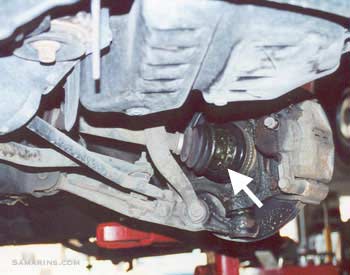
Broken CV joint boot
An OK CV joint boot
A Constant Velocity joint or CV joint is an important component of the drive train. The CV joint is packed with grease and protected by the rubber or plastic boot.
Most common problem with the CV joints is when the protective boot gets damaged. Once this happens, the grease comes out and the moisture and dirt come in, eventually causing the CV joint to fail due to lack of lubrication and corrosion.
In worst case, the CV joint may disjoin causing the vehicle to stop running.
You can check the condition of the CV joint boots visually. You can see them with the front wheel turned outside, looking down from the front of a car. None of them should be damaged. Look at the photos. The CV-joint boot in upper image is damaged, in the lower image it looks OK. If a boot is damaged, it has to be replaced as soon as possible. If continue driving with broken boot, the CV joint or a whole drive shaft will need to be replaced.
While drive test, If you hear clicking or popping noise when turning, the CV joint is probably already defective.
Have the car inspected by a mechanic
Before making your final decision, have the car inspected by a mechanic. There are many things that only an experienced mechanic will be able to reveal.

The Largest Car Forum in the Philippines
- Forums
- Discussions
- Events
- Community
Results 1 to 5 of 5
Threaded View
-

 David Tong

- Join Date
- Oct 2002
- Posts
- 13,415
October 18th, 2006 10:37 PM #2