


wow!nice info,so what happens if its not alinged?

The Largest Car Forum in the Philippines
- Forums
- Discussions
- Events
- Community
Results 21 to 36 of 36
Hybrid View
-
 Tsikot Member Rank 2

- Join Date
- Oct 2002
- Posts
- 441
-
 Chinese Mafia Don
- Join Date
- Feb 2005
- Posts
- 3,299
June 2nd, 2006 05:30 PM #2Well, these dots are properly aligned, the number of balancing weights (tingga) you would need to use would be minimized. Properly mounted tyres limits the RFV or radial force variation. If your tyres have a high RFV, the ride won't be that smooth and the ride won't be that comfortable. Plus, it lessens the effective performance of your car.
Medyo mahaba ang explanation sa RFV eh kaya eto na lang ang link sa Wikepedia, he he he. My apologies: medyo nerdy ang explanation dito.
What is Radial Force Variation?
-
 Tsikoteer
- Join Date
- Feb 2003
- Posts
- 690
June 2nd, 2006 05:43 PM #3cool thread, i just had new tires and wheels mounted last weekend, check ko nga kung aligned.
-
 Blue Eagle
- Join Date
- May 2006
- Posts
- 1,256
June 2nd, 2006 06:16 PM #4Interesting.....pero these marks has minor effects only for older rims di ba? Kasi naglalagay din naman ng weights to make sure of close to zero centrifugal drift during tire alignment if you fit new tires on old rims.....or maybe siguro dahil luma na rin yung rims kaya yun mismo ang may mga deformity contributing to the offset in centrifugal alignment.
-
 Verified Tsikot Member
- Join Date
- Oct 2002
- Posts
- 74
June 2nd, 2006 10:31 PM #5just get a new car..are these tyres correctly installed ?..cannot seem find the dimples on the rims but the yellow dot is aligned to the pito....
[IMG]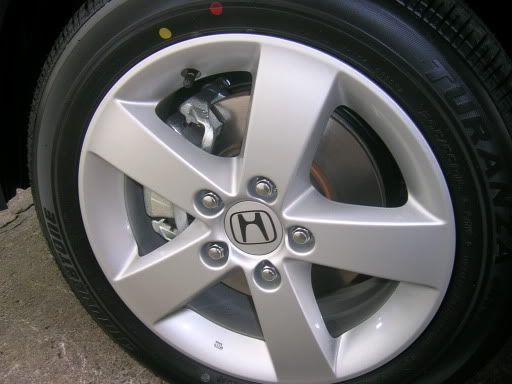 [/IMG]
-
Tsikot Member Rank 4
- Join Date
- Oct 2002
- Posts
- 2,719
October 1st, 2006 12:36 PM #6checked the starex tires which were replaced recently ... air valve was aligned with yellow dot ... tires are thai-made bridgestone dueler h/t 684 with red and yellow dots clearly marked

-
 Tsikot Member Rank 3
- Join Date
- Apr 2006
- Posts
- 894
October 3rd, 2006 11:19 PM #7nahanap ko rin ulit... click me anyway, nung nagpalit yung gf ko yung red ang ginamit... pos nung nagsecond the motion din kuya nya na yun nga raw talaga red... e kung ayun sa yoko e either way, ibig ba sabihin nito, pwedeng i-set sa mga pang-balance nilang machine sa mga servitek, etc. kung uniformity/weight method ang ginawa nilang pagmamatch? may case-to-case basis ba 'to? like kung kailan weight matching ang necessary, kailang uniformity? o as implied sa "click me" e, kailangang unahin muna yung uniformity method at kung wala nga uniformity mark, go to weight? rhetoric na ba?

-
 NUMB3RS all the way!
- Join Date
- Dec 2005
- Posts
- 617
October 4th, 2006 01:06 AM #8another one of those informative threads... meron na naman ako bago natutunan from tsikot.com...
*nicolodeon: medyo nalito lang po ako and i want to clarify...
 Originally Posted by nicolodeon
 quote ko lang yung content nung link: Originally Posted by B2Bomber
"Weight Method
When performing weight match-mounting, the yellow mark on the tire, indicating the point of lightest weight, should be aligned with the valve stem on the wheel assembly, which represents the heaviest weight point of the wheel assembly. After match-mounting by either of the above methods, the tire/wheel assembly can be balanced."
ask ko lang po sana kung yung yellow mark ba is really the heaviest (as you mentioned) or lightest part (as indicated in the link above) of the tire? :question:
reading the entire thread so far, my impression is that the yellow thread seems to indicate the lightest part of the tire which should then be aligned to the valve stem slot on the wheel creating a better off-set using the weighted method.. tama po ba o mali?
:thanx: in advance
edit: salamat din nga po pala dun sa nag-up nitong thread...
-
 Tsikoteer
- Join Date
- Jul 2004
- Posts
- 439
June 3rd, 2006 09:05 AM #9I bought Michelin tires a few weeks ago and it seems that walang dots yung mga tires. Does that mean it is nicely balanced already? Are those dots for all brand of tires??
-
Chinese Mafia Don
- Join Date
- Feb 2005
- Posts
- 3,299
June 5th, 2006 12:05 PM #10*linyx: not all wheel manufactures put that minuscile dimple. Most OEM/factory wheels mounted on locally manufactured cars do not have this minuscile dimple. in the same manner...
*edl100: not all tyre manufacturers put these dots. in fact, even them known tyre manufacturers e.g. goodyear, michellin etc., don't always put these dots on all of their tyre models. No, it does not mean that it is nicely balanced already. AFAIK, there is no perfectly balanced tyre.I watched a tyre manufacturing last week over a cable channel here at Phnom Penh. Them engineers and "tyre scientist" of their say that there is no such thing as a perfectly balaced and perfectly dimensional tyre.
-
Tsikot Member Rank 2
- Join Date
- Sep 2005
- Posts
- 392

 Reply With Quote
 Originally Posted by nicolodeon
