


My sis returned the RAV4 with Fortera 215/70 R16 tires and her post-laminectomized back liked the ride better than the Bridgestone 235/60 R16 tires. See my tire_comparo pics.

The Largest Car Forum in the Philippines
- Forums
- Discussions
- Events
- Community
Results 21 to 40 of 47
Hybrid View
-
 Verified Tsikot Member

- Join Date
- Apr 2005
- Posts
- 65
July 3rd, 2005 11:50 AM #1
-
 www.bigbigcar.com
- Join Date
- Oct 2002
- Posts
- 14,822
June 27th, 2005 09:35 AM #2theveed, thanks for the illustration. hehe. pwede pa nga.
===
nahanap ko na rin yung cause nung parang "sliding" effect. may parang oblong yung isang tire... kaya pala ganun. so far ok na ulit yung ride nung nilagay ko ung rear tires sa harap.
docsuvfan... pwede nga yung 215/70/R16. kaso parang lumiit yung tire contact kaysa sa 235/60/R16. pati parang mas kumapal ng konti yung gulong overall.
-
Verified Tsikot Member
- Join Date
- Apr 2005
- Posts
- 65
June 28th, 2005 10:04 AM #3Mazdamazda, it's true your contact patch may shrink a bit, but hydroplaning is reduced with slightly narrower tires, plus the original specs of the RAV4s in the US were all 215/70 R16 and Consumer Reports had the highest handling speed at 53 mph (evasive right to left to right maneuvers) using this tire spec, actually higher than BMW X5 (52.5 mph).
-
www.bigbigcar.com
- Join Date
- Oct 2002
- Posts
- 14,822
June 28th, 2005 10:06 AM #4Can you post a pix of your ride? Originally Posted by docSUVfan
Am still thinking about it...
-
Verified Tsikot Member
- Join Date
- Apr 2005
- Posts
- 65
June 28th, 2005 10:29 AM #5Mazdamazda, next week na lang ang pics. My little sister rapidly took off with it to the hospital and park it at her dorm's parking. She loves driving it especially when she crosses flooded streets to and from her hospital. She just an big operation on her lumbar spine ( 3 slipped discs) 2 years ago and she said she liked the new tires' comfort.
-
 SobrangBilisMagType!
- Join Date
- Aug 2004
- Posts
- 22,702
July 4th, 2005 07:23 PM #6Actually, thinner tires will reduce aquaplaning in a straight line, merely because they have a smaller contact patch and can "carve" through the water a bit better than wider tires. But conversely, wider tires optimized for wet weather grip, as most sports tires are nowadays... will not slide sideways as easily as thinner tires. Originally Posted by docSUVfan
The RAV4 does better on the emergency handling test because it is a car-based SUV with a low center of gravity, a good suspension set-up and with just over half the weight that the BMW has to carry around.
Still, tire size depends on what you want. I prefer a wider contact patch for better handling and dry braking, but thinner tires will increase fuel economy, reduce tramlining and aquaplaning a bit, and will have better wet braking... me? I just slow down when it's wet.
mazdamazda... i believe your tires aren't worn down... but if they feel slippery to you, the rubber compound may no longer be safe to drive on... so may change them regardless of whether they look worn or not... this is the mistake most people make, thinking tires have to be worn down to the grooves to be dangerous... especially with our hot weather and some of the cheap tires people use out there.
Ang pagbalik ng comeback...
-
Verified Tsikot Member
- Join Date
- Apr 2005
- Posts
- 65
July 9th, 2005 06:33 PM #7For some eye-opening discussion and pics regarding safety of worn tires, here's a link from Consumer Reports:
http://www.consumerreports.org/main/content/display_report.jsp?WebLogicSession=Qs2YhUaMdnUN4OP kwUr2WFKTy5uLAS4DLEkUKhMrd767WMCiR2Xb|-1797732999532485138/169937912/6/7005/7005/7002/7002/7005/-1|6742868866231629566/169937910/6/7005/7005/7002/7002/7005/-1&FOLDER%3C%3Efolder_id=399809&ASSORTMENT%3C%3East _id=389451&bmUID=1120901382648
-
www.bigbigcar.com
- Join Date
- Oct 2002
- Posts
- 14,822
July 11th, 2005 02:50 PM #8wow... thanks for the pics...
by the way... is the Fortera classified as H/L already? the Dueler 687 is classified as H/T (H/L is higher than H/T, highest is H/P). How much are they?
-
Verified Tsikot Member
- Join Date
- Apr 2005
- Posts
- 65
July 11th, 2005 07:37 PM #9The Goodyear Fortera H/L was adjudged by Consumer Reports as the best SUV tire for dry and wet braking, hydroplaning resistance and comfort in a late issue I got for 20 bucks in a comparison with Bridgestone, Yokohama, Continental, Hankook, Dunlop, Michelin, etc. Although there was no H/L nor H/T in its labelling, Tread Wear Rating was 440, Traction Rating was A and Temperature Rating was A. It costs us P3,250/tire for 215/70 R16. We also bought for our Forester 2001 model costing us P2,980/tire for 215/70 R15 replacing our Bridgestone Dueler H/T 684 tires, too. It was immediately apparent that the new Trinuum technology made it quieter, softer and pretty grippy in the wet, occasionally muddy roads that we travel daily. By the way, it comes with a 4-year warranty,too. Originally Posted by mazdamazda
-
www.bigbigcar.com
- Join Date
- Oct 2002
- Posts
- 14,822
July 13th, 2005 05:56 PM #10I just noticed... Originally Posted by docSUVfan
The Fortera is a passenger car tire (P215/70R16) due to the "P" designation. The lack of an H/T, H/P or H/L designation would also mean that it wouldn't have any off-road capability. The load ratings might also be lower than the OE Dueler H/Ts.
-
Verified Tsikot Member
- Join Date
- Apr 2005
- Posts
- 65
July 14th, 2005 05:56 PM #11The Goodyear Fortera 215/70 R16 100T was designed for SUVs with passenger comfort in mind. The max load rating is 800 kg which is the same with the Bridgestone Dueler H/T 235/60 R16 100H max of 800 kg. The Dueler costs P5,800.++ The Fortera costs P3,980.++. It was not really intended for true off-road conditions (the Goodyear Wrangler would be better), but for all season traction and light off-road conditions. After 3 weeks with it, I am honestly satisfied with its performance. I drove the RAV4 up to 140 kph at 2 am along the Quezon Blvd underpass at EDSA and boy was it quiet, save for some engine noise. Wet Traction even when travelling at Quezon Circle elliptical road was reassuring all the way to Philcoa at 100 kph, without hearing any squeal from the tires.
Look at this link: http://www.goodyear.com.ph/catalog_ph/tire_display.jsp?category=Light%20Truck&PRODNAME=F ortera
Bridgestone spec: http://www.bridgestonetire.com/tireselector/dpp/sizespecs.asp?passproductid=20Last edited by docSUVfan; July 14th, 2005 at 06:01 PM. Reason: additional details
-
Verified Tsikot Member
- Join Date
- Jun 2004
- Posts
- 1,311
July 11th, 2005 08:01 PM #12With regards to what I posted before about placing new tires on the rear:
From goodyear website, of course there may be other recommendations.
When buying just two new tyres, should they be put on the front or rear?
When radial tyres are used with bias or bias belted tyres on the same car, the radials must always be placed on the rear axle. Never mix radial and bias-ply tyres on the same axle. When you select a pair of replacement tyres in the same size and construction as those on the car, we recommend you put them on the rear axle. A single new tyre should be paired on the rear axle with the tyre having the most tread depth of the other three.
-
www.bigbigcar.com
- Join Date
- Oct 2002
- Posts
- 14,822
July 12th, 2005 09:03 AM #13docsuv...
parang iba yata ang fortera hl (usa) & fortera (local)
fortera HL:

fortera (local):

Last edited by mazdamazda; July 12th, 2005 at 09:08 AM.
-
www.bigbigcar.com
- Join Date
- Oct 2002
- Posts
- 14,822
July 12th, 2005 09:10 AM #14tread comparison pics:
fortera HL:
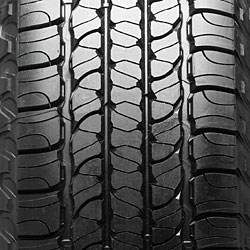
fortera (local):

btw... the more comfy ride can be attributed also to the thicker sidewall of the 215/70 tires.
-
01 EX Ody
- Join Date
- Oct 2002
- Posts
- 437
July 12th, 2005 09:25 AM #15take the penny test by tire rack....
http://www.tirerack.com/tires/tirete....jsp?techid=51
other tech stuff can be found there...
-
Verified Tsikot Member
- Join Date
- Jun 2004
- Posts
- 1,311
July 12th, 2005 09:38 AM #16Taken from tirerack website/link posted above
Where to Install new pairs of tires?
Most vehicles are equipped with the same size tire at every wheel position. Ideally all of these tires should also be of the same type and design, have the same tread depth and be inflated to the pressures specified by the vehicle placard or owner's manual. This combination best retains the handling balance engineered into the vehicle by its manufacturer.
However due to the front tires' responsibility for transmitting acceleration, steering and most of the braking forces on front-wheel-drive vehicles, it's normal for front tires to wear faster than rear tires. If the tires aren't rotated on a regular basis, it's also common for pairs of tires to wear out rather than sets. And if the tires aren't rotated at all, it's likely that the rear tires will still have about 1/2 of their original tread depth when the front tires are completely worn out.
Intuition suggests that since the front tires wore out first and because there is still about half-tread remaining on the rear tires, the new tires should be installed on the front axle. This will provide more traction, and by the time the front tires have worn out for the second time, the rear tires will be worn out too. However in this case, intuition isn't right...and following it can be downright dangerous.
When tires are replaced in pairs in situations like these, the new tires should always be installed on the rear axle and the worn tires moved to the front. The reason is because new tires on the rear axle help the driver more easily maintain control on wet roads because new, deeper treaded tires are more capable of resisting hydroplaning.
Hydroplaning occurs when the tire cannot process enough water through its tread design to maintain effective contact with the road. In moderate to heavy rain, water can pool up in road ruts, depressions and pockets adjacent to pavement expansion joints. At higher speeds, the standing water often found in these pools challenge a tire's ability to resist hydroplaning.
Exactly when hydroplaning occurs is the result of a combination of elements including water depth, vehicle weight and speed, as well as tire size, air pressure, tread design and tread depth. A lightweight vehicle with wide, worn, underinflated tires will hydroplane at lower speeds in a heavy downpour than a heavyweight vehicle equipped with new, narrow, properly inflated tires in drizzling rain.
If the rear tires have more tread depth than the front tires, the front tires will begin to hydroplane and lose traction on wet roads before the rears. This will cause the vehicle to begin to understeer (the vehicle wants to continue driving straight ahead). Understeer is relatively easy to control because releasing the gas pedal will slow the vehicle and help the driver maintain control.
However, if the front tires have more tread depth than the rear tires, the rear tires will begin to hydroplane and lose traction on wet roads before the fronts. This will cause the vehicle to begin to oversteer in which the vehicle wants to spin. Oversteer is far more difficult to control, and in addition to the initial distress felt when the rear of the car starts sliding, quickly releasing the gas pedal in an attempt to slow down may actually make it more difficult for the driver to regain control, possibly causing a complete spinout.
Members of The Tire Rack team had the chance to experience this phenomenon at Michelin's Laurens Proving Grounds. Participants were allowed to drive around a large radius, wet curve in vehicles fitted with tires of different tread depths — one vehicle with new tires on the rear and half-worn tires on the front, and the other with the new tires in the front and half-worn tires on the rear.
It didn't take long for this hands-on experience to confirm that the "proving grounds" name for the facility was correct. The ability to sense and control predictable understeer with the new tires on the rear, and the helplessness in trying to control the surprising oversteer with the new tires on the front was emphatically proven.
And even though our drivers had the advantage of knowing we were going to be challenged to maintain car control, spinouts became common during our laps in the car with the new tires on the front. Michelin advises us that almost everyone spins out at least once!
Experiencing this phenomenon in the safe, controlled conditions of Michelin's Laurens Proving Grounds rather than in traffic on an Interstate ramp in a rainstorm is definitely preferred!
In case there is any doubt, when tires are replaced in pairs, the new tires should always be installed on the rear axle and the worn tires moved to the front.
-
www.bigbigcar.com
- Join Date
- Oct 2002
- Posts
- 14,822
July 12th, 2005 09:58 AM #17is that applicable to the Full-Time 4WD Rav4?
AFAIK, the open differential (one for each axle) will intervene if one wheel loses traction. if both wheels of the rear/front axle loses traction, then the center differential will intervene.Last edited by mazdamazda; July 12th, 2005 at 10:03 AM.
-
Verified Tsikot Member
- Join Date
- Jun 2004
- Posts
- 1,311
July 12th, 2005 12:39 PM #18I am not sure if it would apply to all cars especially those will certain electronics and other mechanical innards that would assist during situations wherein the car would lose traction. I wasnt able to gather any info regarding that.
-
 Tsikoteer
- Join Date
- Jan 1970
- Posts
- 512
July 12th, 2005 07:52 PM #19Another reason why new tires go to the rear is that you generally want your "best" tires to be at the back because if you get a tire blowout at the front, you can still slightly compensate by steering... while if you get a tire blowout at the back, there's no easy way to compensate... Also, try to watch the fifth gear (or maybe topgear) video where Tiff demonstrated what happens when you get a tire blowout (sa front or back). Mas grabe yung spin niya when the rear tire had a problem.
-
www.bigbigcar.com
- Join Date
- Oct 2002
- Posts
- 14,822
July 12th, 2005 11:16 PM #20as I've said... that maybe applicable to 4x2 (fwd or rwd) vehicles only... since the rav4 is equipped with full-time 4wd (w/ 3 differentials) that may not be the case.
I've already switched the front & rear tires... and I haven't experienced any "sliding" when travelling the NLEX during a heavy downpour at 80-100kph (though to note, the sliding that I've mentioned is very subtle... but enough to alarm me already).
as I see it... if you are travelling in a straight line... wouldn't it be preferable to have your better tires in front to cut through the water?

 Reply With Quote
 Originally Posted by docSUVfan
