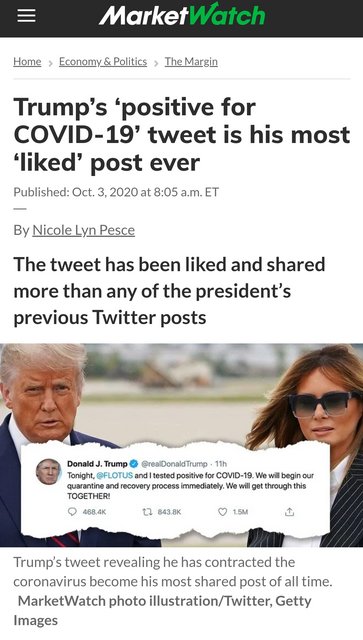
They are now paying the price for ignorance...
I guess RBG is watching over with a big smile on her face...
At least seven people — including President Donald Trump — have tested positive for Covid-19 after attending a Rose Garden event last Saturday, where Trump announced his choice to nominate Judge Amy Coney Barrett to the Supreme Court.
Two GOP senators test positive for Covid-19, potentially jeopardizing Barrett confirmation vote - CNNPolitics
Two Republican senators on the Senate Judiciary Committee announced Friday that they had tested positive for Covid-19, potentially jeopardizing the GOP's hopes of swiftly confirming Judge Amy Coney Barrett to the Supreme Court if they were both to remain unable to vote in the full Senate through the end of the month.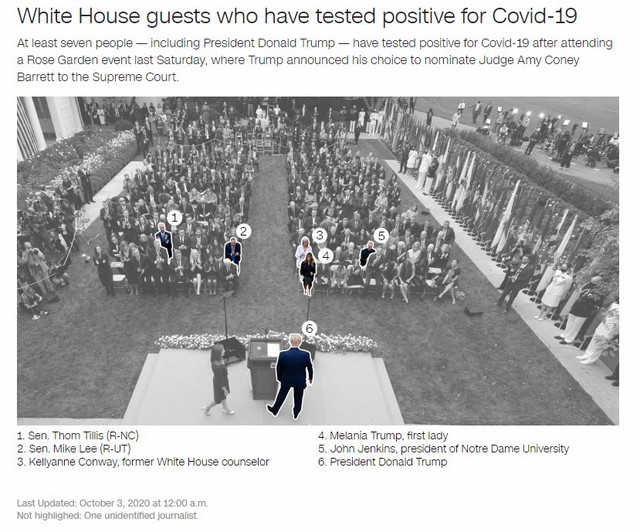

The Largest Car Forum in the Philippines
- Forums
- Discussions
- Events
- Community
Results 1,701 to 1,720 of 4196
-

 Social Dementia

- Join Date
- Sep 2003
- Posts
- 25,189
October 3rd, 2020 03:43 PM #1701
-
Verified Tsikot Member
- Join Date
- Mar 2010
- Posts
- 2,275
October 3rd, 2020 04:57 PM #1702Facebook
Sent from my ASUS_Z017DA using Tsikot Forums mobile appLast edited by Flipo; October 3rd, 2020 at 04:58 PM. Reason: The Democrats must be relieved that the next debates will most likely be postponed. Joe Biden survived the first with the help of some wires and ear piece but they all know he won’t survive more than
-
 Verified Tsikot Member
- Join Date
- May 2017
- Posts
- 2,135
-
 Tsikoteer
- Join Date
- Oct 2012
- Posts
- 27,624
October 3rd, 2020 06:28 PM #1704one of the very best Israeli accounts on twitter Originally Posted by Flipo


-
Verified Tsikot Member
- Join Date
- Mar 2010
- Posts
- 2,275
October 3rd, 2020 09:35 PM #1705True Biblical Christians | Facebook
True Viking Christians
MICHAEL MOORE PRAYS FOR
CORONAVIRUS TO KILL TRUMP
WITHOUT WISDOM, WITHOUT CONSCIENCE;
SUCH IS A MAN INCAPABLE OF HONOUR OR RESPECT
Proverbs 24:17 Rejoice not when thine enemy falleth, and let not thine heart be glad when he stumbleth:
18 Lest the Lord see it, and it displease him, and he turn away his wrath from him.
1 Corinthians 2:14 But the natural man receiveth not the things of the Spirit of God: for they are foolishness unto him: neither can he know them, because they are spiritually discerned.
Sent from my ASUS_Z017DA using Tsikot Forums mobile app
-
Social Dementia
- Join Date
- Sep 2003
- Posts
- 25,189
-
Verified Tsikot Member
- Join Date
- Mar 2010
- Posts
- 2,275
October 3rd, 2020 11:15 PM #1707Facebook
Behold Israel!
Amir Tsarfati
Be very careful who you listen to regarding the President’s health update. The FAKE NEWS channels will make it sound as if he can’t function while they are hiding a senile and incompetent candidate in his basement. As always they are using Covid-19 as their only card to win.
Sent from my ASUS_Z017DA using Tsikot Forums mobile app
-
Verified Tsikot Member
- Join Date
- Mar 2010
- Posts
- 2,275
October 3rd, 2020 11:28 PM #1708This coming election in November will... - End Time Headlines | Facebook
End Time Headline
This coming election in November will allow voters in the swtate of Nevada to be able to decide whether to change the text of the state Constitution to remove language defining marriage as a union between only one man and one woman.
Sent from my ASUS_Z017DA using Tsikot Forums mobile app
-
Tsikoteer
- Join Date
- Oct 2012
- Posts
- 27,624
-
 Verified Tsikot Member
- Join Date
- Aug 2018
- Posts
- 3,733
-
Tsikoteer
- Join Date
- Oct 2012
- Posts
- 27,624
October 4th, 2020 04:59 AM #1711He's editting the Bible for the Chinese schools. This is blasphemy... Originally Posted by Little Missy
-
Verified Tsikot Member
- Join Date
- Aug 2018
- Posts
- 3,733
October 4th, 2020 06:43 AM #1712How is he editing the Bible? Originally Posted by StockEngine
Sent from my LYA-L29 using Tapatalk
-
Social Dementia
- Join Date
- Sep 2003
- Posts
- 25,189
October 4th, 2020 08:48 AM #1713Chris Christie tests positive for coronavirus, checks into hospital as precautionary measure
Sent from my Mi 9T Pro using Tapatalk
-
Social Dementia
- Join Date
- Sep 2003
- Posts
- 25,189
October 4th, 2020 10:54 AM #1714November 3 blowout...
“This Is Spiraling Out of Control”: Allies Panic About Trump’s Hospital Stay as White House Deflects | Vanity Fair
On Saturday, the West Wing plunged into damage-control mode after Trump’s physician, Dr. Sean Conley, told reporters that Trump was diagnosed with COVID-19 on Wednesday—a day earlier than Trump previously disclosed. The new timeline meant that Trump would have been contagious when he debated Joe Biden on Tuesday and attended a fundraiser on Thursday at his Bedminster golf club.
The White House released follow-up statements saying Conley misspoke, but they did little to quell the chaos.
Two sources said doctors gave Trump an ultimatum: he could go to the hospital while he could still walk, or doctors would be forced to take him in a wheelchair or on a stretcher at a later point if his health deteriorated. “They told him, ‘You can go now or we’re taking you later and it’s non negotiable,’” a second source close to the White House said. Trump waited to leave for the hospital until the stock market closed on Friday, a source said.
After spending months denying the dangers of COVID-19, Trump is expressing an emotion aides have rarely seen: fear. On Friday, Trump grew visibly anxious as his fever spiked to 103 fahrenheit and he was administered oxygen at the White House, according to three Republicans close to the White House. Two sources told me Trump experienced heart palpitations on Friday night—possible side effects of the experimental antibody treatment he received. Trump has wondered aloud if he could defeat the disease. “Am I going out like Stan Chera?” Trump has asked aides, referring to his friend, New York real-estate developer Stan Chera, who died of COVID in April.
On Saturday, two sources said Trump was feeling better. But it is difficult to assess the information given the White House's history of lying.Last edited by Monseratto; October 4th, 2020 at 11:00 AM.
-
 Darker and Bigger
- Join Date
- Oct 2002
- Posts
- 40,599
October 4th, 2020 11:02 AM #1715Yari! Obese yan! Originally Posted by Monseratto
Sent from my iPhone using Tapatalk
-
Social Dementia
- Join Date
- Sep 2003
- Posts
- 25,189
October 4th, 2020 11:36 AM #1716If people are wondering why SC appointee Barrett, who was the subject of the Rose Garden spreader event, was not infected, She already had COVID and has recovered...
Amy Coney Barrett: Trump's Supreme Court nominee was diagnosed with coronavirus this summer - CNNPolitics
Trump's Orbit Now Has More New COVID Cases Than Numerous Countries
.With the latest being former New Jersey Governor Chris Christie, 14 people in the president's orbit have reported positive diagnoses since Friday—more than the number of newly reported cases in the last 24 hours in Belgium, New Zealand, Singapore, Sweden, Taiwan, Thailand or Vietnam, according to the World Health Organization (WHO).
In addition to Christie and Trump, the following people have tested positive: first lady Melania Trump; Republican senators Ron Johnson, Thom Tillis and Mike Lee; Trump 2020 campaign manager Bill Stepien; Republican National Convention Chairwoman Ronna McDaniel; Notre Dame University President Rev. John Jenkins; one White House staffer and three White House reporters.
The country of Singapore, comparatively, has reported 10 cases in the last 24 hours, according to the WHO. Thailand has reported eight, Taiwan two and both New Zealand and Vietnam one new case each. Sweden and Belgium boast zero new casesLast edited by Monseratto; October 4th, 2020 at 11:39 AM.
-
Verified Tsikot Member
- Join Date
- Mar 2010
- Posts
- 2,275
October 4th, 2020 01:24 PM #1717President Trump releases update, says he'''s feeling '''much better''' after hospitalization | Fox News
Sent from my ASUS_Z017DA using Tsikot Forums mobile appLast edited by Flipo; October 4th, 2020 at 01:26 PM. Reason: https://www.facebook.com/1491041267795965/posts/2821312158102196/
-
Verified Tsikot Member
- Join Date
- Oct 2014
- Posts
- 1,245
October 4th, 2020 03:07 PM #1718Galing ng script!
Biden calls Trump getting COVID-19 'a reminder to take virus seriously' - YouTube
Sent from my SM-A315G using Tsikot Forums mobile app
-
 Tsikoteer
- Join Date
- Jan 2006
- Posts
- 12,398
October 4th, 2020 03:43 PM #1719I knew it was coming sooner or later. There are a couple of people I don't mind ratting out to the USCIS.
https://www.uscis.gov/sites/default/...Membership.pdf
-
Social Dementia
- Join Date
- Sep 2003
- Posts
- 25,189
October 4th, 2020 04:19 PM #1720

 Reply With Quote
 Originally Posted by Flipo