
last year i was worried about the effect of prolonged lockdown on the banking systemOriginally Posted by Monseratto


The Largest Car Forum in the Philippines
- Forums
- Discussions
- Events
- Community
Results 3,581 to 3,600 of 4789
-

 Tsikot Member Rank 4

- Join Date
- Nov 2005
- Posts
- 45,927
February 4th, 2021 07:24 PM #3581
-
Tsikoteer
- Join Date
- Jul 2013
- Posts
- 2,450
February 4th, 2021 08:24 PM #3582Will lending contraction lower loan interest rate? I'm thinking of getting a housing loan. Originally Posted by Monseratto
-
 Darker and Bigger
- Join Date
- Oct 2002
- Posts
- 40,599
February 4th, 2021 08:27 PM #3583Mas hinigpitan ng banks mag pautang now. Originally Posted by Lew_Alcindor
Saka yun supposedly lower rates hinde naman mapasa talaga sa mga ordinary na tao.
I'm sure big conglomerate makikinabang but not regular Joes.
Ewan ko kung tama ako, let's us uls.
Sent from my iPhone using Tapatalk
-
Tsikot Member Rank 4
- Join Date
- Nov 2005
- Posts
- 45,927
February 4th, 2021 09:50 PM #3584first, let's look at Bangko Sentral interest rate
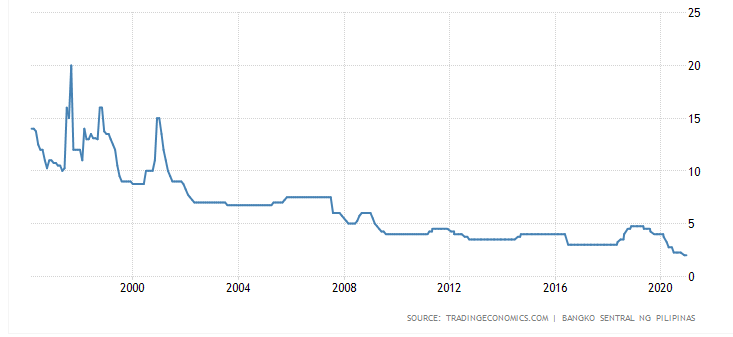
it's at an all time low 2%
i'm not gonna talk about bank loans muna
let's talk about bonds
since monetary policy affects bond yields, ito ang nangyari sa interest rate ng gov't bonds
below is PH 10Y yield
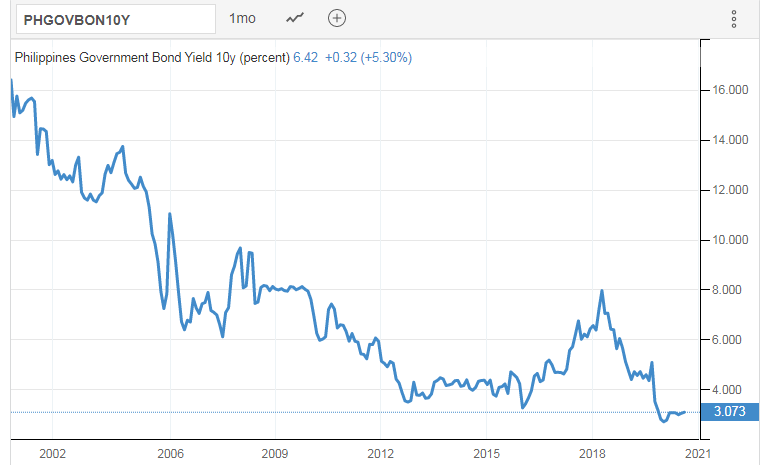
corporations aren't as credit worthy as the PH gov't they have to pay higher rate than the gov't when they tap the bond market for funds
benchmark ang gov't bond
since bumaba ang interest rate ng gov't bonds, bumaba din ang interest rate ng corporate bonds
if you're a bond investor you know what i'm talking about
mga bonds ng top corporations ang baba ng interest rate ngayon
so my point is nakinabang ang mga malaking korporasyon sa pagbaba ng interest rate -- bumaba borrowing cost nila
-
Tsikot Member Rank 4
- Join Date
- Nov 2005
- Posts
- 45,927
February 4th, 2021 09:56 PM #3585pero kung maliit na borrower ka lang, your interest rate will depend on your creditworthiness
they will background check the hell out of you to see if your income is lockdown/pandemic proof
sa dami ng nawalan ng trabaho, sa dami ng business na nawalan ng cashflow dahil sa lockdown/pandemic
konte lang creditworthy borrowers ngayon
-
BANNED BANNED BANNED
- Join Date
- Sep 2015
- Posts
- 13,917
February 5th, 2021 02:07 AM #3586tsikoteers pag sinabi ko walang kwarta mga common peenoise eh waley talaga ngayon january & february.
Inubos-biyaya nung december nagcelebrate-celebrate eh pacharap buhay ayaw ng delayed gratification. Buti sana kung walang pandemic.
gusto nyo sampol, wala ng pila kay uno fuel, twice na ako pumunta one week apart 11pm as in waley na sa kalsada.
after nyan pumunta ako west avenue eh sarado na mr kebab kakagulat ayaw na magpaabot madaling-araw nagcinderella. Si kowloon siopao eh akala ko close din pero may nacoveeed pala so sa february 10 pa daw magreopen so baka tatapusin 14day quaranteeen. Magjujumbopao sana ako kaso mandatory pinaclose eh.
ang bukas lang eh ilocos empanada. Wala din customer.
Last sunday ang luwag ng hitop supermarket. Imagine ah on a sunday pa maluwag.
parang ECQ level ngayon without the checkpoint.
-
 Social Dementia
- Join Date
- Sep 2003
- Posts
- 25,189
February 5th, 2021 10:48 AM #3587
BREAKING: PH inflation rose to a two-year high of 4.2% in January 2021, breaching the upper end of the government's 2 to 4 percent inflation target.
This is the highest inflation recorded since January 2019's 4.4% when inflation last breached the government target.
*EdsonCGuido
We're currently seeing low inflation among major ASEAN economies with the Philippines being an outlier. Some countries are even experiencing deflation.
-
Social Dementia
- Join Date
- Sep 2003
- Posts
- 25,189
February 5th, 2021 11:14 AM #3588
Big banks start revealing extent of covid wounds
by Victor C. Agustin
The country's banks have started publishing their year-end balance sheets, revealing the wounds they each had received from the coronavirus pandemic.
The good news is that unlike the financial crises of the late nineties and eighties, there is no indication of any bank succumbing to covid infection, knock on wood.
Still, there have been startling revelations.
A minor bank known for its conservatism, for instance, reported that its ratio of non-performing loans to total loan portfolio had jumped four times from 2019's 2.08% to 8.32%.
Another bank with a substantial exposure on home financing reported its NPL ratio rising from 4.24% pre-pandemic to 7.86%, a level not seen since the Asian financial crisis.
According to the Bangko Sentral, the NPL ratio of the commercial banking system rose from only 2.8% in 1996 to 10.4 % by 1998, at the height of the regional crisis.
"The impact on non-performing loans did not manifest itself right away, with the ratio peak(ing) at almost 19% of total loans in 2001," said then Governor Amando Tetangco Jr. in a speech before the Bank of Japan in Tokyo in 2007.
In any case, a major plus point for the minor bank, not counting its institutional and political gravitas, is that its capital-adequacy ratio, at 50.74%, by far exceeds industry biggies BDO and Metrobank, with both reporting an identical 13.79%.
The industry wisdom of course is that the higher the bank’s capital adequacy ratio, the higher the degree of protection, the financial buffer, that it can extend to depositor's assets.
Thankfully, the Big 3, BPI included, all reported bad-loan ratios way below the 1997-98 crisis years.
Even more remarkable, two other banks, PBCom and Union, went against the pandemic tide. The two banks even managed to reduce their respective NPL ratios, from 2.57% in 2019 to 2.11% by September 2020 for UnionBank and from 3.82% to 3.63% by end-2020 in the case of PBCom.
Thanks to taipan Lucio Co's deep pockets, the rehabilitated Philippine Bank of Communications also has a much improved CAR ratio of 18.87%, eclipsing BDO's and BPI's.
For a longer-term perspective, the commercial banks’ capital-adequacy-ratio peaked at 19.2% in June 2013. The ratio went down to 16% by end-2019, still above the minimum 10% threshold mandated by the Bangko Sentral.
Finally, three universal banks that have "you" in their respective taglines, have seen their bad-loan ratios, well, check the figures below and then supply the comparative adjective.
Security Bank ("You deserve better") reported 3.89% NPL ratio for end-2020 against 1.17% in 2019; RCBC ("We believe in you"), 4.81% from 3.57%; and PNB, 5.95% from 1.99%.
The contrarian Union Bank, incidentally, has the tagline with a different take on the second person singular, "The future begins with U."
-
Tsikot Member Rank 4
- Join Date
- Nov 2005
- Posts
- 45,927
February 5th, 2021 11:44 AM #3589April last year i was already saying sigurado madami di makakabayad ng utang Originally Posted by Monseratto
the gov't stopped the economy dead
the lockdown caused people and businesses to lose income ---> money that was supposed to go to debt servicing bigla nawala
that's why i got concerned about the stability of our banking system
OA ba?
-
Tsikot Member Rank 4
- Join Date
- Nov 2005
- Posts
- 45,927
February 5th, 2021 11:48 AM #3590 Originally Posted by Monseratto
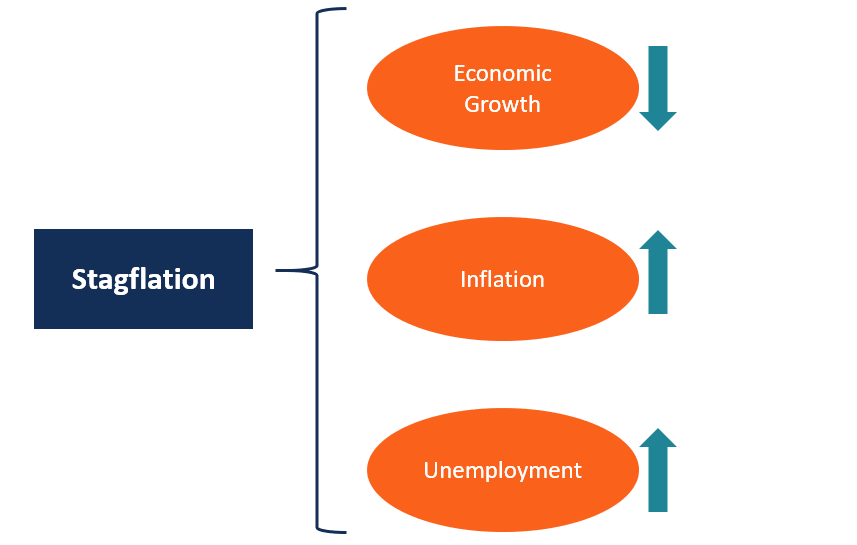
the word STAGFLATION
economic stagnation with rising inflation
-
Tsikot Member Rank 4
- Join Date
- Nov 2005
- Posts
- 45,927
February 5th, 2021 10:34 PM #3591hirap ngayon ng trabaho ng BSP
tumataas ang inflation pero mahina economy
kaya binaba ang interest rate para lumakas ang economy
pero kailangan magtaas ng interest rate para labanan ang inflation
di naman pwede mag rate hike kasi mahina ang economy
-
Social Dementia
- Join Date
- Sep 2003
- Posts
- 25,189
-
Tsikot Member Rank 4
- Join Date
- Nov 2005
- Posts
- 45,927
February 8th, 2021 12:10 PM #3593dunno why governments (yes plural) still don't get it
price controls don't work
price controls only result in shortage
dati nangyari na sa fuel
now pork
-
Social Dementia
- Join Date
- Sep 2003
- Posts
- 25,189
-
Tsikot Member Rank 4
- Join Date
- Nov 2005
- Posts
- 45,927
February 8th, 2021 07:21 PM #3595one doesn't have to be an economist to know ano ang negative effect ng price control
why do governments keep making the same mistake?
-
Social Dementia
- Join Date
- Sep 2003
- Posts
- 25,189
-
Tsikot Member Rank 4
- Join Date
- Nov 2005
- Posts
- 45,927
February 8th, 2021 07:46 PM #3597going forward magiging problema ang inflation
the developed world printed / is still printing tons of money and all that money has to go somewhere
we already see stock prices at record levels
when money flows into commodities lagot ang Pinas
Money is already flowing into the energy complex
look at brent... $60 today
-
Tsikot Member Rank 4
- Join Date
- Nov 2005
- Posts
- 45,927
February 8th, 2021 07:53 PM #3598lagot ang Pinas coz our economy is weak then there's rising inflation
the central bank can't raise rates to fight inflation coz the economy is weak
-
consumers don't have buying power
and higher prices will destroy already weak consumer demand
-
 Verified Tsikot Member
- Join Date
- Feb 2019
- Posts
- 4,291
February 9th, 2021 04:40 PM #3599Bdo is offering RTB *1.9% quarterly payout lower than previous 3-4%
Sent from my SM-N910C using Tsikot Forums mobile app
-
Tsikot Member Rank 4
- Join Date
- Nov 2005
- Posts
- 45,927
February 9th, 2021 05:05 PM #3600 Originally Posted by Deestone
like what i posted sa previous page
binaba ng bangko sentral ang interest rate
bumaba din interest rates ng gov't bonds
 Originally Posted by Monseratto


 Reply With Quote


