
Economies that rely on exports... High interest rate drive down demand
South Korea factory activity suffers longest downturn in at least 19 years
Crippled exports slow Vietnam's growth
Germany’s export expectations fall noticeably in June | Reuters

The Largest Car Forum in the Philippines
- Forums
- Discussions
- Events
- Community
Results 10,661 to 10,680 of 10726
-

 Social Dementia

- Join Date
- Sep 2003
- Posts
- 25,189
July 3rd, 2023 12:53 PM #10661
-
Verified Tsikot Member
- Join Date
- May 2017
- Posts
- 2,134
July 10th, 2023 09:28 PM #10662The Gold Standard Is Back: BRICS To Intro Gold-Backed Reserve Currency
The Gold Standard Is Back: BRICS To Intro Gold-Backed Reserve Currency | ZeroHedge
-
Social Dementia
- Join Date
- Sep 2003
- Posts
- 25,189
-
 Cheap Mechanic
- Join Date
- Jan 2005
- Posts
- 6,107
July 10th, 2023 10:38 PM #10664Global recession might have started already?
Sent from my SM-T970 using Tsikot Forums mobile app
-
Social Dementia
- Join Date
- Sep 2003
- Posts
- 25,189
July 12th, 2023 08:37 AM #10665Domino effect... No demand means no factory activity in China... China then won't buy from overseas suppliers including Taiwan.
Taiwan’s exports plunge at fastest pace in 14 years in June on weak US, mainland China demand | South China Morning Post
Taiwan’s exports fell more than expected in June, clocking their worst decline in almost 14 years, as the island struggled with persistent weakness in demand from the United States and mainland China for its tech products, as well as a dour outlook.
-
 Tsikot Member Rank 4
- Join Date
- Nov 2005
- Posts
- 45,927
July 12th, 2023 01:03 PM #10666^^^
now do south korea exports
and check out samsung's massive profit decline
di lang puro china
hehe
-
Tsikot Member Rank 4
- Join Date
- Nov 2005
- Posts
- 45,927
July 12th, 2023 01:12 PM #10667_____________________________
Last edited by uls; July 12th, 2023 at 01:21 PM.
-
Tsikot Member Rank 4
- Join Date
- Nov 2005
- Posts
- 45,927
July 12th, 2023 01:24 PM #10668sanaol Originally Posted by Monseratto

haha
sa pinas ano inflation rate?
-
Social Dementia
- Join Date
- Sep 2003
- Posts
- 25,189
July 12th, 2023 04:30 PM #10669Sa Youtube, the anti China channels are highlighting it... Of course they won't mention that it's the same situation everywhere else in the world Originally Posted by uls
-
Tsikot Member Rank 4
- Join Date
- Nov 2005
- Posts
- 45,927
July 12th, 2023 05:52 PM #10670^^^
every single day there's a video or article somewhere that says china is about to collapse
there's a book called "the coming collapse of china" by china-hater gordon chang
check out when it was published
Amazon.com
antagal naman
-
Verified Tsikot Member
- Join Date
- May 2017
- Posts
- 2,134
-
Tsikot Member Rank 4
- Join Date
- Nov 2005
- Posts
- 45,927
July 12th, 2023 10:30 PM #10672kahit anong censor gawin ng tsina, if they completely collapse they wouldn't be able to hide it Originally Posted by Athrunzala
this author was predicting china's collapse in 2001

ano na
-
Social Dementia
- Join Date
- Sep 2003
- Posts
- 25,189
July 13th, 2023 10:40 AM #10673No more cheap source... Things will just get more expensive for US consumers.
Some Chinese brands have already moved production to Mexico like HiSense
Trade between the US and China is drying up. That could be bad news for American consumers.
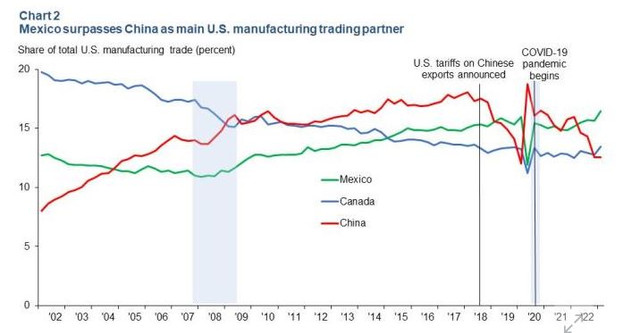
To be clear, if companies pivot away from China's cheap production and supply chains, that likely increases costs for those firms, costs which then trickle down to everyday consumers. All things point to the US and China becoming less reliant on one another as time goes on, which suggests prices for goods that were once sourced from China could get more expensive as the US brings more production stateside or closer to home, "nearshoring" operations in neighboring countries like Mexico.
-
Tsikot Member Rank 4
- Join Date
- Nov 2005
- Posts
- 45,927
July 13th, 2023 11:49 AM #10674the problem with china is weak domestic demand
they produce far more than their people can consume (well because their manufacturing sector is really built for export not only for domestic market)
china gov't can do things to increase domestic consumption
the domestic market can absorb excess production
ang pinas nga 70% ng GDP natin is local consumption

china is less than 40%
if china increases domestic consumption who cares about foreigners decoupling
-
Social Dementia
- Join Date
- Sep 2003
- Posts
- 25,189
-
Social Dementia
- Join Date
- Sep 2003
- Posts
- 25,189
July 13th, 2023 10:14 PM #10676Taiwan June exports slump the most in 14 years on weak China, US demand | Reuters
Taiwan Chip Exports Plunge 21% as Device Makers Clear Inventory
Exports decreased 20.8% from a year earlier to a four-month low of $12.6 billion, according to data from Taiwan’s Ministry of Finance. The island is home to Apple Inc. and Nvidia Corp.’s go-to chipmaker, Taiwan Semiconductor Manufacturing Co., along with a coterie of smaller but essential chip industry players. The annual decline was the largest since March 2009, partly amplified by a high base last June.
“The demand for integrated circuits continues to be weak,” the finance ministry said in a statement accompanying the data, as sticky inflation and continuous rate hikes by central banks have tapered the global economy.
US-China trade tensions have also affected Taiwan’s biggest industry. Shipments to mainland China and Hong Kong, which together account for over 50% of its chip exports, fell for an eighth consecutive month.
-
Social Dementia
- Join Date
- Sep 2003
- Posts
- 25,189
July 19th, 2023 12:59 PM #10677UPDATE 1-Foreigners sell US Treasuries in May; China's holdings drop to 13-year low -data
NEW YORK, July 18 (Reuters) - Foreign holdings of U.S. Treasuries fell in May, data from the Treasury Department showed on Tuesday, led by sell-offs from China and Japan as interest rates in the world's largest economy continued to rise.
Holdings of U.S. Treasuries dropped to $7.527 trillion in May, down from $7.581 trillion in the previous month, declining for the first time in four months. But compared with a year earlier, Treasuries owned by foreigners were up 1.6%.
"What stands out is the big selling by Japan and China. They drove the selling by foreign investors during the month, which overall made sense given the move higher in rates toward the second half of the month," said Gennadiy Goldberg, head of U.S. rates strategy, at TD Securities in New York.
-
Social Dementia
- Join Date
- Sep 2003
- Posts
- 25,189
July 29th, 2023 04:38 PM #10678When China stopped buying US Corn and Soy which previously amounted to USD 5 billion trade , their farmers ended up bankrupt... Same thing will happen to chips. Japan companies that invested in semiconductors see the US ban as a existential threat since no one else will buy their chips unless their government subsidizes their losses.
Also when China stops buying, they won't come back.
-
Social Dementia
- Join Date
- Sep 2003
- Posts
- 25,189
July 29th, 2023 10:10 PM #10679Samsung sees 95% drop in profits for a second consecutive quarterToday, the Korean tech giant posted its Q2 2023 financial results, and it’s not pretty. According to the report, the company once again saw a 95% decline in year-over-year profits. It appears Samsung brought in a profit of 0.67 trillion ($523.5 million) Korean won (KRW), which is a drop in the bucket to the 14.12 trillion KRW ($11.06 billion) it made last year.
Samsung attributes this loss in profit to the decline in smartphone shipments due to “high interest rates and inflation.” As a report from Counterpoint Research suggests, the US smartphone market fell by 24% year-on-year in Q2 2023. Samsung, in particular, saw a 37% yearly decline in shipments, giving it 23% of the total US market.
Samsung has high hopes for its two foldables. In a Google translated quote from TM Roh, the head of Samsung’s mobile division states that he believes the company will sell “one out of three Galaxy flagship smartphones in Korea this year as a foldable.” He also says, “global foldable sales will exceed 20% of all Galaxy flagships.”
-
Tsikot Member Rank 4
- Join Date
- Nov 2005
- Posts
- 45,927
July 30th, 2023 01:11 PM #10680Japan and SK are U S vassals Originally Posted by Monseratto
the U S says jump off a building they will

 Reply With Quote
 Originally Posted by Monseratto
