


Looks like the popular view that oil prices will bounce back to $80 in the second half of 2015 is becoming more unlikely.

The Largest Car Forum in the Philippines
- Forums
- Discussions
- Events
- Community
Results 561 to 580 of 10726
Hybrid View
-
 Verified Tsikot Member

- Join Date
- Mar 2014
- Posts
- 355
July 24th, 2015 05:32 PM #1
-
Verified Tsikot Member
- Join Date
- Mar 2014
- Posts
- 355
July 27th, 2015 06:30 PM #2Oil prices keep heading south. Recent data from the U.S. increased concerns about oversupply as drilling activity picked up. Producers added 21 rigs last week according to oilfield services company Baker Hughes.

That and the recent Iran nuclear deal and Saudi overproduction suggest lower prices to come.
This week we'll find out whether the Fed will raise rates or wait for stronger data. It's unlikely the Fed will raise rates this week but any hint that they're planning to raise rates this year will create volatility. Many market participants still think the U.S. economy is not yet strong enough for a rate hike.
-
Verified Tsikot Member
- Join Date
- Mar 2014
- Posts
- 355
July 30th, 2015 06:03 PM #3The Fed statement didn’t provide any guidance about the timing of a rate hike but reading between the lines there's indication that all conditions to begin raising rates have been met. The cautious Fed didn't want to spook the market by signaling a September move.
-
Verified Tsikot Member
- Join Date
- Mar 2014
- Posts
- 355
August 5th, 2015 03:57 PM #4The dollar index is fighting its way back to 100. With continued talk of a September rate hike the dollar index is now testing recent highs. 98.15 resistance level has been broken and if it stays above that level momentum should take it to 100 soon.
-
BANNED BANNED BANNED
- Join Date
- Jan 2015
- Posts
- 4,580
August 12th, 2015 04:48 PM #5Q&A: What yuan devaluation means for China, other countries
Inquirer. net, August 12, 2015 08:54am
BEIJING, China --- China rattled global financial markets Tuesday by devaluing its currency --- an effort, in part, to revive economic growth.
The yuan's value declined 1.9 percent, its biggest one-day drop in a decade. The move could help Chinese companies by making their products less expensive in global markets. U.S. stocks plummeted, partly on fears about a worsening economic slowdown in China.
WHAT EXACTLY DID CHINA DO?
China doesn't let its currency trade freely in financial markets as the United States does. Instead, it links the yuan's value to the U.S. dollar. Then it restricts trading to a band 2 percent above or below a daily target set by the People's Bank of China. On Tuesday, the central bank set the target 1.9 percent below Monday's level --- the biggest one-day change in a decade. It also made a technical change to give market forces more influence in determining the yuan's value: Its daily target will now be based on the previous day's closing value. That change will allow the yuan to make bigger, faster moves up or down and better reflect investors' outlook on the prospects for China and its currency, said David Dollar, senior fellow at the Brookings Institution.
WHY DID CHINA DEVALUE ITS CURRENCY?
The People's Bank of China said it acted because the yuan has been rising even when market forces say it should be falling. Worried Chinese have been moving money out of the country, putting downward pressure on the yuan. Yet the yuan has remained up anyway because of its link to the dollar, which has been rising. An overvalued yuan has hurt Chinese exporters by making their products more expensive overseas. In July, Chinese exports plunged 8.3 percent year over year.
China's economy already needed help. The economy is expected to grow less than 7 percent this year, its slowest rate since 1990, and could decelerate even more next year. The stock market has been in a freefall since June.
"This move won't solve some of the pressing problems China faces," Sung Won Sohn, an economist at California State University Channel Islands, cautioned in a research note. "There is too much excess capacity, especially in basic industries like steel, aluminum ... A real-estate bubble is alive and well. Chinese banks are loaded with a lot of problem loans. The gyration in the stock market won't go away. "
HOW WILL CHINA'S TRADING PARTNERS BE AFFECTED?
Investors fear the worst. U.S. stocks sank Tuesday, dragged down by falling shares in such big exporters as Caterpillar and General Electric. In theory, a weaker yuan could reduce exports of U.S. goods to China, already down nearly 5 percent this year through June.
But economists doubt that a one-day 2 percent drop in the yuan --- a move China has called a one-time event --- will do much damage to exports from the United States or other countries.
"Two percent is no big deal," said Mark Zandi, chief economist at Moody's Analytics. "Ten percent over the next few months would be a big deal."
American politicians, who have long charged that China keeps its currency artificially low to give its exporters an edge, denounced the devaluation. "Today's news that China has yet again lowered the value of its currency is another harsh reminder that we cannot afford to sit idly by as China refuses to play by the rules," Ohio Republican Sen. Rob Portman said in a statement.
But economists didn't see Beijing's move as an effort to defy market forces and reduce the yuan to an artificially low level. Rather, they perceived an attempt by China to catch up to an economic reality that dictates a cheaper yuan. And the plan to let market forces play a bigger role in determining the yuan's level is something the U.S. government itself has called for.
In a statement, the U.S. Treasury Department said: "China has indicated that the changes announced today are another step in its move to a more market-determined exchange rate. We will continue to monitor how these changes are implemented and continue to press China on the pace of its reforms."
MIGHT THE FEDERAL RESERVE DELAY A RATE HIKE?
Probably not. True, a cheaper yuan hurts U.S. exporters and likely depresses U.S. inflation, which is already below the annual 2 percent rate the Fed targets. But Tuesday's move wasn't big enough by itself to make much difference. So the Fed is likely to go ahead, possibly at its September meeting, and raise the short-term rate it controls, which has been pinned near zero since 2008. The U.S. economy grew at a steady 2.3 percent annual from April through June, and U.S. unemployment has fallen to a seven-year low 5.3 percent.
If the U.S. economy continues to look healthy, wrote JP Morgan Chase economist Michael Feroli, "the yuan move will largely be a sideshow " by September's Fed meeting.
-
Verified Tsikot Member
- Join Date
- Mar 2014
- Posts
- 355
August 12th, 2015 05:45 PM #6The effect of RMB devaluation on other currencies is becoming more pronounced. Worst performers are the Indonesian Rupiah, Malaysian Ringgit, Indian Rupee, Singapore Dollar, South Korean Won, Taiwanese Dollar, Australian Dollar, South African Rand, Mexican Peso.
-
Verified Tsikot Member
- Join Date
- Mar 2014
- Posts
- 355
August 12th, 2015 06:17 PM #7Q: Why are other currencies falling in reaction to RMB devaluation?
A: Because there's fear of competitive devaluation. China devalued its currency to make their exports more competitive so other Asian exporters will also want to devalue their own currencies to stay competitive.
-
 Tsikoteer
- Join Date
- Feb 2008
- Posts
- 12,683
August 22nd, 2015 10:21 AM #8Aug 21 (Reuters) - Fears of a China-led global economic slowdown drove Wall Street to its steepest one-day drop in nearly four years on Friday and left the Dow industrials more than 10 percent below a May record.
Wall Street's selloff this week suggested investors are growing nervous about paying high prices for stocks at a time of minimal earnings growth, tumbling energy prices and an expected rate hike by the U.S. Federal Reserve that could gradually usher the end of almost a decade of easy money.
Stocks have seen few large moves this year, staying in a narrow range throughout 2015, but volatility spiked this month once China surprisingly devalued its currency. Weak Chinese manufacturing data on Friday, and another drop in China's stock market, rattled investors' nerves and led to Friday's tumble.
While this month's selloff has been swift, many analysts feel the declines may be close to being exhausted, with a turnaround possibly starting as soon as next week.
"You're definitely witnessing a perfect storm in terms of China timing, people on vacation that affects liquidity, and you've got a lot of questions on the Fed and people are obviously focused on oil," said Andrew Frankel, co-president of Stuart Frankel & Co in New York.
"If you're buying a stock, you're dipping a toe in here."
The Dow Jones industrial average closed down 530.94 points, or 3.12 percent, to 16,459.75, the S&P 500 lost 64.84 points, or 3.19 percent, to 1,970.89 and the Nasdaq Composite dropped 171.45 points, or 3.52 percent, to 4,706.04.
Next week, investors will focus on housing data, which has been strong of late, and the preliminary reading of second-quarter GDP, which could lead investors back towards riskier assets if they point to an improving U.S. economy.
The Russell 2000 index of small-cap stocks also confirmed a move into correction territory, marking a 10-percent decline from its most recent closing high on June 23.
The CBOE Volatility index, Wall Street's so-called fear gauge, touched its highest since October and notched its biggest-ever weekly percentage gain.
The S&P slumped 5.8 percent for the week, its biggest weekly decline since September 2011. The index lost more than $1 trillion of its value this week, according to S&P Dow Jones Indexes. Only 10 S&P 500 components advanced on Friday.
The selloff was broad, with all 10 major sectors in the red. The energy index dropped 2.6 percent as U.S. crude oil dipped below $40 a barrel for the first time since the 2009 financial crisis.
Many investors still anticipate the U.S. central bank will begin raising interest rates by the end of the year, but fewer of them expect a September hike after reading minutes from the Fed's July meeting on Wednesday.
Apple, still by far the most valuable U.S. company, fell 4.6 percent to $107.44, the biggest drag on the S&P and the Nasdaq.
For the week, the Dow dropped 5.8 percent and the Nasdaq tumbled 6.8 percent.
The drag from Apple pushed the technology sector down 4.2 percent. The consumer staples index fell 2.6 percent, moving into the red for the year. Eight of the 10 S&P sectors are now in negative territory for the year.
Six stocks fell for every one that closed higher on the NYSE; on the Nasdaq, the ratio was about 2-1/2 decliners for every 1 advancer.
The S&P 500 posted no new 52-week highs for the first time since Aug. 8, 2011, after S&P downgraded the U.S. credit rating, while there were 75 new lows; the Nasdaq recorded 13 new highs and 276 new lows.
Volume was heavy, with about 10.6 billion shares traded on U.S. exchanges, well above the 6.75 billion average this month, according to BATS Global Markets.
-
Verified Tsikot Member
- Join Date
- Mar 2014
- Posts
- 355
August 24th, 2015 11:47 AM #9Last week China dragged down global equities. The trigger is the flash manufacturing PMI which fell to its lowest since 2009. The flash manufacturing PMI is an independent measure of China’s manufacturing growth so it's more reliable than Chinese gov't data. The long expected China slowdown is really emerging now. The scary thing is nobody knows how bad things are going to get. This morning we're seeing offshore RMB depreciating against the dollar which could pressure China to let onshore RMB depreciate. So far China is maintaining onshore RMB under 6.4 to the dollar but who knows how long China can maintain the peg with depreciation pressure from outside.
-
Verified Tsikot Member
- Join Date
- Mar 2014
- Posts
- 355
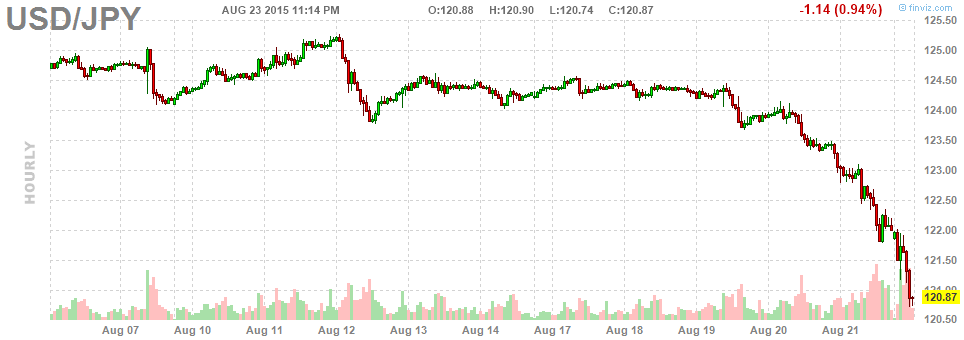
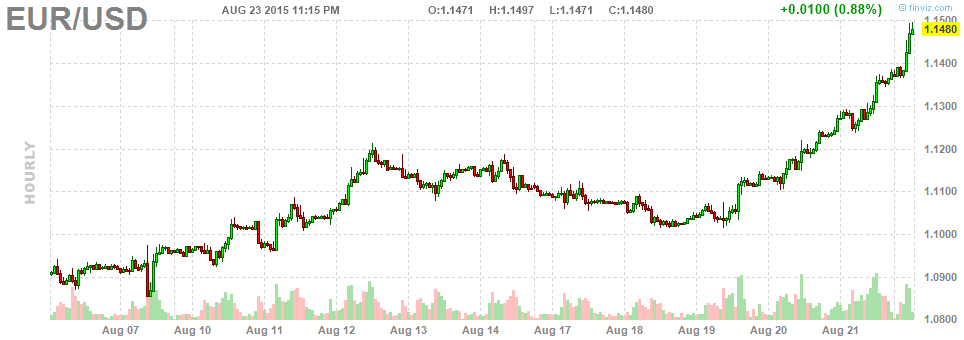
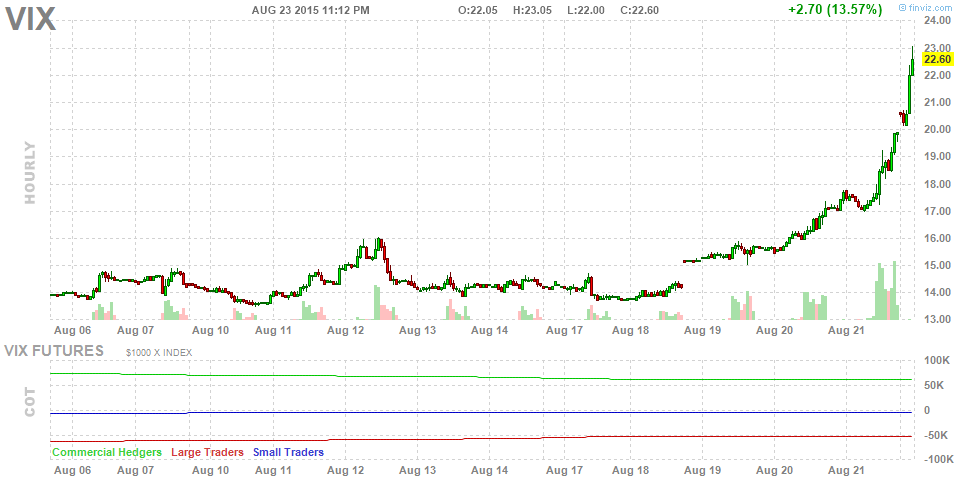
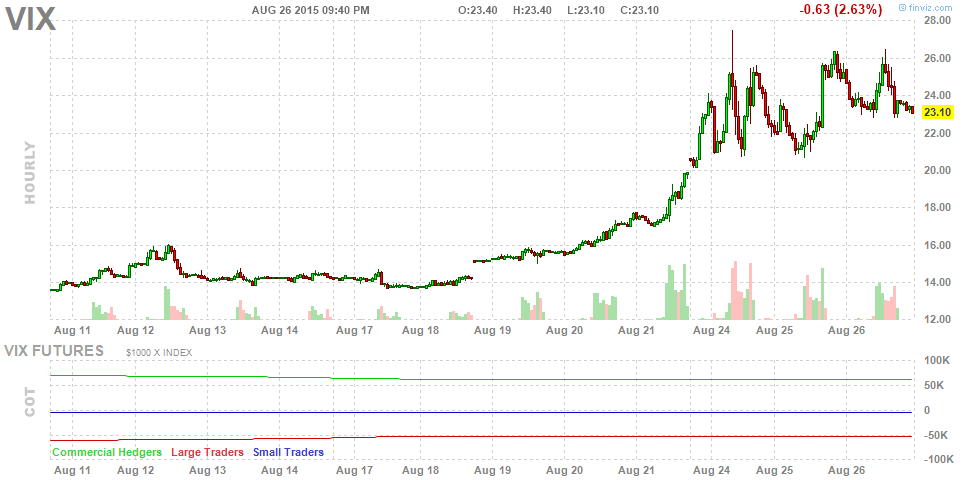
August 24th, 2015 12:19 PM #10Flight to safety drives US 10Y yield to below 2%. Yen and euro rally as carry trades are unwound. The volatility index has gone vertical.
-
Tsikoteer
- Join Date
- Feb 2008
- Posts
- 12,683
August 24th, 2015 01:55 PM #11What is the expected recovery period? Originally Posted by Lady Bathory

-
 Social Dementia
- Join Date
- Sep 2003
- Posts
- 25,189
August 24th, 2015 02:15 PM #12Asian stocks swoon as China stock rout accelerates
Mainland markets in free fall
More than $5 trillion has been wiped off the value of global equities markets since China's shock devaluation of the yuan on August 11 sparked fears the world's second-largest economy is weaker than thought.
The rout in China's benchmark Shanghai Composite index gathered pace early Monday, sinking as much as 8.2 percent to a five-month low of 3,218.5 points, even as authorities allowed pension funds managed by local governments to invest in the stock market for the first time over the weekend. The move could potentially channel hundreds of billions of yuan into the country's struggling equity market.
In Hong Kong, the Hang Seng index tracked the sluggishness in its mainland peers to fall nearly 4 percent at the start of trade, with heavyweights such as HSBC and China Mobile losing more than 3 percent each.
Japan's Nikkei 225 index hit a fresh five-month low of 18,812.4, as the yen climbed against the U.S. dollar amid cooling bets that the Federal Reserve will raise U.S. interest rates next month.
The Topix index lost nearly 4 percent in early trade, bringing the losses from its eight-year peak hit less than two weeks ago to more than 10 percent.
In Southeast Asia, Philippine shares were the biggest losers, down 5.4 percent at its lowest level since December 2014.
Singapore's Straits Times index remained well below the key psychological level of 3,000 points, dropping 2.7 percent to touch a more than three-year low. Meanwhile, Malaysia's FTSE Bursa Malaysia KLCI index retreated 1.7 percent to a three-and-a-half-year low, while the ringgit hit a fresh 17-year low against the greenback.Last edited by Monseratto; August 24th, 2015 at 02:41 PM.
-
Verified Tsikot Member
- Join Date
- Mar 2014
- Posts
- 355
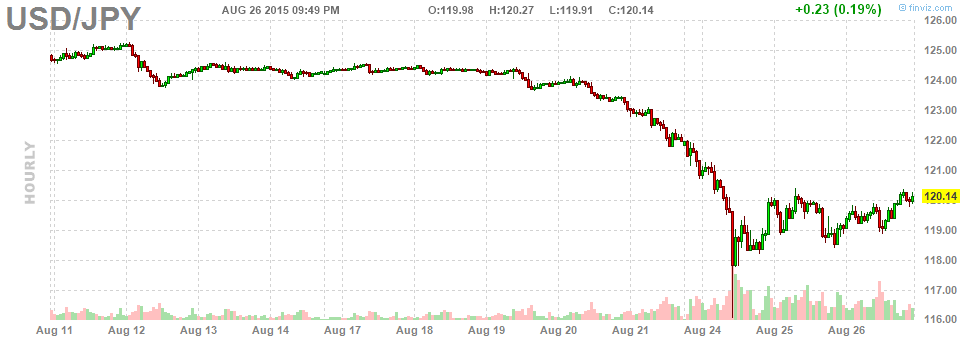
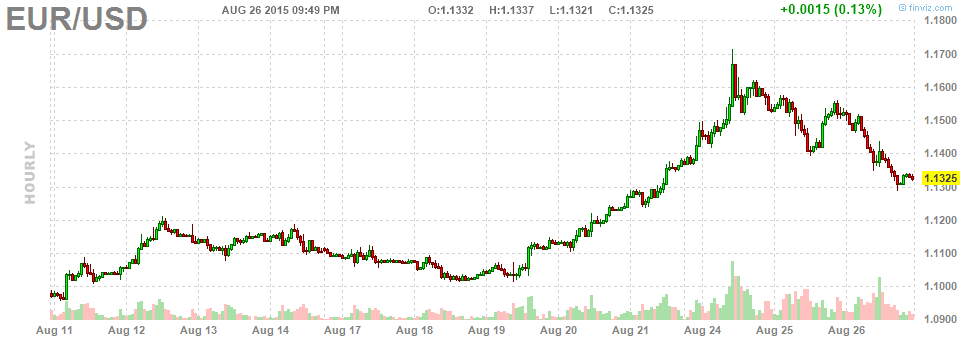
August 27th, 2015 10:57 AM #13Flight from safety: US 10Y yield above 2.1%. Yen and euro weaken. Volatility index pulls back though still elevated.
-
Verified Tsikot Member
- Join Date
- Mar 2014
- Posts
- 355
August 27th, 2015 03:16 PM #14Someone asked me to explain the "carry trade" that i often mention. Here goes... First, you need a funding currency which is a currency that's cheap to borrow. The yen is a favorite funding currency because the BOJ is holding rates at zero for so long. The euro recently became a funding currency also because of ultra-low rates. Then you use the funding currency to buy higher yielding assets like stocks to get a higher return. That's carry trade. When the prices of the assets start falling you sell the assets and buy back the currency you borrowed. That's unwinding the carry trade. To illustrate, here's a chart of USDJPY and SPX (S&P 500 index):

When stock prices go up so does USDJPY (sell yen, buy dollars, buy stocks). When stock prices fall USDJPY also falls (sell stocks, sell dollars, buy yen).
-
Tsikoteer
- Join Date
- Feb 2008
- Posts
- 12,683
-
Verified Tsikot Member
- Join Date
- Mar 2014
- Posts
- 355
August 25th, 2015 11:26 AM #16Dad: did you get wiped out?
Me: nope
Dad: how?
Me: 100% cash since the end of July
Dad: I was hoping you got wiped out so you get a real job
Me: haha
-
Tsikoteer
- Join Date
- Feb 2008
- Posts
- 12,683
-
 Ignore
- Join Date
- Oct 2006
- Posts
- 5,994
August 25th, 2015 11:22 PM #18/me still thinks now is a good time to be a farmer(or anything basic!)
Damn, son! Where'd you find this?

-
Verified Tsikot Member
- Join Date
- Mar 2014
- Posts
- 355
August 26th, 2015 12:25 AM #19EURUSD fell below 1.15 after reaching 1.17 yesterday as risk appetite returns. USDJPY bounced back to nearly 120 after falling to 116. Earlier tonight China cut interest rates and banks' reserve requirement ratio. China apparently ended support for stock prices and is now focused on supporting the broader economy through monetary policy. There will be more depreciation pressure on the RMB as a result of the monetary easing.
-
Verified Tsikot Member
- Join Date
- Mar 2014
- Posts
- 355
November 4th, 2016 10:56 AM #20The S&P 500 is back to the level where i went cash last year. Buy and hold they said. Whatever. Originally Posted by Lady Bathory

 Reply With Quote
 Originally Posted by Lady Bathory

