


Hey we have to contribute. The poor guys live in a desert. And have lived in it for a while...time they got their due?Originally Posted by M54 Powered


The Largest Car Forum in the Philippines
- Forums
- Discussions
- Events
- Community
Results 41 to 56 of 56
Hybrid View
-

 Tsikoteer

- Join Date
- Jun 2006
- Posts
- 784
July 28th, 2006 12:44 PM #1
-
 BANNED BANNED BANNED
- Join Date
- Mar 2005
- Posts
- 8,837
July 28th, 2006 06:11 PM #2I dont feel sorry for them. how come they get to ride in expensive gas guzzling luxury cars, jets and helicopters while we settle for fuel-efficient, back-breaking, mediocre riding comfort vehicles. it's so unfair. dapat ganun din tayo! Originally Posted by M54 Powered

-
 el moderador...
- Join Date
- Sep 2005
- Posts
- 3,003
-
 Sans Pareil
- Join Date
- Oct 2004
- Posts
- 1,526
-
Sans Pareil
- Join Date
- Oct 2004
- Posts
- 1,526
-
 Grease Monkey
- Join Date
- Aug 2003
- Posts
- 1,621
July 29th, 2006 05:17 AM #6according to this article i read, your typical 100cc 2-stroke motorcycle engine (a.k.a. tricycle) like all those 2-stroke wonders na namamasada put out 50X as much pollutants as a modern VTEC-equipped Honda Accord.
and that's why 2-stroke motorcycles are no longer allowed to be sold, but there's still a vast mosquito fleet of them out there.
-
el moderador...
- Join Date
- Sep 2005
- Posts
- 3,003
July 29th, 2006 08:05 AM #7If you can afford it, why not. It's choice. To protect and conserve the environment, make sure to keep the (actually any) vehicle in tip top conditon, from the engine, mechanics, tire pressure, and now, choice of fuel. Some vehicles may be fueled by the E10, so that's one way of helping the environment of minimizing the use of limited oil resources. Again, if you can afford it, why not. My two cents...
-
 Verified Tsikot Member
- Join Date
- May 2005
- Posts
- 259
August 4th, 2006 12:54 PM #8Freedom of choice for me. If they can afford it why not? Whether its a Bugati Veyron or a hybrid, as long as it's maintained in such a way as to optimize the energy that the gases produce, meaning more energy used than wasted. I'd rather bash the rich bus operators who seem to not care that their buses spews smoke like a factory, than the V8 owner who takes cares for his car, and the environment. Ref/AC/Spray Cans, etc, even lola who burns the dried leaves contibute to pollution.
-
 pissing gasoline
- Join Date
- Jan 2005
- Posts
- 3,773
August 4th, 2006 01:45 PM #9i think this has to be emphasized. the concern is not the pollution caused by some gas guzzlers (although it is a legitimate issue) nor the riding comfort that these rides bring, it is the fact that these rides consume more gas than other cars. it appears that the convenient excuse to evade this concern is to invoke freedom of choice.the real issue isn't the cars that drink gas, but rather the fact that fossil fuel is getting less and less without being replenished.
-
Tsikot Member Rank 4
- Join Date
- Jan 2003
- Posts
- 2,979
August 4th, 2006 01:57 PM #10hehehe! balang araw rations na lang ang mangyayari sa gasolina.... pag nangyari yan paktay tayong lahat.... time to learn how to ride a bike? :D
-
 Tsikoteer
- Join Date
- Jul 2004
- Posts
- 439
August 4th, 2006 03:54 PM #11A gas guzzling car does not mean it is bad for the environment.
Did you know that the current S-CLASS mercedes is rated as the most environmental friendly car?? the TOYOTA PRIUS actually lost to the mercedes with a large V8 engine..
Specially to EURO cars with strict TUV regulations and EURO4 compliants. It has one of the lowest emissions ever.. They value emissions than fuel economy. That is why the OPTRA, and some GM made cars are gas guzzlers.
-
couch potato
- Join Date
- May 2005
- Posts
- 1,384
August 4th, 2006 09:19 PM #12The Herd Changes Course and Runs Away From S.U.V.’s
By ROBERT H. FRANK
Published: August 3, 2006
The New York Times
THE herd instinct is as powerful in humans as in other animal species.
Anyone who doubts it should rent “What Do You Say to a Naked Lady?”, the 1970 film by Allen Funt, the creator of “Candid Camera.” The money scene portrays a man responding to a help-wanted ad. He is directed to a waiting room occupied by men who appear to be other job seekers but are actually Mr. Funt’s confederates. At no apparent signal, these men stand and begin to disrobe. The hapless job seeker’s dismay is evident. Yet, after a few moments, he, too, stands and disrobes. At scene’s end, the men are standing naked, apparently waiting for whatever comes next.
Clearly, the herd instinct can lead us astray. For the most part, however, the impulse to emulate others serves us well. After all, without drawing on the wisdom and experience of others, it would be almost impossible to cope with the stream of complex decisions we confront.
Economists increasingly recognize the importance of herd behavior in explaining ordinary purchase decisions. A case in point is the sport utility vehicle. Herd behavior helps us understand not only the explosive rise of this market segment in the 1990’s, but also its imminent collapse.
The Chevrolet Suburban (or, as Dave Barry called it, the Chevrolet Subdivision) has been produced since 1935, but it and other similar vehicles were originally used almost exclusively for commercial purposes. Before the appearance of the Jeep Wagoneer in 1963 and the Ford Bronco in 1966, the family S.U.V. segment essentially did not exist. As recently as 1975, it accounted for only 2 percent of total vehicle sales.
In the 1990’s, however, it became perhaps the biggest success story in automotive history. From a base of only 750,000 units in 1990, annual S.U.V. sales reached almost 3 million by 2000. In 2003, 23 percent of vehicles sold in the United States were S.U.V.’s.
The conventional determinants of consumer demand cannot explain this astonishing trajectory. Cheap fuel was a contributing factor, but clearly not an adequate explanation, because fuel had also been cheap in earlier decades. Similarly, rising average incomes cannot have been decisive, because the pre-S.U.V. decades had experienced even more rapid income growth.
In any case, it is not obvious why wealthier people would want to switch from cars to truck-based S.U.V.’s. Many engineers who helped design these vehicles expressed wonder that they have sold in such numbers. Early ads, coupled with names like Blazer and Pathfinder, stressed the vehicles’ off-road capabilities. But as one engineer quipped, the only time most S.U.V.’s actually go off the road is when inebriated owners miss their driveways.
Nor can safety concerns explain the success of S.U.V.’s. As Keith Bradsher, a reporter for The New York Times, explains in his 2002 book, “High and Mighty,” their weight confers some advantage in head-on collisions with smaller vehicles (at the expense of occupants of those vehicles), but their poor handling, high propensity to roll over and longer stopping distances make them more dangerous, on balance, than cars.
Nor, finally, is the greater cargo capacity of S.U.V.’s enough to explain their popularity, as minivans and station wagons offer similar capacity without the handling and mileage penalties.
To understand the explosive growth of S.U.V. sales, we must look first to changes in demand caused by new patterns of income growth and then to how others responded to those changes in demand. Unlike the three post-World War II decades, when incomes grew at about the same rate for people at all income levels, the period since the mid-1970’s has seen most income growth accrue to the wealthy. That change helped persuade Land Rover, then a British-owned company, to bring its premium Range Rover to the United States in 1987, at the then astonishingly high base price of $31,375.
Although Range Rover initially had the luxury S.U.V. market to itself, and top earners could easily afford one, its early sales were modest. A turning point was its appearance in the 1992 Robert Altman film, “The Player.” The film’s lead character, the studio executive Griffin Mill (played by Tim Robbins), could have bought any vehicle he pleased. His choice? A Range Rover with a fax machine in the dashboard.
An important feature of the herd instinct is that people are more likely to emulate others with higher incomes. Seeing a wealthy studio executive behind the wheel of a Range Rover instantly certified it as a player’s ride. As more and more high-income buyers purchased these vehicles, their allure grew. And when other automakers began offering similar vehicles at lower prices, S.U.V. sales took off.
But what the herd instinct giveth, it also taketh away. Even when gasoline was still relatively inexpensive, many urban motorists had begun to question the merits of owning poor-handling off-road vehicles that got only 10 miles a gallon. And with gas now selling for more than $3 a gallon, the cachet of S.U.V.’s has vanished completely. If driving one was once like having a T-shirt saying, “I’m a player,” it is now more like having one saying, “I’m a chump.”
And that is a perception that no product can long survive. With unsold inventory languishing on dealer lots, prices of S.U.V.’s have been plummeting. In some markets, G.M. is offering subsidized gas at $1.99 a gallon, and Ford is offering $1,000 worth of free gas, to anyone willing to buy one.
The last of Ford’s mammoth Excursions rolled off its Louisville, Ky., assembly line last Sept. 30. And G.M.’s largest S.U.V., the Hummer H1, was discontinued in June of this year.
With the herd now in full stampede, the era of big, gas-guzzling S.U.V.’s may soon be history.
-
 Tsikoteer
- Join Date
- Oct 2002
- Posts
- 9,894
August 5th, 2006 01:41 AM #13^excellent, maybe i'll be able to afford a Range Rover Sport in a couple of years when they start offering deep discounts
-
BANNED BANNED BANNED
- Join Date
- Mar 2005
- Posts
- 8,837
August 5th, 2006 01:53 AM #14siguro the next big thing can be any of two forms: high ceiling cars (like MPV's, bigger version of Honda Jazz/Swift/Yaris) or high-ground clearance cars like CX-7, Sta. Fe, Murano.
yan siguro fuel-efficient na, and without the uncomfortable seating of an ordinary sedan.
-
 SobrangBilisMagType!
- Join Date
- Aug 2004
- Posts
- 22,702
August 5th, 2006 12:26 PM #15Uncomfortable seating? Depends on who you ask. While today's high roof cars are pleasant, and it's nice looking out and down at other motorists from an SUV, nothing compares to the feeling of being cocooned in a low-slung car (but with lots of head-space, mind you), like the Mazda 626, stretched out horizontally more than vertically.
And the ride and lateral-roll-resistance of taller cars cannot match the suppleness of these low slung chariots... ...at least, very few tall vehicles have ever felt comfortable to me from the driver's seat (on road, that is). That's why the 7-Series, S-Class and XJ still sell respectably, and why you don't see many SUVs among the ranks of super-luxury automobiles (Maybach, Rolls Royce, Bentley, etcetera).
Interesting article. What's up in the air, at the moment, about Crossovers, is how well they will sell in the coming years (in the US). Sure, they're more fuel efficient than SUVs, but with the current scare and the increasing globalization of the US car market (at least in taste), I'm betting the boom will come in small cars again.
Small cars (actually, micro cars) kept Europe alive after the war. Maybe it's time Europe went back to the microcar and the US will go to the MPV, in all its iterations.
Ang pagbalik ng comeback...
-
BANNED BANNED BANNED
- Join Date
- Mar 2005
- Posts
- 8,837
August 6th, 2006 04:51 AM #16*niky, for the future, i'm betting on the car that the sidekick black guy drove in FF tokyo drift ...

or this Honda concept from another thread:
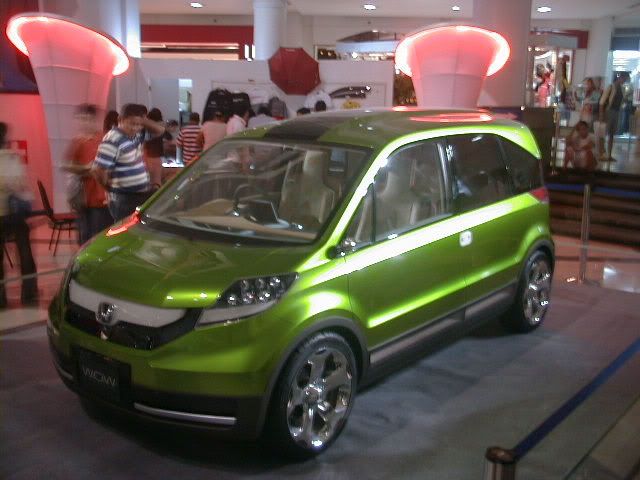
suv-like, van-like, yet compact.
 Originally Posted by M54 Powered

 Reply With Quote