
Originally Posted by phezthie

mapuan. . .
register na dito
http://tsikot.yehey.com/forums/showt...=30907&page=21
pasensya na kung ot
*rene tagle, alam mo naman ang mga eng'g peeps, they know their math, but don't know how to put them in words so kailangan pang i-research. . .we all relearned something today :-)

The Largest Car Forum in the Philippines
- Forums
- Discussions
- Events
- Community
View Poll Results: My Answer to the equation is...
- Voters
- 64. You may not vote on this poll
Results 221 to 240 of 267
-

 Tsikoteer

- Join Date
- Apr 2007
- Posts
- 2,452
April 16th, 2011 02:28 AM #221Last edited by vito corleone; April 16th, 2011 at 02:32 AM.
-
 fLaKeZ
- Join Date
- Oct 2002
- Posts
- 4,388
April 16th, 2011 03:25 AM #222yung multiplication by juxtaposition yung hinahanap kong argument if such thing exist. given that it is, 2 nga ang sagot. haha. ngayon ko lang narinig yung term na yan.
-
 Tsikoteer
- Join Date
- Aug 2003
- Posts
- 3,273
-
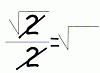 Tsikot Member Rank 5
- Join Date
- Sep 2003
- Posts
- 21,384
-
Verified Tsikot Member
- Join Date
- Feb 2008
- Posts
- 128
-
 Tsikot Member Rank 2
- Join Date
- Nov 2007
- Posts
- 2,566
April 16th, 2011 09:20 AM #226nopee.. antayin mo pa sagot ni OB hehehe Originally Posted by ydreph962

-
Verified Tsikot Member
- Join Date
- Feb 2008
- Posts
- 128
April 16th, 2011 11:02 AM #227stock knowledge yan bro..simpleng algebraic expression lang yan..sigurado ako sa sagot kong 2.. Originally Posted by rene_tagle
di ko na kayang hanapin ang libro kasi bata pa ko nung naituro samin yan..
-
 twoyotas
- Join Date
- Mar 2009
- Posts
- 21,667
April 16th, 2011 11:26 AM #228Hay salamat natapos din ....
Lintek ka jansky, ang init ng thread na ginawa mo ! :hysterical:
So yun, [SIZE=6]2 [SIZE=2]ang sagot. Hehehehe[/SIZE][/SIZE].
 vito corleone. hahaha.
Last edited by renzo_d10; April 16th, 2011 at 11:28 AM.
-
 Moderator
- Join Date
- Nov 2010
- Posts
- 25,276
April 16th, 2011 11:26 AM #229nagpa-poll na rin ako sa opis kung ano tamang sagot. Based on my stock knowledge (math olympiad member-interpurok division hehehe), the answer is 2.
Fasten your seatbelt! Or else... Driven To Thrill!
-
BANNED BANNED BANNED
- Join Date
- Nov 2008
- Posts
- 1,383
April 16th, 2011 12:17 PM #230Parang Accounting lang yan.
Get a group of Accountants, and expect them to end up with different results.
-
Moderator
- Join Date
- Nov 2010
- Posts
- 25,276
April 16th, 2011 01:05 PM #231nice one. Originally Posted by marg
hehe, oks lang yan. exercise ng brain.
Fasten your seatbelt! Or else... Driven To Thrill!
-
 Tsikot Member Rank 2
- Join Date
- Jan 2007
- Posts
- 3,428
April 16th, 2011 01:45 PM #232http://mathforum.org/library/drmath/view/54341.html
Question:
Answer:The problem was presented like this:
a = 1.56
b = 1.2
x = 7.2
y = 0.2
ax/by = ?
Here are two ways that I solved it:
1) I first rewrote the problem as [1.56(7.2)/ 1.2](0.2). Second, a was multiplied by x. The product was 11.232. Then, since no parentheses were present, I followed the order of operations and divided 11.232 by b, which was 1.2. The quotient was 9.36. Then I multiplied 9.36 by y, which was 0.2. The final answer was 1.872.
2) The other way, the first thing I did was multiply a by x. The product, which was 11.232, was set aside for the time being. Then b was multiplied by y, which gave the product of 0.24. The problem was now solved by dividing 11.232 (or ax) by 0.24 (or by) to reach a final answer of 46.8.
Can you please tell us which answer is correct and why?
As written, your expression
ax/by
should be evaluated left to right: a times x, divided by b, times y. The multiplication is not done before the division, but both are done in the order they appear. Your first solution is right.
Some texts make a rule, as in your second solution, that multiplication without a symbol ("implied multiplication") should be done before any other operations in an expression, including "explicit multiplication" using a symbol. Following this rule, you would multiply a by x, then multiply b and y, then divide one by the other. Some (probably most) texts don't mention such a rule - but some of those may use it without saying so, which is far worse.
I don't know of a general rule among mathematicians that implied multiplication should be done before explicit multiplication. As far as I'm concerned, all multiplications fit in the same place in the order of operations. It's not an unreasonable rule, though, since it does seem that implied multiplication ties the operands together more tightly, at least visually; but the idea of Order of Operations (or precedence, as it is called in the computer world) is supposed to be to ensure that everyone will interpret an otherwise ambiguous expression the same way - so if some texts change the rules, or if people do what feels natural, the purpose has been lost.So to answer your question, I think both answers can be considered right - which means, of course, that the question itself is wrong... The main lesson to learn is not which rule to follow, but how to avoid ambiguity in what you write yourself. Don't give other people this kind of trouble.Last edited by donbuggy; April 16th, 2011 at 01:53 PM.
-
 Tsikoteer
- Join Date
- Jul 2008
- Posts
- 351
April 16th, 2011 01:53 PM #233huling hirit... Originally Posted by flakez
multiplication by juxtaposition pertains to side by side values which are being multiplied first before processing the other operations...
it is performed in accordance with the automatic concatenation rule which means to eliminate or simplify the series of equation..
-
 Verified Tsikot Member
- Join Date
- Apr 2006
- Posts
- 165
April 16th, 2011 02:01 PM #234ha ha ha okay na okay tong usapang ito ah.... napaisip isip ako dito ah pero ang sagot ko it must be 2...
kahit ano pang DAS ang gamitin nyo even haagen Dazs, adiDAS...
kudos to TS...
heto na lang ang narecall ko sa algebra ko.....kaya sangayon ako dito...
""likewise, i just want to share, i hope my memory serves me right, that a number followed by parenthesis does not need the * or X symbol. its automatic multiplication... my cent""
-
Tsikot Member Rank 2
- Join Date
- Nov 2007
- Posts
- 2,566
April 16th, 2011 02:07 PM #235 Originally Posted by marg
hahaha.
pag magpapa audit ka sa accountant mo at magbabayad ka sa BIR ang ibibigay nya 2
pero pag magpapaudit ka sa accountant ng BIR ang ibibigay nya 288
-
Verified Tsikot Member
- Join Date
- Jul 2008
- Posts
- 292
April 16th, 2011 02:14 PM #236bro chumamba ka lang Originally Posted by ydreph962
, mali ang approach mo kung bakit mo nakuha ang 2 although tumama ka sa sagot. ang argument mo kasi sa mdas or PEMDAS dapat multiply muna ang una bago division. both multiplication ang division have the same precedence, ang confusing part kasi sa equation kung one entity ba ang 2(9+3) o hindi? ang tamang sagot sa argument is "multiplication by juxtaposition", yun lang at wala nang iba! hindi ba sir vito.
parang practical exam lang sa law yan, kahit tama ang article na tinutukoy mo pero mali naman ang arguments mo, mali parin sagot mo.
-
Tsikoteer
- Join Date
- Jul 2008
- Posts
- 351
April 16th, 2011 02:22 PM #237OT: about OT(old testament) Originally Posted by rene_tagle
naalala ko tuloy nung nasa MIT pa ako, pag alam na ang sagot because meron tip o OT of previous exams, write the answer first at the bottom of your exam paper then compute it pabalik
basta i highlight lang yung answer by means of box, circle o double underline, di na mapapansin na mali pala yung computation ginawa hehehe
-
Verified Tsikot Member
- Join Date
- Jul 2008
- Posts
- 292
-
Tsikot Member Rank 2
- Join Date
- Nov 2007
- Posts
- 2,566
April 16th, 2011 02:40 PM #239hahaha..
i conduct Survey sa mga sikat
Justin Bieber

President of the USA
Jackson
sagot nila 2 din nyahahahahah
-
Tsikot Member Rank 5
- Join Date
- Sep 2003
- Posts
- 21,384
April 16th, 2011 02:49 PM #240flying voter yang isa dyan eh.....patay na bumoto pa. Originally Posted by jansky
 Originally Posted by phezthie

 Reply With Quote