
Hi All,
New here sa Tsikot kasi mejo mago lang din ako nagkaron ng kotse (2nd hand)Pero question ko ay sa mga bibili ng bagong sasakyan or nakabili na ng bagong sasakyan, pano kayo magbreak in ng sasakyan? long drive? uphill drive? highway? sabi kasi ng tatay ko i-test sa highway, mabilisin tapos pabagalin tapos bilis ulit then bagal (gradually pabilisin hindi harurot). di ko narin maback read. Share your exeperience how you attain or be satisfied on your car.
Thanks.

The Largest Car Forum in the Philippines
- Forums
- Discussions
- Events
- Community
Results 1 to 10 of 10
-
 Tsikot Member

- Join Date
- Feb 2014
- Posts
- 1
February 21st, 2014 05:54 PM #1
-
Tsikoteer
- Join Date
- Aug 2012
- Posts
- 2,767
February 21st, 2014 06:39 PM #2the break-in procedure is discussed in your vehicle owner's manual. just follow it.
example, from Toyota Innova Owner's Manual..
For the first 1000 km (600 miles):
- Avoid full throttle acceleration when starting and driving
- Avoid racing the engine
- Try to avoid hard stops during the first 300 km (200 miles)
- Do not drive slowly with the manual transmission in a high gear
- Do not drive for a long time at any single speed, either fast or slow.
-
 Tsikoteer
- Join Date
- Jan 2011
- Posts
- 642
February 21st, 2014 10:17 PM #3drive like you stole it. drive hard and fast as you can. this is how race drivers break in race cars. therefore, IMHO, is the right way to break in new cars.
-
Tsikoteer
- Join Date
- Aug 2012
- Posts
- 2,767
February 21st, 2014 10:32 PM #4*shelu: if race cars ang ibi-break-in, applicable yan dahil custom-built, hindi factory-assembled.
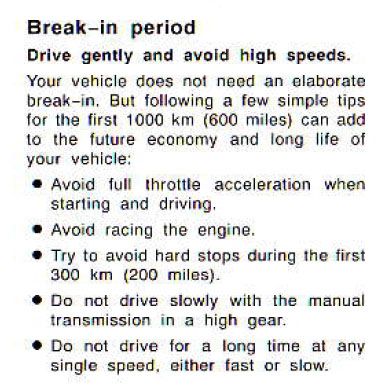
even sa owner's manual, nakasulat na "You're car does not need an elaborate break-in".Most modern car engines are broken in at the factory, before assembly. Therefore the old tradition of breaking in a new car doesn't apply anymore. Just drive as you normally would drive and treat the car the way you would treat anything else of value.
-
Tsikoteer
- Join Date
- Aug 2012
- Posts
- 2,767
-
Tsikoteer
- Join Date
- Aug 2012
- Posts
- 2,767
-
Tsikoteer
- Join Date
- Aug 2012
- Posts
- 2,767
-
Tsikoteer
- Join Date
- Jun 2010
- Posts
- 321
February 22nd, 2014 10:18 AM #8motoman break in secrets Break In Secrets--How To Break In New Motorcycle and Car Engines For More Power
Warning:
This is a very controversial topic !!
I wrote "Break-In Secrets" after successfully applying this method
to approximately 300 new engines, all without any problems whatsoever.
The results are always the same... a dramatic increase in power at all RPMs. In addition, many professional mechanics have disassembled engines that have used this method, to find that the condition of the engine is much better than when the owner's manual break-in method has been used.
The thing that makes this page so controversial is that there have been many other break-in articles
written in the past which will contradict what has been written here.
Several factors make the older information on break-in obsolete.
The biggest factor is that engine manufacturers now use a much finer honing pattern in the cylinders than they once did. This in turn changes the break-in requirements, because as you're about to learn, the window of opportunity for achieving an exceptional ring seal is much smaller with
newer engines than it was with the older "rough honed" engines.
In addition, there is a lot less heat build up in the cylinders from ring friction
due to the finer honing pattern used in modern engines.
The other factors that have changed are the vastly improved metal casting and machining
technologies which are now used. This means that the "wearing in" of the new parts
involves significantly less friction and actual wear than it did in the distant past.
With that in mind ...
Welcome to one of the most controversial motorsports pages on the internet !!
How To Break In Your Engine For
More Power & Less Wear !
One of the most critical parts of the engine building process is the break in !!
No matter how well an engine is assembled, it's final power output is all up to you !!
Although the examples shown here are motorcycle engines,
these principles apply to all 4 stroke engines:
Street or Race Motorcycles, Cars, Snowmobiles, Airplanes & yes ...
even Lawn Mowers !!
( regardless of brand, cooling type, or number of cylinders. )
These same break in techniques apply to both steel cylinders and Nikasil, as well as the ceramic
composite cylinders that Yamaha uses in it's motorcycles and snowmobiles.
What's The Best Way To Break-In A New Engine ??
The Short Answer: Run it Hard !
Why ??
Nowadays, the piston ring seal is really what the break in process is all about. Contrary to popular belief, piston rings don't seal the combustion pressure by spring tension. Ring tension is necessary only to "scrape" the oil to prevent it from entering the combustion chamber.
If you think about it, the ring exerts maybe 5-10 lbs of spring tension against the cylinder wall ...
How can such a small amount of spring tension seal against thousands of
PSI (Pounds Per Square Inch) of combustion pressure ??
Of course it can't.
How Do Rings Seal Against Tremendous Combustion Pressure ??
From the actual gas pressure itself !! It passes over the top of the ring, and gets behind it to force it outward against the cylinder wall. The problem is that new rings are far from perfect and they must be worn in quite a bit in order to completely seal all the way around the bore. If the gas pressure is strong enough during the engine's first miles of operation (open that throttle !!!), then the entire ring will wear into
the cylinder surface, to seal the combustion pressure as well as possible.
The Problem With "Easy Break In" ...
The honed crosshatch pattern in the cylinder bore acts like a file to allow the rings to wear. The rings quickly wear down the "peaks" of this roughness, regardless of how hard the engine is run.
There's a very small window of opportunity to get the rings to seal really well ... the first 20 miles !!
If the rings aren't forced against the walls soon enough, they'll use up the roughness before they fully seat. Once that happens there is no solution but to re hone the cylinders, install new rings and start over again.
Fortunately, most new sportbike owners can't resist the urge to "open it up" once or twice,
which is why more engines don't have this problem !!
An additional factor that you may not have realized, is that the person at the dealership who set up your bike probably blasted your brand new bike pretty hard on the "test run". So, without realizing it, that adrenaline crazed set - up mechanic actually did you a huge favor !!
Here's How To Do It:
There are 3 ways you can break in an engine:
1) on a dyno
2) on the street, or off road (Motocross or Snowmobile.)
3) on the racetrack
On a Dyno:
Warm the engine up
completely !!
Then, using 4th gear:
Do Three 1/2 Throttle dyno runs from
40% - 60% of your engine's max rpm
Let it Cool Down For About 15 Minutes
Do Three 3/4 Throttle dyno runs from
40% - 80% of your engine's max rpm
Let it Cool Down For About 15 Minutes
Do Three Full Throttle dyno runs from
30% - 100% of your engine's max rpm
Let it Cool Down For About 15 Minutes
Go For It !!
Frequently asked Question:
What's a dyno ??
A dyno is a machine in which the bike is strapped on and power is measured.
It can also be used to break in an engine.
NOTE: If you use a dyno with a brake, it's critical during break - in that you allow the engine to decelerate fully on it's own. (Don't use the dyno brake.) The engine vacuum created during closed throttle deceleration sucks the excess oil and metal off the cylinder walls.
The point of this is to remove the very small (micro) particles of ring and cylinder material which are part of the normal wear during this process. During deceleration, the particles suspended in the oil blow out the exhaust, rather than accumulating in the ring grooves between
the piston and rings. This keeps the rings from wearing too much.
You'll notice that at first the engine "smokes" on decel, this is normal, as the rings haven't sealed yet. When you're doing it right, you'll notice that the smoke goes away after about 7-8 runs.
Important Note:
Many readers have e-mailed to ask about the cool down, and if it
means "heat cycling" the engine.
No, the above "cool down" instructions only apply if you are using a dyno machine to break in your engine. The reason for cool down on a dyno has nothing to do with
"Heat Cycles" !!!
Cool Down on a dyno is important since the cooling fans used at most dyno facilities are too small to equal the amount of air coming into the radiator at actual riding speeds. On a dyno, the water temperature will become high enough to cause it to boil out of the radiator after
about 4 dyno runs. This will happen to a brand new engine just as it will
happen to a very old engine.
(Always allow the engine to cool down after 3 runs whenever you use a dyno.)
If you're breaking your engine in on the street or racetrack, the high speed incoming air will keep the engine temperature in the normal range.
(In other words, you don't have to stop by the side of the road to let your bike cool down.)
What about "heat cycling" the engine ??
There is no need to "heat cycle" a new engine. The term "heat cycle" comes from the idea that the new engine components are being "heat treated" as the engine is run. Heat treating the metal parts is a very different process, and it's already done at the factory before the engines are assembled. The temperatures required for heat treating are much higher than an engine will ever reach during operation.
The idea of breaking the engine in using "heat cycles" is a myth that came from the misunderstanding of the concept of "heat treating".
END OF PART 1
-
Tsikoteer
- Join Date
- Jun 2010
- Posts
- 321
February 22nd, 2014 10:23 AM #9PART 2
On the Street:
Warm the engine up completely:
Because of the wind resistance, you don't need to use higher gears like you would on a dyno machine. The main thing is to load the engine by opening the throttle hard in 2nd, 3rd and 4th gear.
Realistically, you won't be able to do full throttle runs even in 2nd gear on most bikes without exceeding 65 mph / 104 kph. The best method is to alternate between short bursts of hard acceleration and deceleration. You don't have to go over 65 mph / 104 kph to properly load the rings. Also, make sure that you're not being followed by another bike or car when you decelerate, most drivers won't expect that you'll suddenly slow down, and we don't want
anyone to get hit from behind !!
The biggest problem with breaking your engine in on the street (besides police) is if you ride the bike on the freeway (too little throttle = not enough pressure on the rings) or if you get stuck in slow city traffic. For the first 200 miles or so, get out into the country where you can vary the speed more
and run it through the gears !
Be Safe On The Street !
Watch your speed ! When you're not used to the handling of a new vehicle, you should accelerate only on the straightaways, then slow down extra early for the turns. Remember that both hard acceleration and hard engine braking (deceleration) are equally important during the break in process.
On the Racetrack:
Warm the engine up completely:
Do one easy lap to warm up your tires. Pit, turn off the bike & check for leaks or
any safety problems. Take a normal 15 minute practice session
and check the water temperature occasionally. The racetrack is the perfect environment to break in an engine !! The combination of acceleration and deceleration is just the ticket for sealing the rings.
Go For It !!
Yeah - But ...
the owner's manual says to break it in easy ...
Notice that this technique isn't "beating" on the engine, but rather taking a purposeful, methodical approach to sealing the rings. The logic to this method is sound. However, some will have a hard time with this approach, since it seems to "go against the grain".
The argument for an easy break-in is usually: "that's what the manual says" ....
Or more specifically: "there are tight parts in the engine and you might do damage or even seize it if you run it hard."
Consider this:
Due to the vastly improved metal casting and machining technologies which are now used, tight parts in new engines are not normal. A manufacturing mistake causing a tight clearance is an extremely rare occurrence these days. But, if there is something wrong with the engine clearances from the factory, no amount of gentle running will fix the problem.
The real reason ???
So why do all the owner's manuals say to take it easy for the first
thousand miles ???
This is a good question ...
Q: What is the most common cause of engine problems ???
A: Failure to:
Warm the engine up completely before running it hard !!!
Q: What is the second most common cause of engine problems ???
A: An easy break in !!!
Because, when the rings don't seal well, the blow-by gasses contaminate the oil with acids and other harmful combustion by-products !!
Ironically, an "easy break in" is not at all what it seems. By trying to "protect" the engine, the exact opposite happens, as leaky rings continue to contaminate your engine oil for the rest of the life of your engine !!
tried this on our montero, mag 2 years na so far wala namang side effect and di siya mausok
-
 Tsikot Member Rank 1
- Join Date
- Dec 2002
- Posts
- 1,299
February 22nd, 2014 02:43 PM #10Tama sabi ng Tatay mo yan ginawa ko parang kay Motoman. mag- 6 years na, mula noong ginawa ko yan, gamit ko pa premium (not unleaded) shell. Til now ok pa takbo ng auto, ok din arangkada nya kahit all stock. mas ok sana kung may budget ipa dyno test ko ito tapos kumapara ko sa bagong auto na same model and engine. Originally Posted by Omi Ventura


 Reply With Quote
 Originally Posted by Omi Ventura

